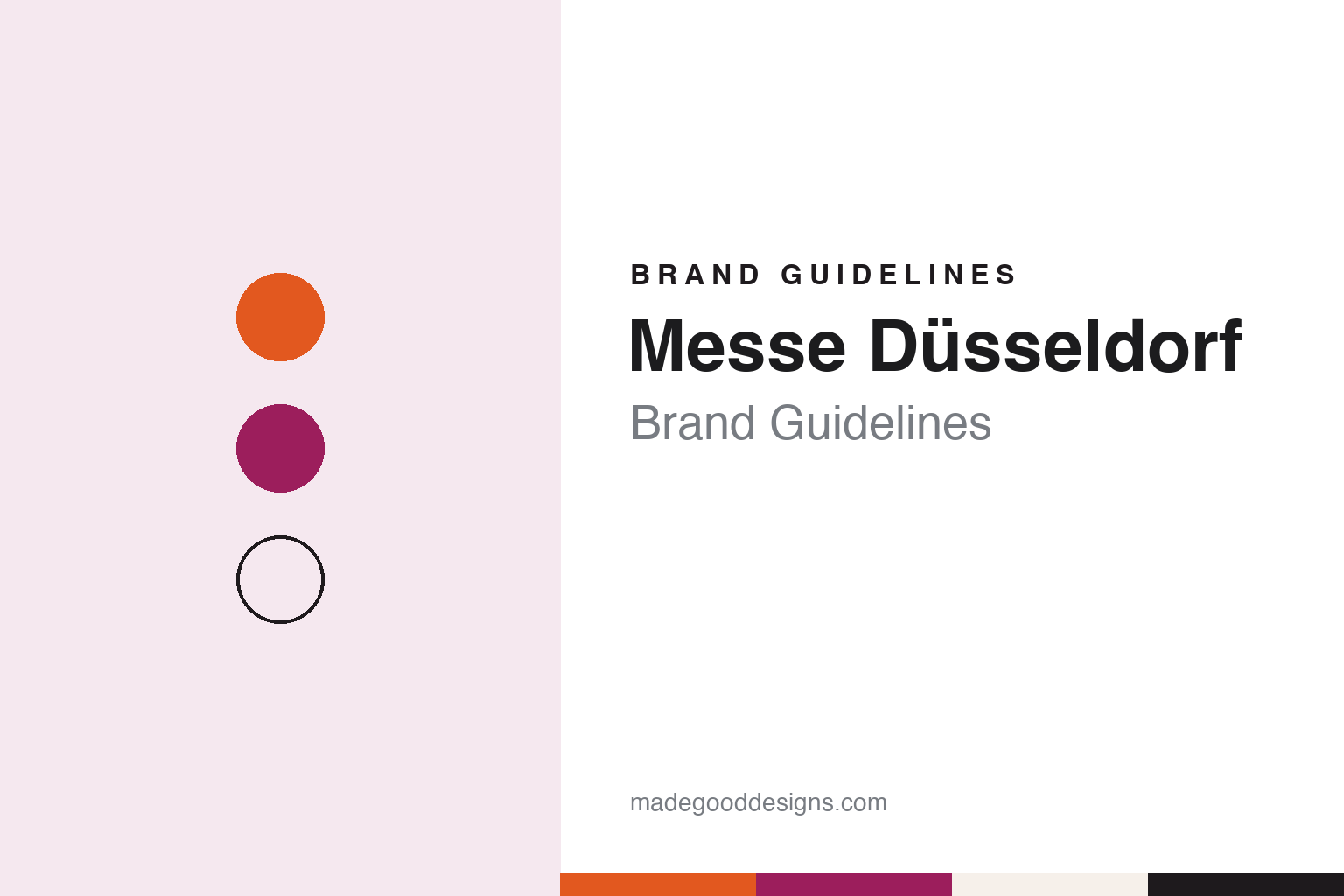
Messe Düsseldorf Brand Guidelines
A 1947 fair company, a run of trade fairs and an orange “m”.
Aa
Two constants: an orange and magenta palette and a grotesque sans register. Abstract homage — not a Messe Düsseldorf mark; no logo, fair name or hall is reproduced.
NOWEA
A post-war company in an old exhibition city.
Messe Düsseldorf began on 7 January 1947 as the Nordwestdeutsche Ausstellungsgesellschaft mbH, or NOWEA, the company and German Wikipedia say. Its own history describes a first “trade and export show” housed in a wooden hut, and a 1947 press exhibition that it counts as the first fair in the city after the Second World War. The company took its present name, Messe Düsseldorf GmbH, in 1997, according to the 70-year history it published in 2017.
The city’s exhibition history is older than the company. German Wikipedia traces it to a trade exhibition of 1811 held under Napoleon’s patronage, and to large industrial shows in 1852, 1880 and 1902, when more than 2,500 exhibitors gathered between Golzheim and the Hofgarten. The GeSoLei exhibition of 1926 left the Tonhalle and the Ehrenhof buildings, the same source says. NOWEA was set up as a new company in 1947, after the war.
The post-war company began with 4,800 square metres at the Ehrenhof in the city centre and built six halls there by the end of the 1950s, its history says. Its organising idea was the specialist fair: instead of general showcases of industry, it arranged fairs by trade. Herbert Engst led the expansion of the 1950s and 1960s, German Wikipedia says. In 1971 the company moved to new grounds on the Rhine at Stockum, in the north of the city, with 174,000 square metres of exhibition space, according to the company. German Wikipedia says the Stockum grounds were extensively modernised and extended between 2000 and 2020, including a new Hall 1 and South entrance built from 2017 to 2020, and that by the end of 2020 twelve of the 18 halls had been modernised or newly built. A subsidiary, Düsseldorf Congress, runs conventions and corporate events, the company says.
Colour
Short names, travelling fairs, public owners.
The company’s fairs carry short names, several of them set in lower case. Its history dates drupa, the printing fair, to 1951; K, for plastics and rubber, to 1952 (German Wikipedia gives 1951); interpack, for packaging, to 1958; EuroShop, for retail, to 1966; and boot, for water sports, to 1969. MEDICA, for medical technology, followed in 1972 and ProWein, for wine and spirits, in 1994. In a November 2024 press release the company described a programme of around 40 trade fairs, more than 20 of which it calls leading international fairs, at a 613,000-square-metre exhibition centre with 18 halls.
Many of those fairs have travelled. The company says it helped organise a German industry exhibition in New York in 1948, and it founded subsidiaries in North America in 1980, Japan in 1994, Singapore in 1995, India in 2007 and Shanghai in 2009. It groups a home fair and its offshoots abroad into what it calls global portfolios: MEDICA, for example, has had a sister fair in Singapore, Medical Fair Asia, since 1997, the 2017 history says. In 2024 the company listed more than 70 events abroad and representatives covering 142 countries.
Messe Düsseldorf is publicly owned. Its website lists the City of Düsseldorf with 56.5 per cent of the capital, Industrieterrains Düsseldorf-Reisholz AG and the state of North Rhine-Westphalia with 20 per cent each, and the Düsseldorf chamber of industry and commerce and the chamber of crafts with 1.75 per cent each. The city’s lord mayor chairs the supervisory board. In December 2019 the shareholders named Wolfram N. Diener, who had joined in 2018 after posts with Messe Frankfurt in Hong Kong and UBM Asia, to succeed Werner M. Dornscheidt as chief executive from July 2020, FashionUnited reported. In 2024 the company held 16 of its own events and 10 guest events in Düsseldorf, its published figures say.
Typography
How fair organisers present themselves.
Exhibition and trade-fair organisers sell two things at once: the shows themselves and the places that hold them. Their corporate websites reflect that split. GL events, for example, divides its group page into Live, Venues and Exhibitions, while Easyfairs gives its owned halls in Belgium, the Netherlands and Sweden their own section and logo files alongside the group mark.
Most of the visible branding belongs to the shows rather than the parent company. A group may run more than a hundred show brands, each with its own name, logo and audience, so the corporate identity often works as an endorsement in the background. Many show names simply state a sector, a material or a place, as Global Industrie, UK Metals Expo and Packaging Première do, while others, such as Sirha or Première Vision, work as names in their own right.
Photography does much of the work. Organisers publish wide shots of busy aisles, stands and halls, and some credit the photographer by name beside the show and city, as GL events does on its exhibitions page. Venue pages lean on floor areas, hall counts and plain descriptions of what the space can be shaped into, from a small trade show to a large conference.
Behind the shows sit practical tools for exhibitors and visitors, described plainly: online portals, exhibitor packages, floor plans and visitor registration. Corporate pages then cover the owners, the board and the venues held under ownership or concession, often with a dated history timeline. This guide sets out what can be checked about each organiser — who founded it, who owns it and which shows and venues it runs — and marks what rests on the company’s own word.
Aa
A grotesque sans for a company mark built on a lower-case “m”. (Specimen set in Archivo, a sans STAND-IN; NOT the Messe Düsseldorf logo.)
The “m”
An old mark, renewed in 2024.
The company’s mark is a lower-case “m”, which it describes as long established. On 19 November 2024 Messe Düsseldorf began rolling out a new brand identity under the line “For those who create tomorrow’s business.” The press release says the redesign modernised the “m” with updated colours and typography, kept the corporate orange and added magenta, with gradients between the two; print, building signage and the logo in the cityscape were to be replaced step by step over 18 months. The identity was created by the Cologne agency rheinfaktor, the release says, and the German Brand Award also lists rheinfaktor as its designer.
In 2026 the German Brand Award named the relaunch a winner in its Corporate Brand of the Year category; the company says it also received Gold in the award’s category for trade fairs and event locations. The jury wrote that the relaunch evolves the familiar “m” instead of seeking identity through rupture, and praised a digitally conceived design system, a revised colour palette and highly legible typography.
For a design guide, Messe Düsseldorf shows how a publicly owned fair company can renew an old mark without replacing it. Compare Messe Frankfurt and Koelnmesse, two other German fair companies with their own grounds. For this guide we use an orange and a deep magenta with ink and a warm paper, set in a sans, an unofficial interpretation; no product or logo is reproduced.
Explore & save
Keep Messe Düsseldorf’s identity on hand — save it to a board in the Made Good inspiration library.
Messe Düsseldorf identity set
Pin the Messe Düsseldorf orange and magenta palette and the grotesque sans register to your own board.