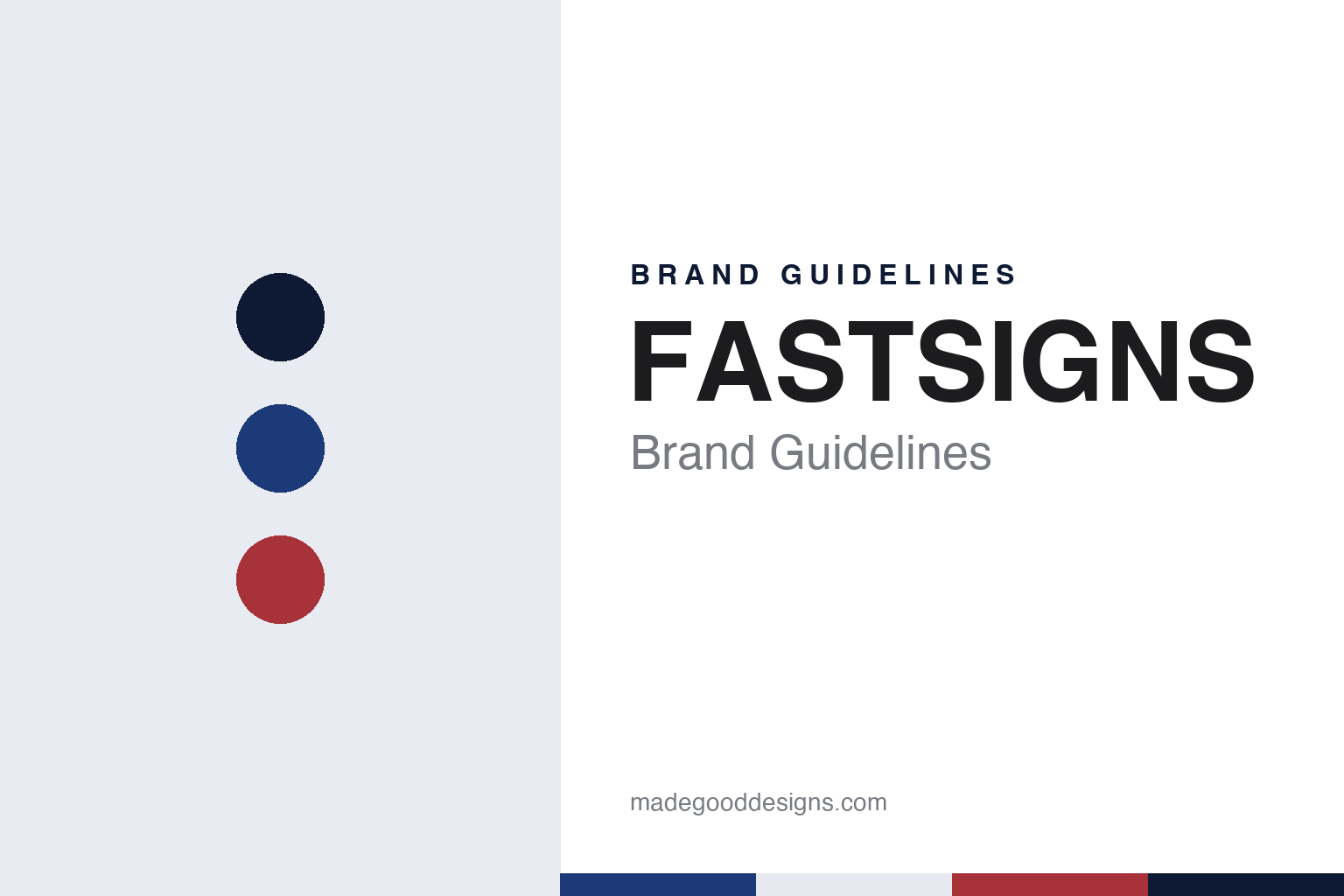
FASTSIGNS Brand Guidelines
A 1985 Texas vinyl-sign shop that became a franchise network.
Aa
Two constants: a FASTSIGNS signal blue and vinyl red palette and a Heavy grotesque sans register. Abstract homage — not a FASTSIGNS product or mark; no sign, logo or wordmark is reproduced.
Next-day signs
Two Texans, a vinyl cutter and a promise of speed.
FASTSIGNS began in Texas in 1985, founded by Gary Salomon and Bob Schanbaum. Accounts differ on the city. English Wikipedia places the founding in Austin, while the company’s own history, published for its 30th anniversary in December 2015, says the two partners opened the original FASTSIGNS in Dallas. Fox Business, profiling the firm in August 2015, described the founders simply as Texans and quoted the chief executive, Catherine Monson, saying that Salomon “opened a single, independent store and it grew like crazy.”
The idea was speed. The company says its original concept was fast-turnaround banners and signs, made with a computerised process that cut lettering from precision-cut vinyl, so that customers could have a sign the next day, which it describes as unusual at the time. Banners that were once cut and assembled by hand, the same history notes, are now printed in batches far more quickly. Fox Business reported Monson’s account that digital advances in the early 1990s made full-colour printing possible for the network, and that technology had stayed central to how the business worked.
Franchising followed within a year. English Wikipedia says the first franchise was sold in December 1986 and the first international franchise in 1991; the company says the network reached 150 locations within five years and spread from Texas across the United States and then abroad, to Canada, Mexico, the United Kingdom, the Caribbean, Saudi Arabia, the United Arab Emirates and Australia. Not every market lasted: English Wikipedia says FASTSIGNS withdrew from Brazil in 1996 and has also left Argentina, and that its Australian centres trade under a different name, Signwave. Its current list of countries also includes the Cayman Islands and Chile. The story of the company’s creation and growth, English Wikipedia adds, was used as a case study in the management textbook Managing: A Competency-Based Approach.
Colour
Roark, Levine Leichtman, then LightBay and Freeman Spogli.
The franchisor has changed hands several times. English Wikipedia says the Atlanta private-equity firm Roark Capital Group bought the company in October 2003, and that in 2009 Catherine Monson, a former president of PIP Printing, was named chief executive. On 23 July 2014, Private Equity Professional reported that Levine Leichtman Capital Partners had partnered with management to complete its acquisition of FASTSIGNS International, then described as a franchisor of custom sign and graphics stores with more than 550 locations and headquarters north of Dallas in Carrollton, Texas. The years before had been difficult: Fox Business reported Monson’s account that the recession of the late 2000s hit the network hard in 2009, that the company helped franchisees cut costs, and that business began to improve in 2010.
That holding lasted under five years. On 20 March 2019 the same publication reported that Levine Leichtman had sold FASTSIGNS International to LightBay Capital and Freeman Spogli & Co., with the network then at more than 700 locations in 45 states and eight countries. Freeman Spogli’s portfolio page dates the investment to March 2019 and files it under the name of the group that now sits above the sign brand.
That group is Propelled Brands. In a release dated 30 March 2021, FASTSIGNS International announced the new corporate umbrella, saying the name reflected a wider range of services after its 2020 acquisition of the IT-services franchise NerdsToGo, and naming Monson as chief executive of Propelled Brands. Propelled Brands’ website now lists three brands, FASTSIGNS, My Salon Suite and Camp Bow Wow, and Freeman Spogli describes it as their umbrella company, based in Carrollton.
Typography
Storefronts, vans and service menus.
Sign, print and promotional-products franchises sell mostly to other businesses, through local centres run by franchisees under a shared name. Their identity is carried less by national advertising than by the surfaces the centres themselves produce: shop windows, vehicle wraps and reception displays. When Signarama renewed its colour scheme, logo, tagline and icon in 2014, Signs of the Times reported that the new look would be applied to exactly those three things across its franchise locations.
The photography such companies publish tends to show the same surfaces: storefronts with the brand name across the fascia, vans in full wraps, and finished signs installed on clients’ buildings, much of it carrying the client’s name rather than the franchise’s own. Individual centres are commonly identified by the town or district they serve, so one national name is repeated across hundreds of locations, and in some markets a network trades under a different name altogether, as FASTSIGNS does in Australia, where English Wikipedia says its centres operate as Signwave.
Service menus tend to be written plainly, as lists of what a centre can make and do: signs and banners, vehicle graphics, interior décor, wayfinding, digital signs, printed material and branded merchandise, often with design, permitting and installation alongside. The menus have widened over time; FASTSIGNS, which began with next-day cut-vinyl signs in 1985, now describes a much broader range of visual communications.
Behind the storefronts sit corporate pages about owners and franchise systems. Some networks belong to private-equity firms and have changed hands several times; others remain in family control, as the Titus family’s United Franchise Group does with Signarama. Location counts are given by date and by source, and they vary, because centres open, close, convert from independent shops or share premises with related franchises.
Aa
A heavy grotesque sans for a name set in capitals. (Specimen set in Archivo, a sans STAND-IN; NOT the FASTSIGNS logo.)
FASTSIGNS
Four logos and a longer tagline.
The service menu has widened over four decades. Describing the company in March 2019, Private Equity Professional listed signs, custom visual communications, interior décor, architectural signage, vehicle graphics and digital signs, together with consulting, surveying, permitting and installation. The company’s 2015 history adds wayfinding systems, vehicle wraps and mobile marketing, and describes the business as offering “comprehensive visual marketing solutions.”
The growth model also takes in existing shops. Fox Business, in a 2015 profile for its “Salute to American Success” series, reported that FASTSIGNS ran a conversion programme that let smaller independent sign shops rebrand under the FASTSIGNS name, and a co-brand option that let related businesses, such as small printers, share a location with a centre; Monson told the channel that owners who converted kept their businesses. At that point, it said, there were about 590 locations, 522 of them in the United States, across nine countries; English Wikipedia now gives a figure of more than 780.
The identity has been revised along the way. The company’s 30th-anniversary history shows four successive logos, from an original black-and-white design to the current mark, and says the tagline changed as the services grew; the current line is “More than fast. More than signs.” English Wikipedia records the capitalised styling of the name, FASTSIGNS, which the company uses throughout its own material.
For a design guide, FASTSIGNS shows a franchise name built on a promise of speed, set in capitals, with a tagline that has been rewritten as the service menu widened. Compare Signarama, the sign franchise founded a year later in New York, and PIP, the printing franchise where Monson was president before FASTSIGNS. For this guide we use a signal blue, an ink blue and a vinyl red with a heavy grotesque sans, an unofficial interpretation; no product or logo is reproduced.
Explore & save
Keep FASTSIGNS’s identity on hand — save it to a board in the Made Good inspiration library.
FASTSIGNS identity set
Pin the FASTSIGNS signal blue and vinyl red palette and the Heavy grotesque sans register to your own board.