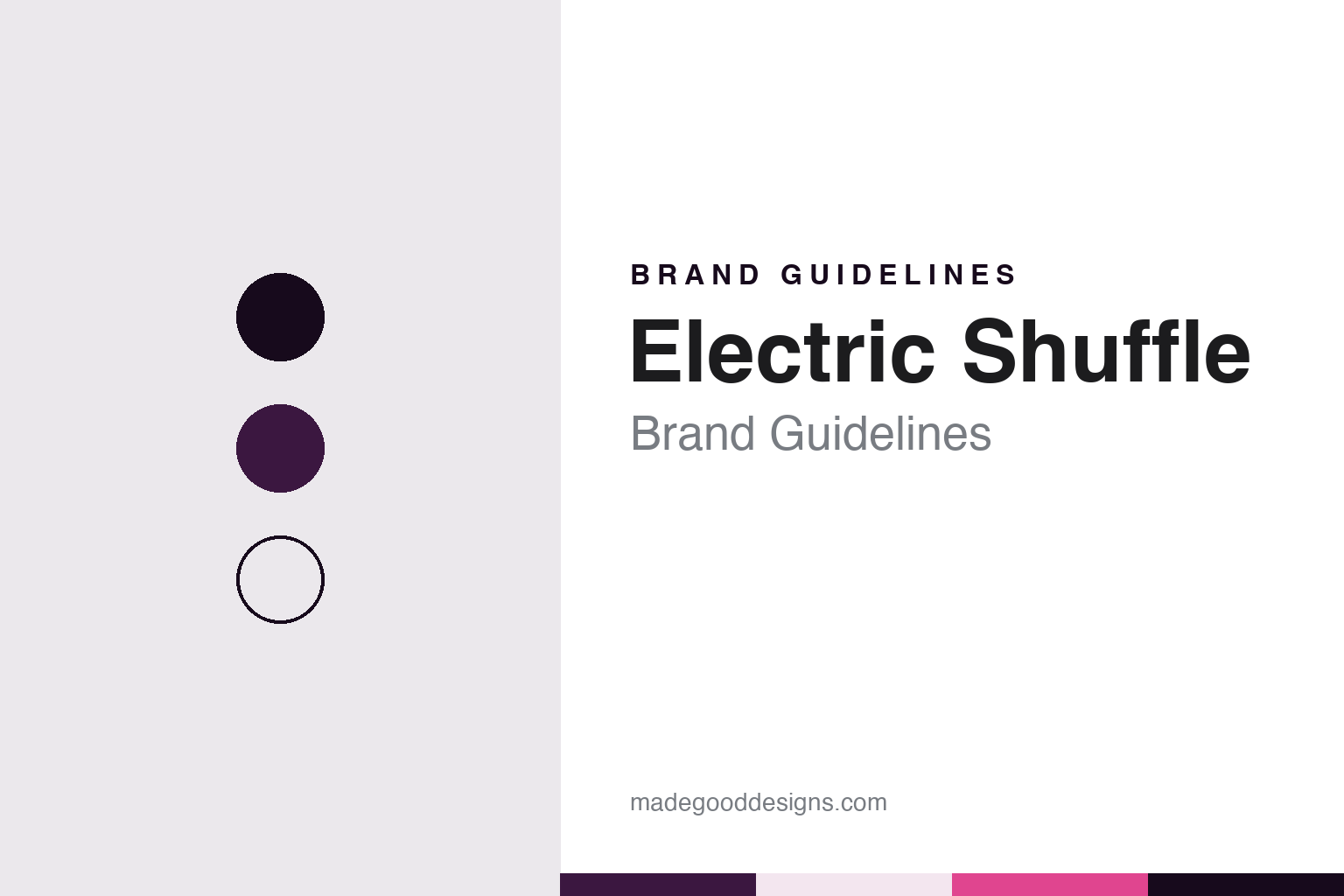
Electric Shuffle Brand Guidelines
Flight Club’s founders, Canary Wharf 2019 and a neon turbine.
Aa
Two constants: an Electric Shuffle plum, neon pink and mint palette and an Electric sans register. Abstract homage — not an Electric Shuffle venue, table or mark; no logo, sign or interior is reproduced.
Canary Wharf
A second concept from the Flight Club founders.
Electric Shuffle is a shuffleboard bar brand that began in London’s Canary Wharf in 2019. Its founders are Steve Moore and Paul Barham, the pair behind the social darts bars of Flight Club. Restaurant Online, the restaurant-trade title published alongside BigHospitality, reported in November 2019 that the first venue was set to open later that month in Cabot Square, on a site of about 9,000 square feet over two floors with two bar areas. Barham later told the attractions-industry title blooloop that it opened in late 2019.
The game is old; the format is new. Shuffleboard sends weighted discs down a long, narrow table towards a marked scoring area, and Barham has linked it to the British pub game of shove ha’penny. Speaking to blooloop in 2022, he said the pair came across shuffleboard while they were still developing Flight Club, and that Electric Shuffle spent three years in development, going through the same rounds of focus groups as the darts concept before the first venue opened.
From the start the brand sat inside a company of the founders’ own making. Restaurant Online reported in 2019 that Electric Shuffle would operate under Red Engine, a parent company Moore and Barham had recently launched, which also oversaw five Flight Club venues in the UK and a partner site in Chicago. blooloop gives 2019 as the year Red Engine was created, and describes it as the team behind both brands. In 2024 the trade title Hospitality Interiors still described Electric Shuffle as owned and operated by Red Engine.
Colour
A table with a camera above it.
The product is a table with a computer attached. Restaurant Online described shuffleboard tables “integrated with ‘cutting edge’ gaming technology” in 2019. By 2024 the company was describing a camera vision system that tracks and scores every puck and captures replays, according to Hospitality Interiors, which reported that a single game can take up to 32 players, and up to 150 for corporate events. Barham told blooloop in 2022 that the brand had launched with three games and then had four, and that players are put into teams, photographed, and sent their pictures in a small folder at the end of a booking. Moore made a similar point in 2019 to the trade title MCA, as Restaurant Online reported: having an in-house creative company, he said, meant the gameplay could be updated regularly, because “the development never goes away.”
Barham described the business plainly: the games are the hook, but the venue is sold as a bar first, with food and drink at its centre, and he called the result “an accessible premium experience.” The first Canary Wharf menu, Restaurant Online reported, was to include tapas-style small plates, sharing platters and pizzas.
The brand travelled quickly. Time Out New York reported in June 2024 that Electric Shuffle would open in Manhattan’s NoMad district on 12 July 2024, its third location in the United States and its first in New York, on the second floor of a building it shares with a hotel. The magazine counted 13 shuffleboard tables for up to 20 players each and two bars across about 10,000 square feet. In the UK, Hospitality Interiors reported that the Manchester venue on Deansgate, in a former bicycle shop, opened on 21 June 2024 as the brand’s fourth UK site and sixth worldwide, and, at 11,400 square feet with 15 play spaces, its largest.
Typography
Venues and the way they are presented.
Bowling, competitive-socialising and indoor-leisure operators sell an evening out rather than a product, so their identities live mostly in rooms and on screens. Their own websites lead with venue interiors: lanes lit in neon, bars set beside the games, and photographs of groups mid-throw or mid-putt. Some build a whole venue around one period theme; Swingers, according to The Caterer, styles its crazy golf clubs on 1920s English country golf clubs.
Naming does a lot of the work. Swingers names its venues after their districts, such as the West End or Back Bay, and operators give house names to games that turn familiar pastimes into branded attractions: an arcade called Carnival, a shuffleboard called Supercharged Shuffle, a shooting game called HotShots. Kingpin’s 2017 identity, Mumbrella reported, put a bowling spare mark inside the name and adopted the line “Roll like a Royal.”
Booking is part of the identity too. Kingpin’s website, for example, opens with a venue picker, a date selector, party packages and gift cards, placed ahead of any story about the company. Some operators add a scoring tool inside the venue; Time Out listed a scorecard app among the features of one Swingers site.
Behind the venues sit owners that are often less visible than the brands. Kingpin belongs to TEEG, a group formed in 2017 by the family company behind Timezone and Quadrant Private Equity, and it is TEEG’s corporate website, rather than the venue site, that sets out the timeline and the brand list. This guide sets out what can be checked about each brand, from founding and ownership to how it presents its venues, and marks clearly what rests on the company’s own word.
Aa
An electric sans — a turbine by the bar. (Specimen set in Syne, a sans STAND-IN; NOT the Electric Shuffle logo.)
Electric Shuffle
A power station turned into a bar.
Electric Shuffle’s look started with an outside studio and moved in-house. For Canary Wharf, the shuffleboard format was given what Restaurant Online called a “contemporary, experiential reimagining” by Ellis Design Studio, whose managing director described the scheme as a “beautiful factory.” By the Manchester opening in 2024, Hospitality Interiors reported, Red Engine’s own interior design team was doing the work, and the look had moved from a high-level concept towards a softer, more welcoming neighbourhood bar. Barham told blooloop in 2022 that Red Engine does everything in-house, from the interiors of its venues to its website.
The constants are electrical. The signature object is a spinning neon turbine by the main bar, which Hospitality Interiors says was inspired by old power stations and Time Out New York calls a signature of the brand across its locations. Around it, in Manchester, sit references to power and industry — exposed conduit, concrete wall finishes and an interactive control panel that lights up in time with the music — alongside gold glitter balls. Red Engine described that scheme as a retro mash-up of “art-deco meets Miami, with subtle industrial vibes,” in a palette of mint, pink, green and deep red, according to Hospitality Interiors; a commissioned mural there reads “Electric Power Company.” The New York venue, Time Out New York reported, adds a pink staircase under a gold disco ball and windows facing the Empire State Building. Its games, in words from the company’s press release quoted by the magazine, were “inspired by the thrill of casino classics like craps.” Manchester, by contrast, leans on local media: Hospitality Interiors lists records, cassettes, a neon sign themed on the television show Top of the Pops and “on air” lightboxes, under capiz shell pendants and fluted glass fittings in a 1920s style.
For a design guide, Electric Shuffle shows how a single word in a brand name can set the theme for every room. Compare Flight Club, its sister brand from the same founders, and Swingers, another London competitive-socialising brand. For this guide we use a deep plum, a neon pink and a mint with a sans, an unofficial interpretation; no product or logo is reproduced.
Explore & save
Keep Electric Shuffle’s identity on hand — save it to a board in the Made Good inspiration library.
Electric Shuffle identity set
Pin the Electric Shuffle plum, neon pink and mint palette and the Electric sans register to your own board.