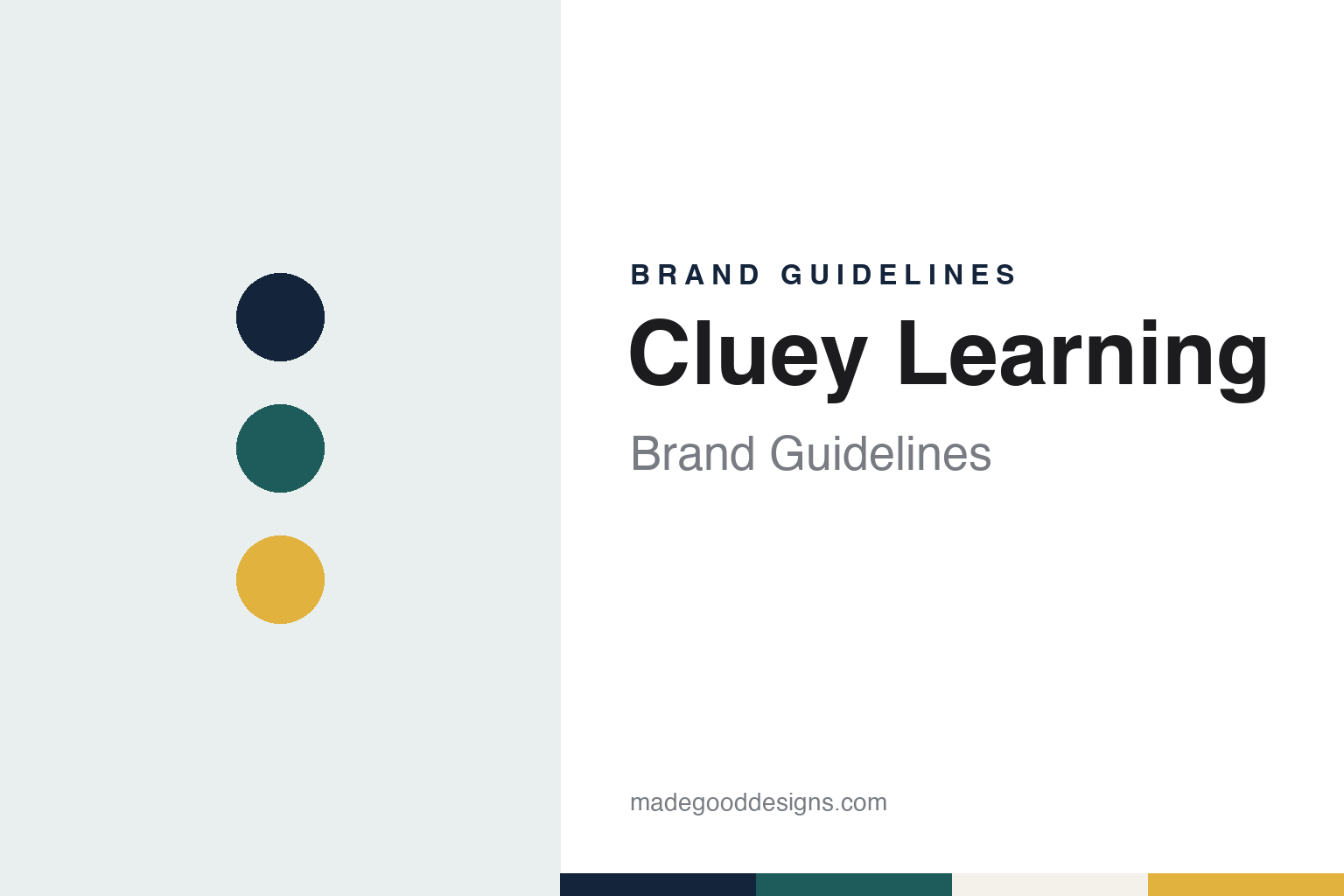
Cluey Learning Brand Guidelines
A Sydney tutoring company that moved the lesson online.
Aa
Two constants: a navy, teal and wattle palette and a rounded sans register. Abstract homage — not a Cluey Learning product or mark; no screen, logo or lesson page is reproduced.
Sydney, 2017
A tutoring company built by education operators.
Cluey Learning is the tutoring brand of Cluey Ltd, a Sydney company. Its investor website says Mark Rohald co-founded Cluey in 2017, after a career in private education and training in the United Kingdom, South Africa, Canada and Australia. The same page credits him with co-founding the Think Education Group, a provider of campus-based vocational and higher education, and, in 2010, the Open Colleges Group, an online learning provider; it names Greg Fordred, the chief financial officer and company secretary, as a co-founding executive.
The service itself came a year later. When the company floated in December 2020, Stockhead reported that its tutors had held more than 192,000 sessions since its launch in July 2018, with 620 tutors on its books at that point, offering both one-to-one and small-group sessions; it said 52,700 sessions had been delivered in the latest quarter. Matteo Trinca, who the company says joined as chief customer officer in July 2018, was made joint chief executive in September 2022 and sole chief executive in March 2026. Rohald was described as executive deputy chairman in the company’s July 2026 notice to shareholders.
The company presents itself as an education technology business that, in its own words on its investor site, “combines expert human tutoring with AI-powered learning” for school students in Australia and New Zealand. It keeps separate Australian and New Zealand websites, and its July 2026 announcement describes its headquarters as Sydney.
Colour
Live lessons, a hub and a coding camp.
The core product is live, one-to-one tutoring delivered online. Cluey’s about page describes “a personalised, face-to-face online tutoring experience” for students in Years 2 to 12, across Maths, English, Chemistry, Biology and Physics. Lessons run through the company’s own learning platform, so a student logs in from home rather than travelling to a centre. The company says its content is mapped to the Australian Curriculum, that every session is recorded so it can be watched again, and that parents can see what their child has covered. Families sign in to a portal the site calls Cluey Hub.
The website organises its programmes by school stage — Primary, Secondary and Senior — and then by year and subject. Alongside the weekly programmes it lists exam preparation for NAPLAN, the national literacy and numeracy tests, for ATAR, the university-entrance rank, and for LANTITE, the literacy and numeracy test for trainee teachers, as well as selective-school preparation. Its about page counts more than 33,000 students and more than 2,500 tutors, figures given by the company in 2026.
Two newer strands sit beside the tutoring. Cluey+ is described on the investor site as an always-on AI learning platform that gives students practice, feedback and study tools between lessons. Code Camp, a wholly owned subsidiary according to Cluey’s 2026 announcements, runs holiday camps and after-school programmes in person and online. Kalkine Media reported in January 2023 that buying Code Camp was a milestone of Cluey’s 2022 financial year, and that its programmes covered coding, animation, game design and virtual reality. The current website lists camps with names such as Minecraft Engineers, YouTube Creators and Animation.
The same Kalkine Media article noted outside recognition: Cluey was named Technology Growth Company of the Year at the Australian Growth Company Awards and appeared on Deloitte’s Technology Fast 50 list for 2021.
Typography
How the category presents itself.
Tutoring brands sell something hard to picture: time with a teacher and steady practice. So they make it visible in other ways. The centre front is the first of them. Explore Learning says it opened its first centre in 2001 right beside the entrance of a supermarket in Chelmsford, so that parents could leave a child to work while they shopped; Kip McGrath says it began in 1976 in a family garage in Maitland, New South Wales, before growing into a franchise of locally run centres.
The second is the screen. Many of these companies now present their teaching through their own software, and give it a name of its own. Explore Learning calls its adaptive platform Compass and fills it with avatars and named characters; Kip McGrath calls its learning management system KipLearn and points parents to a portal for progress reports and bookings. Programme names, reward schemes and four-step “how it works” sequences do much of the explaining on their websites.
The third is the corporate page. A tutoring brand is often a network rather than a single business: franchisees run centres under one name while the company supplies curriculum, training and systems, as Kip McGrath’s 2026 shareholder documents describe. Ownership pages matter too. Explore Learning has been backed by Graphite Capital since a 2012 buyout, according to the trade title Unquote, and Kip McGrath, listed in Australia, became the subject of a takeover by Crimson Consulting in 2026.
This guide sets out what can be checked about each brand — who founded it, who owns it, how many centres it reports and where — and marks clearly what rests only on the company’s own word. Centre and student numbers are given as each source states them, with dates, because they change from year to year.
Aa
A rounded sans — a register for a friendly one-word name. (Specimen set in Nunito, a sans STAND-IN; NOT the Cluey Learning logo.)
Cluey Learning
Listed in 2020, leaving the exchange in 2026.
Cluey Ltd joined the Australian Securities Exchange on 9 December 2020 under the code CLU, Stockhead reported on the day, describing it as the latest education technology company on the exchange. Chief executive Mark Rohald called the listing “a significant milestone” at the time.
Five and a half years later the company changed course. On 25 June 2026 it told the exchange that its board proposed to turn Cluey from an ASX-listed company into an unlisted public company, citing thin trading and the cost and workload of a listing at its current size; the chairman, Robert Gavshon, said the listed structure was “no longer serving our shareholders as it should.” At a general meeting on 13 August 2026, shareholders passed the special resolution approving removal from the official list, the company announced that day, and it offered holders of small parcels a buy-back before the delisting. The notice of meeting, issued on 10 July 2026, gave the expected delisting date as 6 October 2026. The same announcements said Code Camp’s operations in the United Kingdom would close by 31 August 2026, leaving the business focused on Australia and New Zealand.
On its website the offer is still the one described at the listing: live one-to-one sessions with a tutor, booked at a time that suits each child’s schedule, as the about page puts it, with programmes sorted by school year and by the local test names NAPLAN, ATAR and LANTITE.
For a design guide, Cluey Learning shows how an online tutoring brand can organise itself around the school calendar rather than a building. Compare Kip McGrath, another Australian tutoring name, and Preply, an online tutoring marketplace. For this guide we use a harbour navy, a deep teal and a wattle yellow with a sans, an unofficial interpretation; no product or logo is reproduced.
Explore & save
Keep Cluey Learning’s identity on hand — save it to a board in the Made Good inspiration library.
Cluey Learning identity set
Pin the Cluey Learning navy, teal and wattle palette and the rounded sans register to your own board.