Tutor.com Brand Guidelines
An online classroom that kept its domain name through four changes of owner.
Aa
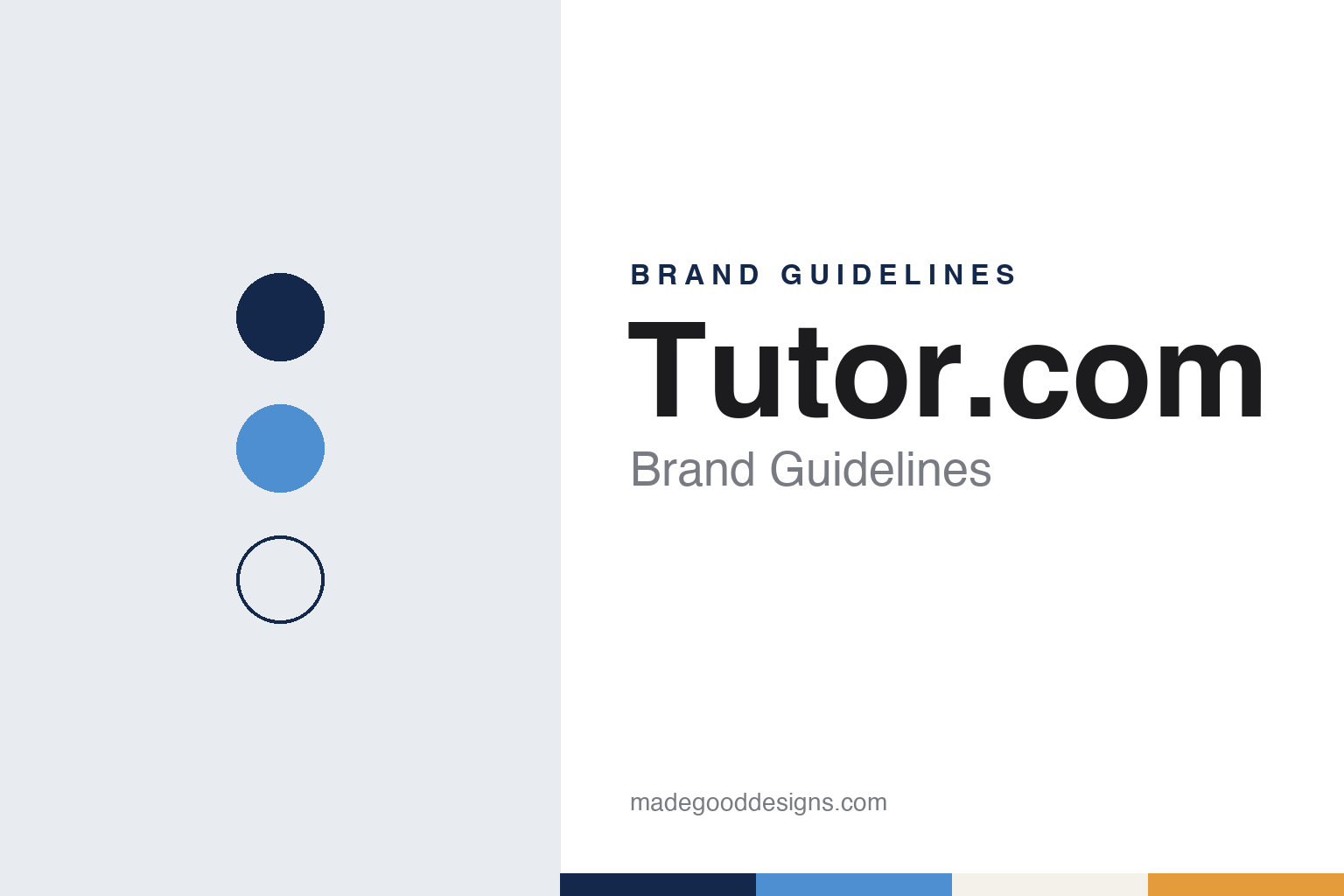
Two constants: a navy, sky blue and paper palette and a plain sans register. Abstract homage — not a Tutor.com product or mark; no logo, screen or classroom is reproduced.
An online classroom, 1998
A founder, a domain name and the public library.
Tutor.com was founded in 1998 by George Cigale. In a September 2006 interview with Library Worklife, the newsletter of the American Library Association–Allied Professional Association, Cigale said he began working full-time on the company that year, after tutoring part-time in the late 1980s and then working as an executive at a test-preparation company, where he led a team that built tutorial software. The company’s own history says the founding team started with “a big idea — and a great URL,” and that Tutor.com, Inc. was incorporated in Delaware by 2000.
Its first market was the public library. In the same 2006 interview Cigale described two services: Live Homework Help, which connected students from fourth grade through college with a live tutor, and Ask a Librarian, which connected people of any age with a reference librarian. Tutor.com sold annual subscriptions to public and academic library systems, which then offered the services free to their communities. He put its reach at more than 1,500 libraries in more than 40 states, with more than 1,300 tutors and about 50 full-time staff, most of them in an office in downtown Manhattan.
The library business has stayed. In January 2022 the company said its Learning Suite for Libraries had received a Platinum award in LibraryWorks’ Modern Library Awards, judged by librarians, and that its tutoring was then available to more than 67 million library patrons at more than 2,700 library locations.
Colour
IAC, The Princeton Review and a run of owners.
In January 2013 Tutor.com was bought by IAC, the New York internet group then behind Match.com. An IAC announcement of 18 April 2013, published on Tutor.com’s site, named Mandy Ginsberg, previously chief executive of Match.com, as chief executive, with Cigale staying on as founder and chairman. EdSurge later reported that after the IAC purchase the company turned towards selling directly to consumers.
The larger change came in 2014. On 29 July 2014 EdSurge reported that The Princeton Review, the test-preparation company founded in 1981, had agreed to be sold to Tutor.com, with the deal set to close on 1 August. It put Tutor.com at about 3,000 tutors and some 6,000 sessions on an average school night, covering 40 academic subjects for grades four to twelve. The brand split that followed still shapes the identity: according to EdSurge, consumer tutoring was to be rolled under the Princeton Review name, while the institutional business with colleges, libraries and companies kept the Tutor.com name. English Wikipedia describes the same deal as IAC’s Match Group buying The Princeton Review and combining it with Tutor.com.
Ownership kept moving. English Wikipedia says Match Group sold The Princeton Review, together with Tutor.com, to the Korean education company ST Unitas in March 2017; The Korea Times reported the Princeton Review signing on 14 February 2017. In January 2022 the Hong Kong-based private-equity firm Primavera Capital Group bought both companies from ST Unitas, The College Fix reported in May 2023, citing The Wall Street Journal, to which Primavera said U.S. government approval of the purchase had come that month.
That ownership drew attention in Florida. On 26 March 2024 the Pensacola broadcaster WEAR reported that Santa Rosa County schools had ended a supplemental tutoring arrangement with Tutor.com, on the same day that Florida’s education commissioner wrote to school districts, charter schools and state colleges that they should not contract with companies tied to “foreign countries of concern.” Tutor.com told the station that it was an American company and that no personal information of students or families was shared with Primavera. English Wikipedia says the company became fully U.S.-owned in July 2025; Tutor.com now describes itself as a U.S.-owned and operated company headquartered in New York.
Typography
Design and documentation.
Tutoring brands sell something hard to picture: time with a teacher and steady practice. So they make it visible in other ways. The centre front is the first of them. Explore Learning says it opened its first centre in 2001 right beside the entrance of a supermarket in Chelmsford, so that parents could leave a child to work while they shopped; Kip McGrath says it began in 1976 in a family garage in Maitland, New South Wales, before growing into a franchise of locally run centres.
The second is the screen. Many of these companies now present their teaching through their own software, and give it a name of its own. Explore Learning calls its adaptive platform Compass and fills it with avatars and named characters; Kip McGrath calls its learning management system KipLearn and points parents to a portal for progress reports and bookings. Programme names, reward schemes and four-step “how it works” sequences do much of the explaining on their websites.
The third is the corporate page. A tutoring brand is often a network rather than a single business: franchisees run centres under one name while the company supplies curriculum, training and systems, as Kip McGrath’s 2026 shareholder documents describe. Ownership pages matter too. Explore Learning has been backed by Graphite Capital since a 2012 buyout, according to the trade title Unquote, and Kip McGrath, listed in Australia, became the subject of a takeover by Crimson Consulting in 2026.
This guide sets out what can be checked about each brand — who founded it, who owns it, how many centres it reports and where — and marks clearly what rests only on the company’s own word. Centre and student numbers are given as each source states them, with dates, because they change from year to year.
Aa
A plain sans for a name that is also a web address. (Specimen set in Figtree, a sans STAND-IN; NOT the Tutor.com logo.)
Tutor.com
A name that is also an address.
Today Tutor.com sells mainly to institutions. Its website lists colleges and universities, K–12 schools and districts, libraries and employers, alongside individual subscriptions, and says it offers on-demand tutoring, high-dosage tutoring, test preparation and homework help in nearly 250 subjects, delivering about two million sessions a year. In May 2024 The Princeton Review named Robert Batten its chief executive, also heading its affiliate Tutor.com, with both companies based in New York City, according to the announcement. The company says its 25-millionth session was delivered in September 2023, and in October 2025, when it announced a CODiE award in a customer-experience category for education for its LEO platform for institutional partners, it put the total at more than 28 million.
The name carries the brand. Tutor.com’s own history treats the domain as part of the founding idea, and the company has kept it as its trading name under IAC, ST Unitas, Primavera and its present owners, while consumer test preparation sits under The Princeton Review. The website presents the online classroom itself as the product, with chat and audio tutoring, and says the platform is ADA- and Section 508-compliant, with a keyboard-operable classroom that works with common screen readers.
For a design guide, Tutor.com shows how a plain domain name can hold a brand together through repeated changes of ownership. Compare Varsity Tutors, another U.S. online tutoring platform, and Sylvan Learning. For this guide we use a deep navy, a clear sky blue and a warm paper white with a sans, an unofficial interpretation; no product or logo is reproduced.
Explore & save
Keep Tutor.com’s identity on hand — save it to a board in the Made Good inspiration library.
Tutor.com identity set
Pin the Tutor.com navy, sky blue and paper palette and the plain sans register to your own board.