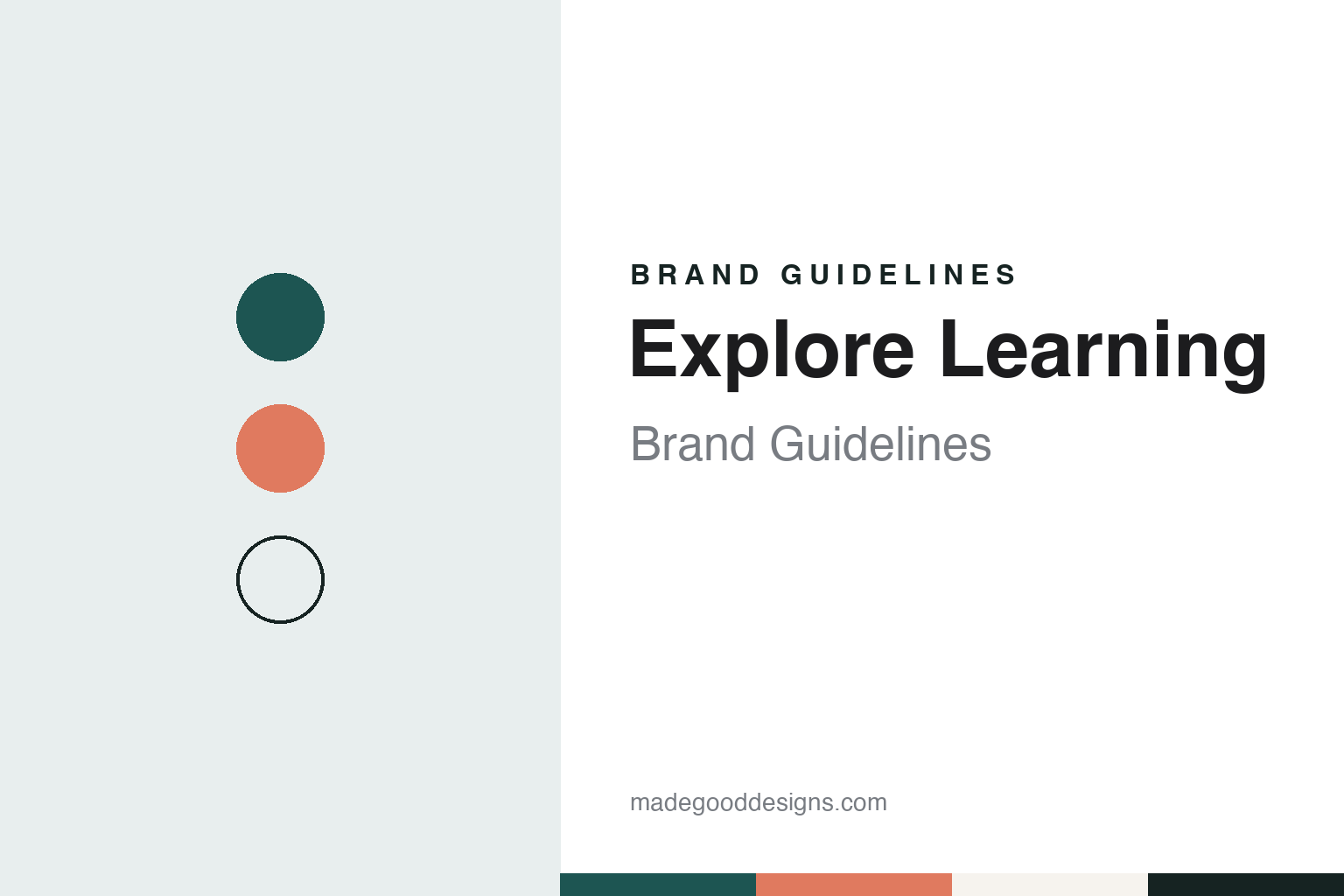
Explore Learning Brand Guidelines
The tuition centre that opened beside a supermarket door.
Aa
Two constants: a deep teal, coral and chalk palette and a rounded sans register. Abstract homage — not an Explore Learning product or mark; no logo, character or screen is reproduced.
Chelmsford, 2001
A tuition centre by the supermarket entrance.
Explore Learning is a British tuition company for children of school age, teaching maths and English in learning centres and online. It opened its first centre in October 2001 in Chelmsford, Essex, right next to the front entrance of a Sainsbury’s supermarket, according to an article the company published for its twentieth anniversary in 2021. The idea, as the company tells it, was that parents could leave a child to work through a computer-based maths and English curriculum while they did the weekly shop, instead of waiting in the car outside a club.
The founder was Bill Mills, who led the business as chief executive until 2025. The same anniversary article says he won the interest of the then Sainsbury’s chief executive Sir Peter Davis, the then Pearson chief executive Marjorie Scardino and the philanthropist Sir Peter Lampl, and that the launch team numbered four. Those are the company’s own recollections. The trade press adds the early investors: in August 2012 Unquote, the private-equity trade title, reported that the shareholders before that year’s buyout had included Spectrum Venture Management and Wittington Investments.
The early centres were bright rooms full of computers, the company recalls. Children earned “lizard cards” for their work and could end a session in a “surf club” on the web. By the time of the 2012 buyout, Unquote counted 62 centres teaching children aged five to fourteen, with extra courses in creative writing and preparation for the 11+ entrance exams; Graphite Capital’s own announcement of the deal gave more than 16,000 children enrolled as members.
The head office is now at the Whiteley shopping centre in Hampshire, according to the company’s website. The name is easily confused: the US company ExploreLearning, maker of the Gizmos science and maths simulations, is a separate business founded in 1999 and part of Cambium Learning Group, according to English Wikipedia.
Colour
Compass, characters and Fearless Four.
What Explore sells is a membership: regular sessions in a centre or online, built around maths and English and following the school curriculum. Its website covers primary maths and English, SATs, the 11+ and other entrance exams, GCSE maths, home education and support for children with special educational needs, the company says.
The heart of the product is software. Compass, which the company describes as its proprietary adaptive learning platform, chooses each child’s next question from earlier answers, gives instant feedback, spaces revision across lessons and brings a mastered skill back 28 days later to check it has stuck, according to Explore’s own explanation of how it works. In September 2025 the company launched Compass 2.0, which it says can place a child’s level in as few as 15 questions and forecast how long a concept will take to master; it names Vygotsky’s zone of proximal development and Bloom’s mastery learning as the theory behind it.
The interface has its own cast. Children earn points for effort, progress and attitude and spend them in a Character Studio to build an avatar of their own, the company says. Compass also has a set of named characters, Kai and Zola among them, which the company calls the “Compass gang”; in 2022 Explore ran a competition for members to design a new one, drawing more than 300 entries, and announced that the winning design would join the set that November. Tutors give praise through a scheme called Fearless Four: a fearless learning habit, overcoming challenges, “understand and convince” and respect, as a 2022 company article sets out.
Recognition has come mostly from education-business awards. Graphite Capital lists the British Private Equity & Venture Capital Association’s Excellence in Impact award in 2024, and the EdtechX Generator award and the EducationInvestor Private Tuition Provider of the Year award in 2025. The company also says it has funded subsidised scholarships for families in financial hardship since 2001 and runs a Big Dream Programme of fully funded tutoring hours.
Typography
How tutoring brands present themselves.
Tutoring brands sell something hard to picture: time with a teacher and steady practice. So they make it visible in other ways. The centre front is the first of them. Explore Learning says it opened its first centre in 2001 right beside the entrance of a supermarket in Chelmsford, so that parents could leave a child to work while they shopped; Kip McGrath says it began in 1976 in a family garage in Maitland, New South Wales, before growing into a franchise of locally run centres.
The second is the screen. Many of these companies now present their teaching through their own software, and give it a name of its own. Explore Learning calls its adaptive platform Compass and fills it with avatars and named characters; Kip McGrath calls its learning management system KipLearn and points parents to a portal for progress reports and bookings. Programme names, reward schemes and four-step “how it works” sequences do much of the explaining on their websites.
The third is the corporate page. A tutoring brand is often a network rather than a single business: franchisees run centres under one name while the company supplies curriculum, training and systems, as Kip McGrath’s 2026 shareholder documents describe. Ownership pages matter too. Explore Learning has been backed by Graphite Capital since a 2012 buyout, according to the trade title Unquote, and Kip McGrath, listed in Australia, became the subject of a takeover by Crimson Consulting in 2026.
This guide sets out what can be checked about each brand — who founded it, who owns it, how many centres it reports and where — and marks clearly what rests only on the company’s own word. Centre and student numbers are given as each source states them, with dates, because they change from year to year.
Aa
A rounded, friendly sans for a children’s learning brand. (Specimen set in Nunito, a sans STAND-IN; NOT the Explore Learning logo.)
Explore Learning
A buyout in 2012, a new chief executive in 2025.
The business has been backed by private equity since August 2012, when Graphite Capital backed a management buyout and took a majority stake from the earlier investors, Unquote reported on 24 August 2012; the management team reinvested alongside it. The same report noted that several other buyout firms, Equistone among them, had also shown interest. Graphite Capital still lists Explore Learning in its portfolio, describing a network of almost 100 centres and about 21,000 students a week. The company calls itself the UK’s largest independent tuition provider; by its own figures it supports more than 27,000 children a week across 95 centres and has tutored 400,000 children since 2001.
Leadership changed in June 2025. Explore announced that Lisa Haycox, until then chief operating officer, had become chief executive, succeeding founder Bill Mills, who stayed on the board as founder director; the chairman named in the announcement is David Kelly. The same announcement put the number of school-aged children it supported in 2024 at 50,000, across 94 centres and online, and described Compass as the platform behind every child’s programme.
For a design guide, Explore Learning shows how a tuition brand can live in a shopping centre and on a screen at once: a bright room by a supermarket door, and an adaptive interface with avatars and named characters. Compare Kumon and Kip McGrath, a franchise network of teacher-led centres with many sites in Britain. For this guide we use a deep teal, a warm coral and a chalk white with a rounded sans, an unofficial interpretation; no product or logo is reproduced.
Explore & save
Keep Explore Learning’s identity on hand — save it to a board in the Made Good inspiration library.
Explore Learning identity set
Pin the Explore Learning deep teal, coral and chalk palette and the rounded sans register to your own board.