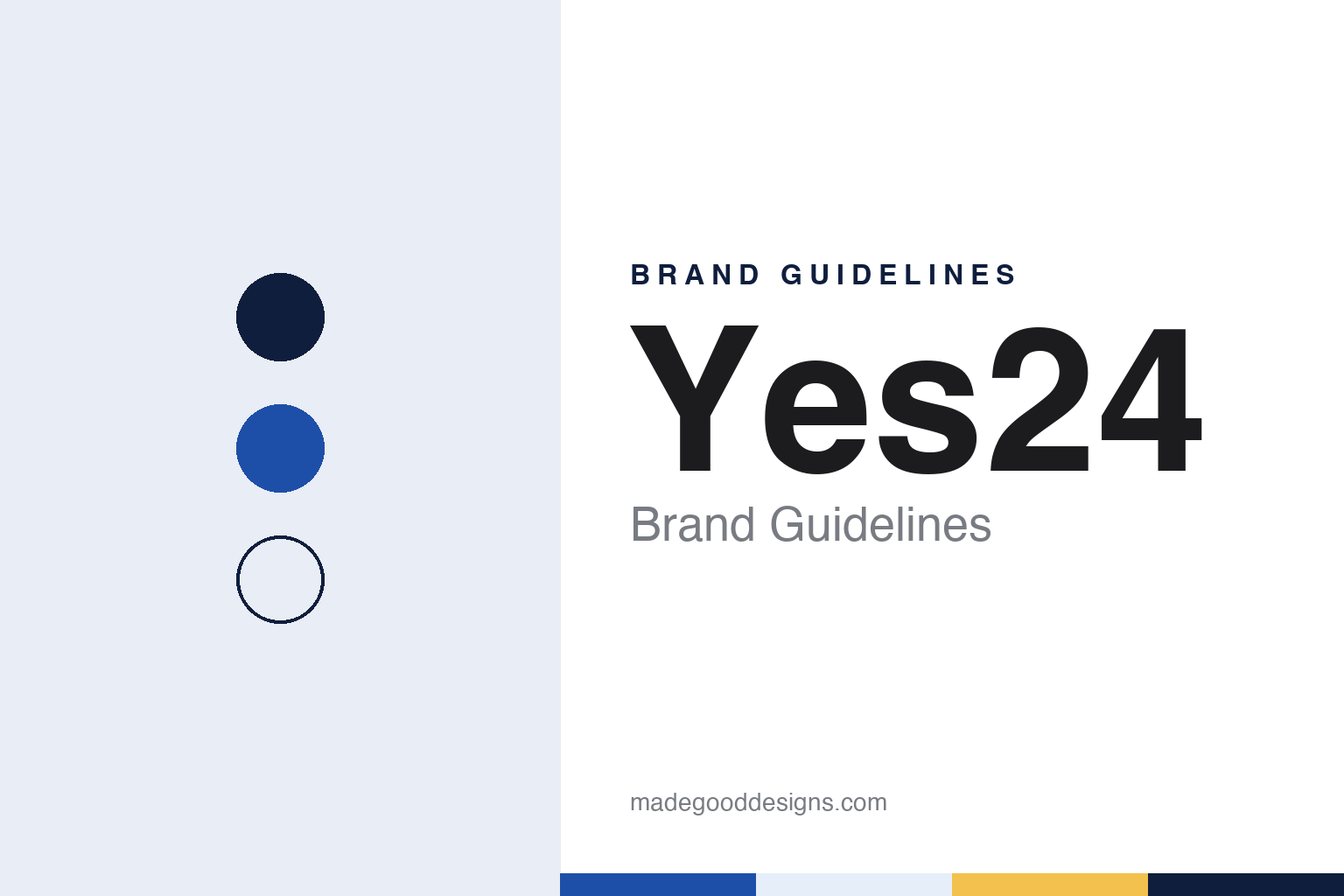
Yes24 Brand Guidelines
The Seoul online bookshop of 1998, its tickets, its e-readers and its blue smile.
Aa
Two constants: a Yes24 cobalt blue and warm yellow palette and a Rounded sans register. Abstract homage — not a Yes24 product or mark; no logo, smile symbol or app screen is reproduced.
From WebFox to YES24
An online bookshop of 1998.
Yes24 began as a website. Its own company timeline and Korean Wikipedia trace it to WebFox, an online bookshop that started in June 1998; Korean Wikipedia describes WebFox as selling only e-books, and says an internet discount bookshop called Davinci followed in December 1998. The business took the name YES24 in 1999 — on 1 April 1999, for both the company and its web address, according to Korean Wikipedia, and in June 1999, according to the company’s timeline. Publishers Weekly and the Asia Business Daily both date its start to 1998. The company sets the name in capitals on its corporate pages; English-language press reports usually write Yes24.
Korean Wikipedia says Yes24 merged with Wowbook, then a rival online bookshop, in August 2002 through a share swap, finishing the integration that November, and that the clothing manufacturer Hansae bought control of the company in May 2003. Korean Wikipedia describes Yes24 as a subsidiary of Hansae Yes24 Holdings, the group holding company, and the Yes24 website lists Hansae Yes24 Holdings, Hansae and Dong-A Publishing among its family companies. The company’s timeline records approval for a listing on the KOSDAQ market in May 2008. Its corporate offices are in Yeouido, in western Seoul, according to its website.
Much of its growth came from logistics. The company says it built its own distribution centre in September 2005, began same-day delivery in Seoul in September 2007 and opened a distribution centre in Daegu in July 2013. In 2010 The Korea Times described that same-day service, which it called “bullet delivery,” and a warehouse in Paju, Gyeonggi Province, holding about two million books; by March 2014 Publishers Weekly put the stock there at nearly three million titles and reported about nine million registered users, with more than 400 reader events a year, including author talks, book signings and a Book of the Year selection.
Colour
Books, tickets and e-readers.
Yes24 has widened well beyond books. The company dates a film-booking service to December 2004 and a performance-booking service to August 2007. Yes24 Ticket is one of the four major sites for buying K-pop concert tickets in Korea, alongside Ticketlink, Interpark Ticket and Melon Ticket, Korea JoongAng Daily wrote in a September 2024 guide. The company says it began running Yes24 Stage, a theatre in Seoul’s Daehangno district, in March 2019, and in July 2021 it bought the musical-theatre magazine The Musical, founded in 2000, from the performance company Clip Service, the Asia Business Daily reported; the magazine had stopped after its December 2020 issue.
Its own e-reader line is called Crema. Publishers Weekly reported that the first model, Crema Touch, went on sale in September 2012 and was followed by the backlit Crema Shine. The company’s timeline lists later models including the Crema Carta of 2015, the Crema Grande of 2017 and the Crema Pebble of 2024, as well as an e-book subscription service, the Yes24 Book Club, launched in November 2018, and an investment in 2009 in Korea ePub, a jointly owned e-book company. In 2014 Publishers Weekly also reported that Yes24 had ventured into Vietnam, Indonesia and Thailand.
The company moved into publishing and live music too. Its timeline records buying the publisher Doosan Dong-A in October 2014 and selling Dong-A Publishing in June 2015, the same month it bought the concert venue now called Yes24 Live Hall. In April 2024 it launched Sarak, a reading-community app, the timeline says. The Asia Business Daily described Yes24 in 2023 as a cultural content platform selling books, e-books, performance tickets, music albums and serials as well as subscriptions.
Typography
Design and documentation.
South Korea’s online marketplaces present themselves first through their apps. When eBay Korea reworked Gmarket in 2021, The Korea Times reported, the change ran from the logo and a company-made typeface to icons, loading animations and a simpler home screen built around a larger search bar. In 2022 11st carried its new gradient logo onto its app icon, its in-app banners and its “buy” button, the Munhwa Ilbo reported.
Several platforms now publish their design rules. 11st opened a public design-system website in 2024, with logo rules, a house typeface and guidance on colour, grids and icons, according to the design magazine Design Compass, while Gmarket made its Gmarket Sans typeface free for anyone to use. Naming tends to be plain and descriptive. “Open market” is the usual Korean term for a platform on which independent sellers list goods, and membership schemes and sale days carry their own names, such as Gmarket’s Smile Club.
The bookshop chains in this group work across screens and shop floors alike, so their identities reach from websites and apps to delivery boxes, flagship bookshops, reading lounges and campaign graphics. Each guide describes those materials only as the companies themselves publish them, or as dated press reports describe them, and names platforms and stores in the form the companies use in English.
Ownership is part of the story across the sector. Gmarket passed from Interpark to eBay, then to Shinsegae, and into a joint venture with Alibaba; 11st moved between SK companies and outside investors before becoming a subsidiary of SK Planet at the end of 2025. Each guide sets out founders, owners and stock-market listings as dated facts from corporate pages, official registers and independent press, and marks clearly what rests only on a company’s own word.
Aa
A rounded sans — a cheerful register for a smile and a blue. (Specimen set in Nunito, a sans STAND-IN; NOT the Yes24 logo.)
Yes24
A smile and a blue.
Yes24 also has shops. The Asia Business Daily dated its entry into physical bookselling to August 2016, starting with its Mokdong branch in Seoul, while the company’s timeline and Korean Wikipedia also list a store near Gangnam Station opened in April 2016. Used-book stores followed in Busan, Daegu, Cheongju and elsewhere, the timeline shows. As of August 2026 the Asia Business Daily reported six stores — two selling new books and four selling used ones — including Daegu Banwoldang, Busan Suyeong F1963 and Cheongju NC. Over that first decade, the paper reported, 453,158 members had visited the shops, and the top-selling book in them was Han Kang’s The Vegetarian. The Japanese novelist Keigo Higashino was the top-selling author of adult books, and at Mokdong his The Miracles of the Namiya General Store was the top-selling used book of the decade.
The identity was renewed in April 2023 for the company’s 24th anniversary. The Asia Business Daily reported on 3 April 2023 that the new brand identity kept the two core symbols of the old one — a smile and the colour blue — and that the letter Y now takes in the eyes of the smile, drawn in a cursive lettering style the company described as intellectual yet lively. The company’s timeline records the new identity in the same month.
For a design guide, Yes24 shows how an online retailer can keep one symbol and one colour while its business spreads from books to tickets, e-readers and shops. Compare Kyobo Book Centre, the Seoul bookshop chain that moved the other way, from shops to online, and Interpark, which The Korea Times named in 2010 among the online bookshops Yes24 competed with. For this guide we use a cobalt blue, an ink blue and a warm yellow with a sans, an unofficial interpretation; no product or logo is reproduced.
Explore & save
Keep Yes24’s identity on hand — save it to a board in the Made Good inspiration library.
Yes24 identity set
Pin the Yes24 cobalt blue and warm yellow palette and the Rounded sans register to your own board.