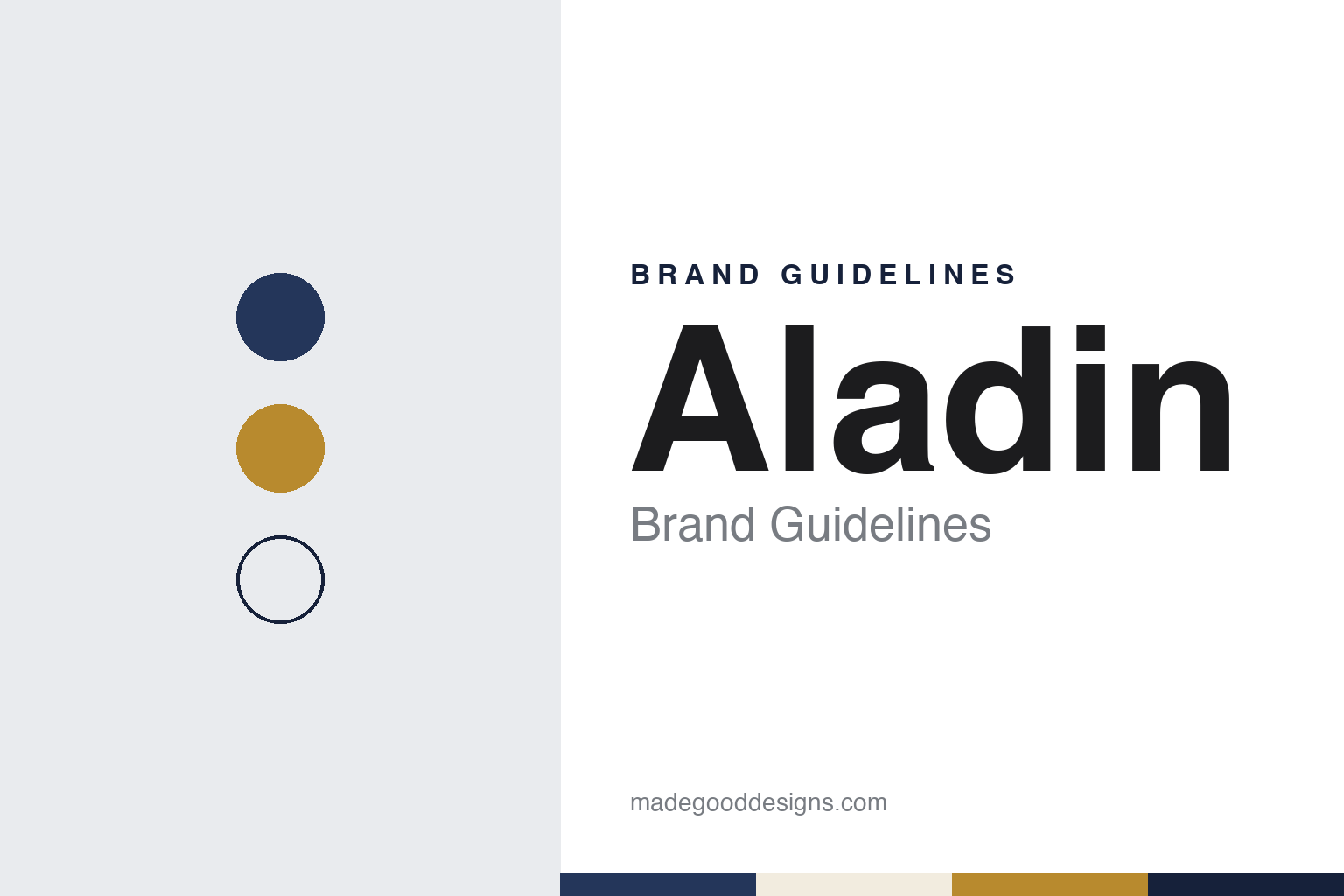
Aladin Brand Guidelines
A Seoul online bookshop that turned used books into a chain of shops.
Aa
Two constants: an ink blue, gold and old-paper palette and a bookish serif register. Abstract homage — not an Aladin product or mark; no logo, shop sign or packaging is reproduced.
An online bookshop
A company set up in 1998 and a website that opened in 1999.
Aladin is a South Korean online bookseller run by the Seoul company Aladin Communication. Korean Wikipedia says the company was set up on 23 November 1998 and opened its website and began trading on 14 July 1999. It describes Aladin as an e-commerce business headquartered in Seoul that sells books, DVDs and music, together with used books, used DVDs and used records.
The company writes its name in English as Aladin, with one “d.” English-language press does not always follow it: The Korea Herald, writing about the used-book shops in August 2018, called them “Aladdin Used Books.” This guide uses the company’s own spelling throughout.
Aladin grew up as a website rather than a shop, and its early changes were technical ones. On 30 December 2009, Korean Wikipedia says, the company announced it would stop relying on ActiveX for payment and moved to a checkout that worked in Internet Explorer, Firefox, Safari and Chrome, with the update rolled out by the following April.
The range on the website has widened well beyond new Korean books. In November 2026 the site’s menus ran to Korean and foreign books, e-books, music including LPs, Blu-ray discs and DVDs, and an online used-goods section. In April 2024 The Korea Times, writing about the vinyl record market, described Aladin as an online bookstore that sells LPs alongside books.
Colour
From an online used shop to a chain of stores.
The used-book business is what turned Aladin from a website into a chain of shops. Korean Wikipedia says the company began running an online used shop for books, records and DVDs in February 2008. Three years later it moved offline. The Korea Times reported in December 2012 that Aladin had opened its first offline store near Jongno 3-ga Station in central Seoul in September 2011, and that by the end of 2012 it had eight stores in prime locations in Seoul and other large cities. The same article described how one small used bookseller near Hongik University had moved after Aladin opened a store directly across from it in February 2012.
The format changed what a used bookshop looked like. In August 2018 The Korea Herald said the used-book franchise had more than 40 branches across the country, and that its shops looked like an ordinary bookstore: unless a customer looked closely, it was hard to tell that the stock was secondhand, because the books were in good condition. Customers could use in-store computers to find the exact shelf a book stood on, and could search online to see which branch held a title the shop lacked. The paper visited the Jongno branch on a weekday afternoon and found it full of students and office workers.
The shops also buy. The Korea Herald explained in 2018 that people who want to sell books can bring them into a store, where staff assess the price from the available stock and the condition of each book and pay in cash on the spot; the store then resells them. The Korea Times had described the same buying in 2012, reporting that Aladin was paying a share of the cover price for recent bestsellers.
The chain is now national. In November 2026 Aladin’s website listed 59 used-book stores: 20 in Seoul, from Garosu-gil and Gangnam to Sinchon and Jongno; 15 in Gyeonggi Province; and 24 in other cities, including Busan, Daegu, Daejeon, Gwangju, Incheon, Ulsan, Jeonju and Cheongju. Several sit inside larger shops, among them branches in a Homeplus, a Lotte Mart and a Hanaro Mart, and one is at the Masan intercity bus terminal. The same menu lists an online branch called the Space store.
Typography
Platforms, parcels and bookshops.
South Korea’s online marketplaces present themselves first through their apps. When eBay Korea reworked Gmarket in 2021, The Korea Times reported, the change ran from the logo and a company-made typeface to icons, loading animations and a simpler home screen built around a larger search bar. In 2022 11st carried its new gradient logo onto its app icon, its in-app banners and its “buy” button, the Munhwa Ilbo reported.
Several platforms now publish their design rules. 11st opened a public design-system website in 2024, with logo rules, a house typeface and guidance on colour, grids and icons, according to the design magazine Design Compass, while Gmarket made its Gmarket Sans typeface free for anyone to use. Naming tends to be plain and descriptive. “Open market” is the usual Korean term for a platform on which independent sellers list goods, and membership schemes and sale days carry their own names, such as Gmarket’s Smile Club.
The bookshop chains in this group work across screens and shop floors alike, so their identities reach from websites and apps to delivery boxes, flagship bookshops, reading lounges and campaign graphics. Each guide describes those materials only as the companies themselves publish them, or as dated press reports describe them, and names platforms and stores in the form the companies use in English.
Ownership is part of the story across the sector. Gmarket passed from Interpark to eBay, then to Shinsegae, and into a joint venture with Alibaba; 11st moved between SK companies and outside investors before becoming a subsidiary of SK Planet at the end of 2025. Each guide sets out founders, owners and stock-market listings as dated facts from corporate pages, official registers and independent press, and marks clearly what rests only on a company’s own word.
Aa
A bookish serif for a bookseller. (Specimen set in Source Serif 4, a serif STAND-IN; NOT the Aladin logo.)
Aladin
Books, goods and a disclosure label.
Aladin also sells things that are not books. In November 2026 its website had a section called Aladin Goods, with bags and pouches, desk items, reading accessories, stationery and kitchen goods, as well as notebooks, book stands, bookmarks and book covers. The same menus carried a coffee section, with beans, drip bags and cold brew, and pages for a reader-funded book scheme called Book Fund and a creative writing platform called Tobecontinued.
It has also had to take positions on what it sells. In February 2026 The Korea Times reported on a wave of books produced with generative AI in South Korea, and said that since 2025 Aladin had asked publishers to declare any AI involvement in a book and showed that information on each book’s product page. An Aladin official told the paper that readers wanted to know whether the books they bought had been written by AI.
The company’s web pages, its used-book shops and its goods share one name, and the shops carry it into Seoul and other cities, some of them inside larger stores. What can be documented about the brand comes mostly from those shops: their look, their buying counters, their in-store search computers and their spread from one branch near Jongno 3-ga in 2011 to 59 listed in November 2026.
For a design guide, Aladin shows how an online bookseller can build a physical presence out of secondhand stock, with shops that look new. Compare Yes24, another Korean online bookseller, and Kyobo Book Centre, the Seoul bookshop chain. For this guide we use ink blue, gold and old paper with a serif, an unofficial interpretation; no product or logo is reproduced.
Explore & save
Keep Aladin’s identity on hand — save it to a board in the Made Good inspiration library.
Aladin identity set
Pin the Aladin ink blue, gold and old-paper palette and the bookish serif register to your own board.