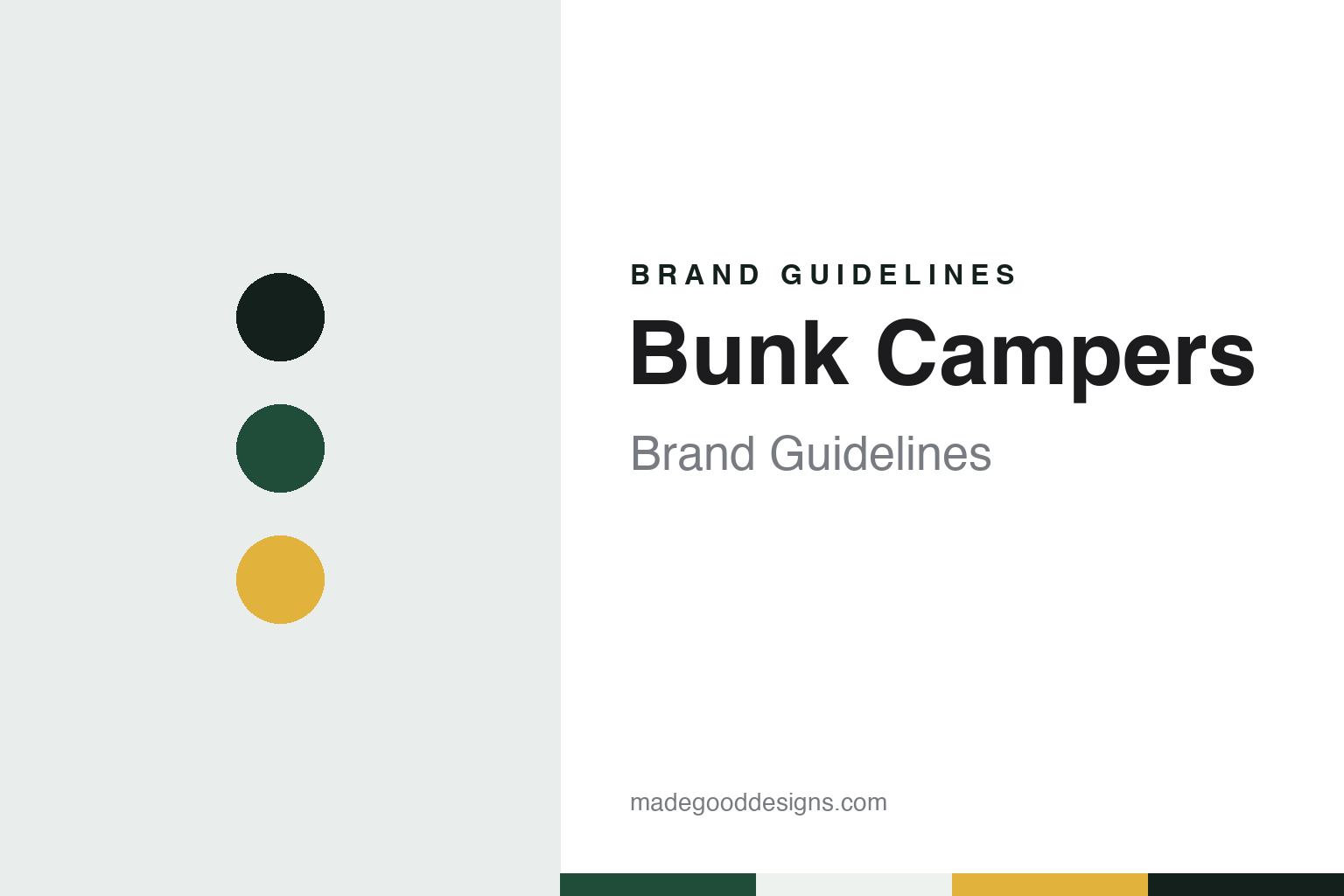
Bunk Campers Brand Guidelines
A 2007 Belfast and Dublin start, Apollo and Indie Campers.
Aa
Two constants: a glen green, ink and gorse yellow palette and a geometric sans register. Abstract homage — not a Bunk Campers vehicle or mark; no livery, logo or photograph is reproduced.
Five vans, two depots
A campervan trip abroad, then a business at home.
Bunk Campers began in 2007. Its founders, Keith Charlton and Louise Corken, started it after touring Australia and New Zealand in a campervan, the company’s own history says, and returned to Ireland to find no similar hire business there. The hire-industry site Anything for Hire reported in March 2018 that the business had been built up from five vans in 2007 and that its parent group was headquartered in Belfast. The company’s milestones page, dated March 2022, says the first fleet was five campers and one van, spread across two rental sites in Belfast and Dublin.
Early growth came through tourism partners. By 2009, the company says, Bunk Campers was selling through international tour operators and ran 20 vehicles in five campervan types. A Scottish depot followed in 2010, which the company calls its first expansion overseas, bringing the fleet to 50 vehicles, and a London depot opened in 2014. In 2013 it bought and absorbed Nomad Campervans, which the company says brought knowledge of campervan building inside the business.
The group then widened beyond rental. An online parts and accessories store, Camperworks, launched in 2015, and a Camperco showroom selling new and ex-hire motorhomes and campervans opened in 2017, the company says. The umbrella company became known as the Camperco Group; The Motley Fool Australia noted in March 2018 that Camperco had previously been known as Bunk Campers, and Anything for Hire described it at that point as a group of four businesses in the UK and Ireland employing about 40 people.
Colour
Named models, a short list of depots.
The fleet is presented as a ladder of named models rather than numbered classes. On the company’s website in November 2026 the range runs from the Aero and Aero Plus, which sleep two, through the Vista, Vista Plus and Europa for four, to the Horizon for five and the Grande for six. The company says its campervans are converted, fitted and kitted to its own specification, that it updates the fleet every year, and that its vehicles come both from leading European manufacturers and from its own manufacturing facility. Under the line “Freedom is functional,” it frames the vans as “bright, modern accommodation on wheels,” and it offers everything from compact two-person campervans to large motorhomes for four to six people, which it describes as transport and accommodation in one.
Geography is the other half of the offer. The company describes itself as the only all-Ireland campervan rental company, and in November 2026 its website listed depots for Belfast, Dublin, Edinburgh and Greater London, with its about page also naming the Glasgow airport area. One-way hire between depots, unlimited mileage and discounted ferry crossings are set out as headline features on the home page, alongside pet-friendly and winter hire. The website is published in English, Spanish, German, French, Dutch and Italian.
Its stated mission is to be the “first choice for campervan hire and motorhome rental in the UK & Ireland,” with principles grouped under five headings: the campervans, the customers, the service, performance and community. The tone is direct and personal. The company promises a reply “from a name not a number,” a full demonstration of each vehicle by trained staff before handover, and published performance statistics at its locations, and it asks customers to share their trips with the company and with each other.
Typography
Design and documentation.
Campervan and motorhome rental is sold with pictures of the open road, but two different kinds of business sit behind those pictures. Some companies own and run fleets of their own vehicles from depots; others are marketplaces, on which private owners list their own caravans, campervans and motorhomes and the platform handles the booking and the cover. Camplify, launched in Newcastle, New South Wales, in 2015, and PaulCamper, launched in Berlin in 2013, are marketplaces of the second kind, and since December 2022 both have belonged to the same group listed in Australia.
This guide looks first at the vehicle as each company publishes it: in a company livery or paint scheme, photographed against a landscape, or listed as an owner’s own van in that owner’s own photographs. Where a company describes its vans, its colours or its paintwork, the guide gives that as the company’s own account, with the date of the source.
Names come next. Rental firms give names to their vehicle ranges and models, and marketplaces give names to their memberships and cover products: Camplify sells a premium membership called Club Camplify and member cover under the name MyWay, while PaulCamper says it built its rental cover together with Allianz. Bookings are made online, and some companies also offer an app, as Camplify does on its website; this guide describes such apps plainly, from what the companies say about them.
Finally, there are the owners. Some names in this category belong to larger groups, and corporate pages, annual reports and stock-exchange filings show who owns what and since when. This guide follows those documents and dated press reports, gives fleet, depot and country counts only as a dated source states them, and treats the colours and typefaces shown here as an unofficial interpretation rather than official brand values.
Aa
A geometric sans for a hire firm that names its vans. (Specimen set in Outfit, a sans STAND-IN; NOT the Bunk Campers logo.)
Bunk Campers
Apollo in 2018, Indie Campers in 2026.
Bunk Campers has changed hands twice in eight years. In March 2018 the Australian listed company Apollo Tourism & Leisure agreed to buy the Camperco Group, including Bunk Campers. The Motley Fool Australia reported on 27 March 2018 that Camperco was one of the largest independent motorhome operators in the United Kingdom and Ireland, that its founders and management team would stay on to run the business, and that the purchase was Apollo’s entry into the UK market. Anything for Hire covered the deal the next day. The company says Apollo went on to open its first mainland European locations, in Germany and France, in 2019.
Apollo is now one of the rental brands of the New Zealand group Tourism Holdings (thl), and by 2026 Bunk Campers formed part of thl’s UK & Ireland business, alongside the Just Go brand. On 16 February 2026 thl told the NZX and ASX that it had agreed, subject to conditions including landlords’ consent to the transfer of depot leases, to sell that business to Indie Campers, the rental company headquartered in Portugal. In a further announcement dated 1 April 2026, thl said the sale had completed with effect from 31 March 2026. Indie Campers said in February 2026 that it would keep Just Go and Bunk Campers as distinct brands within its group, with nine pick-up locations across the UK and Ireland between the three names.
For a design guide, Bunk Campers shows how a regional hire firm builds an identity from named vehicle models, a short list of depots and a plainly worded set of promises. Compare Indie Campers, its owner since 2026, and Apollo Motorhome Holidays, the group that bought it in 2018. For this guide we use glen green, ink and gorse yellow with a geometric sans, an unofficial interpretation; no product or logo is reproduced.
Explore & save
Keep Bunk Campers’s identity on hand — save it to a board in the Made Good inspiration library.
Bunk Campers identity set
Pin the Bunk Campers glen green, ink and gorse yellow palette and the geometric sans register to your own board.