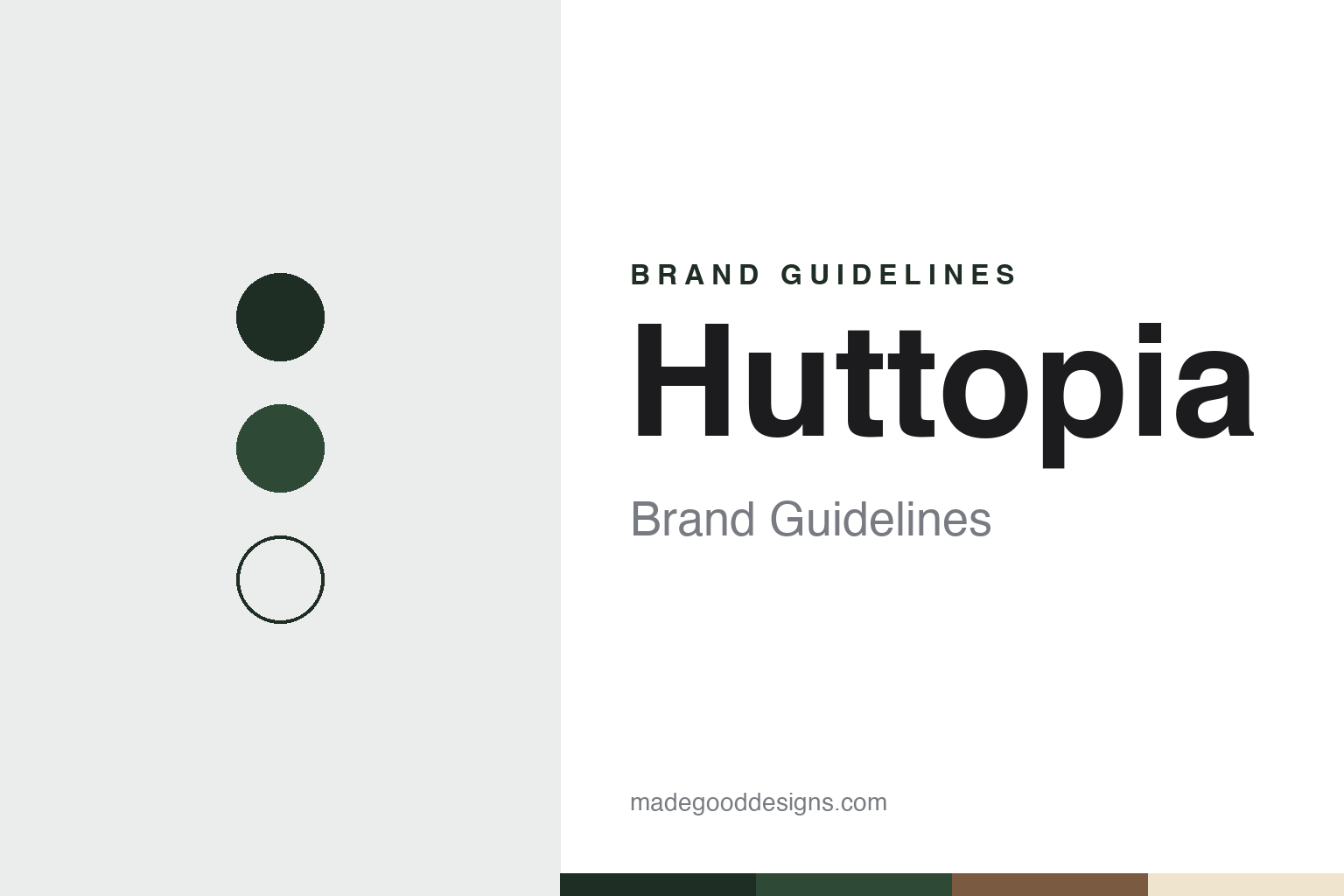
Huttopia Brand Guidelines
The Lyon nature-campsite company founded in 1999.
Aa
Two constants: a forest green, bark and canvas palette and a woodland serif register. Abstract homage — not a Huttopia product or mark; no logo, tent or site image is reproduced.
Lyon, 1999
A hut, a utopia and a family from the Drôme.
Huttopia is a French campsite and outdoor-holiday company founded in 1999 in Lyon by Céline and Philippe Bossanne. French Wikipedia says the couple came from Romans-sur-Isère and set the company up with shareholders from the tourism and outdoor trades, among them the outdoor-equipment maker Lafuma, and that they drew on their experience in Canada. The company tells the same story: the project first took root in the Drôme, the founders’ home area, and matured in Canada, where they lived for a few years.
The name, the company says, joins a “hut,” a simple shelter, with Utopia, the island described by Thomas More. Its stated idea is to set up light, easily dismantled campsites in natural settings and to welcome families, often city dwellers, who want simple contact with nature. The founders write that they did not start Huttopia as early environmentalists but because they wanted the kind of campsite they enjoyed themselves, where people could pitch a tent without being packed together.
Accounts of the first site differ in detail. The company says it opened its first, very small nature campsite in the Alps in 2000; French Wikipedia says the business started from a first campsite of 45 pitches in the south of France. The company also dates to 2000 what it calls its “Art of Camping,” a mix of nature, comfort and aesthetics in wood-and-canvas tents that it says laid the foundations for glamping.
From early on Huttopia worked with public land managers. The company says it has developed sites in French state forests run by the Office national des forêts since 2000; French Wikipedia dates the partnership agreement with the ONF to 2001, and says the two later set up a joint company, ONF Huttopia.
Colour
Quebec, Paris and a network of nature campsites.
The first move abroad was to Canada. In 2008, according to both the company and French Wikipedia, Huttopia signed a partnership with the Sépaq, the body that runs Quebec’s national parks, to put its canvas-and-wood tents in the province’s parks; the company says this meant about 500 tents in about twenty parks, and that people in Quebec began to talk of going “Huttopia” camping. It now has a base in Montreal, and French Wikipedia says that by June 2023 it had five villages in the United States, in California, New York, Maine and New Hampshire.
At home the company built several networks. French Wikipedia says that in 2011 it took over the running of the only campsite inside Paris under a public-service contract, and that in 2017 it bought a nature campsite near Lyon that became its first CityKamp. In July 2021 Le Journal des Entreprises reported that the Lyon company was buying the OnlyCamp network, created in 2012 by Récréa, a Calvados company that manages aquatic centres under public contracts; the trade site TourMaG said OnlyCamp then had eight campsites in the Centre-Val de Loire and Pays de la Loire regions. Philippe Bossanne, quoted as chief executive, said the deal would help Huttopia answer towns asking it to revive their old campsites.
The largest deal so far came in January 2026. TourMaG reported on 19 January 2026 that Huttopia was acquiring the 18 Terracamps campsites of the Aquadis group, a business it said was created by Frédéric Martin in 1996 and focused on small campsites, often by lakes or rivers and mostly in central France. The sites were to be brought up to the standards of the Huttopia or Onlycamp brands, and the purchase was expected to take the group past 200 sites for the 2026 season. TourMaG said a typical Huttopia site has around 150 pitches on ten hectares, and a typical Onlycamp site around 100 pitches on three.
Typography
Holiday parks and campsites.
Holiday park and campsite operators sell a place before they sell a stay. Their websites open on photographs of the parks themselves: lodges and cottages among trees, pitches and mobile homes beside water, covered pools and play areas, published by each company as its own pictures of each site. The operators in this guide range from woodland villages built around an indoor pool to campsites with tents, pitches and wooden cabins, and their imagery follows those settings.
Naming does much of the branding work. Center Parcs renamed one of its early Dutch parks after customer research, according to Dutch Wikipedia, and later called its bungalows “cottages” and its pools Aqua Mundo; Landal pairs its own name with a local one, as in Landal Beach Park Texel. Accommodation is sold by type, from a pitch to a lodge, cottage or villa, and those type names carry through from park maps to booking pages.
The booking interface is where the parts meet. On the operators’ own sites a guest picks a park, then dates, party size and an accommodation type, and the site shows what is free. The journey can continue on a phone: parkurlaub.de reported in 2026 that check-in and a digital door key ran through the Landal app. Park maps show the layout of houses, pitches, paths and facilities, and are published by the companies themselves.
Behind the consumer brands sit corporate pages on owners, and these change often. Several of the companies in this guide have been bought and sold by brewers, insurers, listed groups and investment firms, and some share a name with a business they no longer own. This guide records those ownership changes as dated facts from named sources, and treats each company’s description of itself as its own claim.
Aa
A warm serif for a brand of forests and canvas. (Specimen set in Fraunces, a serif STAND-IN; NOT the Huttopia logo.)
Huttopia
Forest Villages, Nature Campsites and City Kamps.
The company describes itself as independent and organised in three branches: the main campsite business, run since 1999; a digital branch, Huttosoft, dating from 2000; and an industrial branch, Hékipia, which it says has made tents and tiny houses since 2004. French Wikipedia says Hékipia also builds shelters for emergency housing. In April 2022, French Wikipedia says, shareholders approved a move to a management board and supervisory board; Stéphane Duc, who joined in 2005, became chairman of the management board, and Philippe Bossanne chairman of the supervisory board.
Its holidays come in several formats: Forest Villages, Nature Campsites and City Kamps, plus the smaller Onlycamp sites. Accommodation is built mainly in wood and canvas, and the company says its infrastructure is light and easily dismantled so that sites can be returned to nature. The company said in 2025 that it ran 152 sites in eight countries on three continents, with offices in Utrecht and Madrid alongside Lyon and Montreal, and that it had worked with national park authorities in the Netherlands since 2018 and in Argentina since 2019. French Wikipedia lists sites in France, Spain, Belgium, Portugal, the Netherlands, the United States, Sweden, Argentina and Canada.
For a design guide, Huttopia shows a campsite brand organised around wood, canvas and forest settings. Compare Center Parcs, another forest-holiday operator, and Eurocamp, which sells holidays on European campsites. For this guide we use a forest green, a bark brown and a canvas cream with a serif, an unofficial interpretation; no product or logo is reproduced.
Explore & save
Keep Huttopia’s identity on hand — save it to a board in the Made Good inspiration library.
Huttopia identity set
Pin the Huttopia forest green, bark and canvas palette and the woodland serif register to your own board.