Center Parcs Brand Guidelines
A Rotterdam sports shop, a wood near Reuver and a village under a dome.
Aa
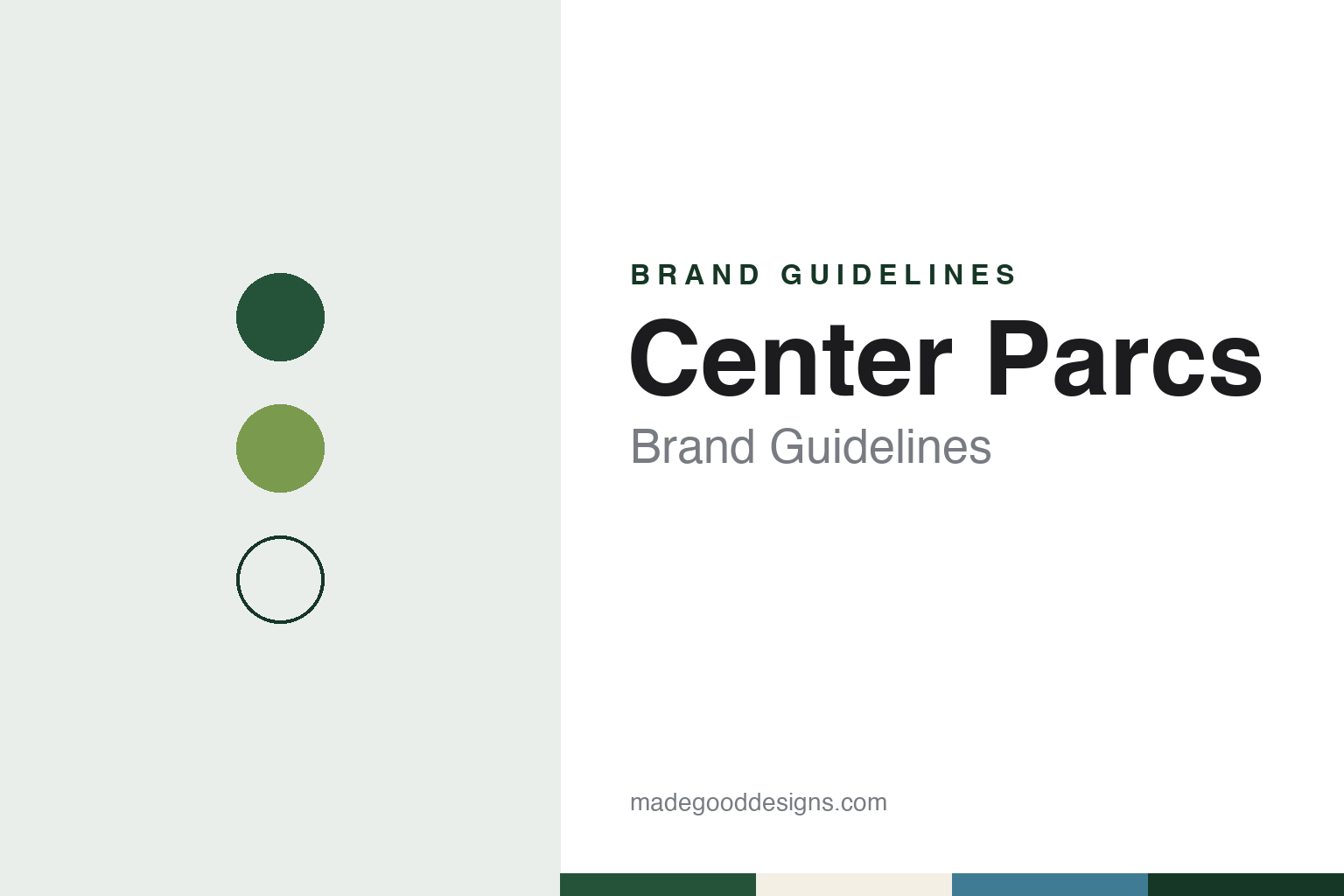
Two constants: a forest green, moss and lake blue palette and a friendly sans register. Abstract homage — not a Center Parcs product or mark; no logo, sign or photograph is reproduced.
Sporthuis Centrum
A sports shop, a wood and a row of tents.
Center Parcs grew out of a Rotterdam sports shop. In 1953 the entrepreneur Piet Derksen opened Sporthuis Centrum, a sporting-goods store on the Lijnbaan; Dutch Wikipedia says it grew into a chain of seventeen shops across the Netherlands and, from the 1960s, sold more and more camping equipment. In 1968 Derksen bought woodland near Reuver, in Limburg, and put up tents that he rented to his staff and customers. The park, De Lommerbergen, was a success, and the tents were soon replaced by bungalows.
The Rotterdam architect Jaap Bakema was asked to design the bungalows and the parks, Dutch Wikipedia says. His approach tied each house to its setting: every bungalow had a sliding door with a wide view of the greenery, and the interiors, with colour television, central heating and a bathroom with a bath, were luxurious for the time. Lower prices outside the school holidays kept the bungalows close to full.
More parks followed: Het Vennenbos at Hapert in 1970; a third park near America, in Limburg, in 1971; De Huttenheugte at Dalen in 1972, with its bungalows set around a large lake; and De Berkenhorst at Kootwijk in 1975. The third park opened as Bos en Strand (“wood and beach”). According to Dutch Wikipedia, customer research found that the name made people think of a windy spot, so it was renamed Het Meerdal, the first park where every bungalow stood beside a woodland pool. In 1978 Derksen sold all seventeen shops to Perry Sport to concentrate on the parks, which kept the Sporthuis Centrum name.
The 1980s brought the features now most associated with the brand. De Eemhof, opened in 1980 on the new Flevoland polder with 600 bungalows, introduced a park centre with a supermarket, restaurants and shops, and a large subtropical swimming paradise. The first park outside the Netherlands, Erperheide near Peer in Belgium, opened in 1981. In 1986, with nine parks, Sporthuis Centrum took the more international-sounding name Center Parcs.
Colour
Plazas, domes and a flock of birds.
Center Parcs has built its identity as much through buildings and place names as through graphics. At De Vossemeren in Belgium, opened in 1987, it added the Parc Plaza, a fully covered subtropical centre that put the shops, restaurants, terraces and pool under one roof, Dutch Wikipedia says. The first English village opened at Sherwood Forest in Nottinghamshire in July 1987, followed by Les Bois-Francs in Normandy in 1988 and Elveden Forest in Suffolk in 1989.
By the mid-1990s, Dutch Wikipedia says, a common criticism was that every park and every house looked alike. From 1996 the parks were refurbished and each was given its own character: bungalows were renamed “cottages,” the Parc Plaza became the Market Dome, the most tropical pools were renamed Aqua Mundo, and the house style and logos were brought up to date. In 2006 the sub-brands Sea Spirit and Free Life, used for former Gran Dorado parks, were dropped; differences between parks were shown instead with birds taken from the logo, with more birds marking more facilities. English Wikipedia describes the continental logo as green initials “CP” stylised as a tree beside a green wordmark.
The group added a second name in 2007, when Pierre & Vacances bought the Belgian chain Sunparks. From January 2009 several parks traded as Sunparks, and in 2011 most were renamed Center Parcs again. Today the Pierre & Vacances-Center Parcs group lists 28 Center Parcs and 2 Sunparks in France, Belgium, Germany, the Netherlands and Denmark, under the line “Follow your nature,” with seven brand pillars running from “Together” and “Nature” to “In all weathers.”
The British villages use a similar vocabulary in English. English Wikipedia says each covers about 400 acres of woodland and that the pool is called the Subtropical Swimming Paradise in the UK. Health Club Management reported in June 2015 that Woburn Forest, opened in June 2014, had 625 lodges, a 75-bedroom hotel and an Aqua Sana spa.
Typography
How holiday parks present themselves.
Holiday park and campsite operators sell a place before they sell a stay. Their websites open on photographs of the parks themselves: lodges and cottages among trees, pitches and mobile homes beside water, covered pools and play areas, published by each company as its own pictures of each site. The operators in this guide range from woodland villages built around an indoor pool to campsites with tents, pitches and wooden cabins, and their imagery follows those settings.
Naming does much of the branding work. Center Parcs renamed one of its early Dutch parks after customer research, according to Dutch Wikipedia, and later called its bungalows “cottages” and its pools Aqua Mundo; Landal pairs its own name with a local one, as in Landal Beach Park Texel. Accommodation is sold by type, from a pitch to a lodge, cottage or villa, and those type names carry through from park maps to booking pages.
The booking interface is where the parts meet. On the operators’ own sites a guest picks a park, then dates, party size and an accommodation type, and the site shows what is free. The journey can continue on a phone: parkurlaub.de reported in 2026 that check-in and a digital door key ran through the Landal app. Park maps show the layout of houses, pitches, paths and facilities, and are published by the companies themselves.
Behind the consumer brands sit corporate pages on owners, and these change often. Several of the companies in this guide have been bought and sold by brewers, insurers, listed groups and investment firms, and some share a name with a business they no longer own. This guide records those ownership changes as dated facts from named sources, and treats each company’s description of itself as its own claim.
Aa
A friendly sans for a woodland village. (Specimen set in Figtree, a sans STAND-IN; NOT the Center Parcs logo.)
Center Parcs
One name, two owners.
The founder’s era ended in 1989, when Derksen sold his shares to the British brewer Scottish & Newcastle. The new owner sold some smaller Dutch parks, including De Lommerbergen in 1996, and expanded abroad, with Longleat Forest in 1994 and Bispinger Heide in Germany in 1995. In 2001 the business was split: Scottish & Newcastle sold the British villages to Deutsche Bank Capital Partners, creating Center Parcs UK, while the continental parks went to a joint venture of the French group Pierre & Vacances and Deutsche Bank Capital Partners. Dutch Wikipedia dates the continental sale to 2001; English Wikipedia gives 2003. Pierre & Vacances later bought out its partner. Because it already owned Gran Dorado, the Dutch competition authority required parks to be sold: the smaller ones went to Landal GreenParks and Weerterbergen to Roompot.
Since then the two halves have shared a name but not an owner. English Wikipedia says Center Parcs UK was listed in London in the mid-2000s and bought by Blackstone in 2006; Health Club Management reported on 2 June 2015 that Blackstone had sold it to the Canadian property group Brookfield. Its sixth village, Longford Forest in Ireland, opened in 2019, and the company is now called Center Parcs UK and Ireland.
On the continent, Center Parcs Europe belongs to the Pierre & Vacances-Center Parcs Group, which gives its own founding year as 1967; the first Center Parcs park dates from 1968. In June 2026 the group announced a binding offer from Mubadala Capital of Abu Dhabi for all of its shares, NOS reported on 24 June 2026. The trade magazine EuroAmusement Professional reported in July 2026 that a tender offer agreement had been signed and that holders of just over 80 per cent of the shares had committed to it, with completion scheduled for the first half of 2027. The offer was announced in June 2026 and is not completed at the time of writing.
For a design guide, Center Parcs shows how architecture, renamed buildings and a park-grading system of logo birds can carry a brand as far as any wordmark. Compare Landal GreenParks, which took over many of the smaller Gran Dorado parks, and Roompot. For this guide we use a forest green, a moss, a lake blue and a bark brown with a sans, an unofficial interpretation; no product or logo is reproduced.
Explore & save
Keep Center Parcs’s identity on hand — save it to a board in the Made Good inspiration library.
Center Parcs identity set
Pin the Center Parcs forest green, moss and lake blue palette and the friendly sans register to your own board.