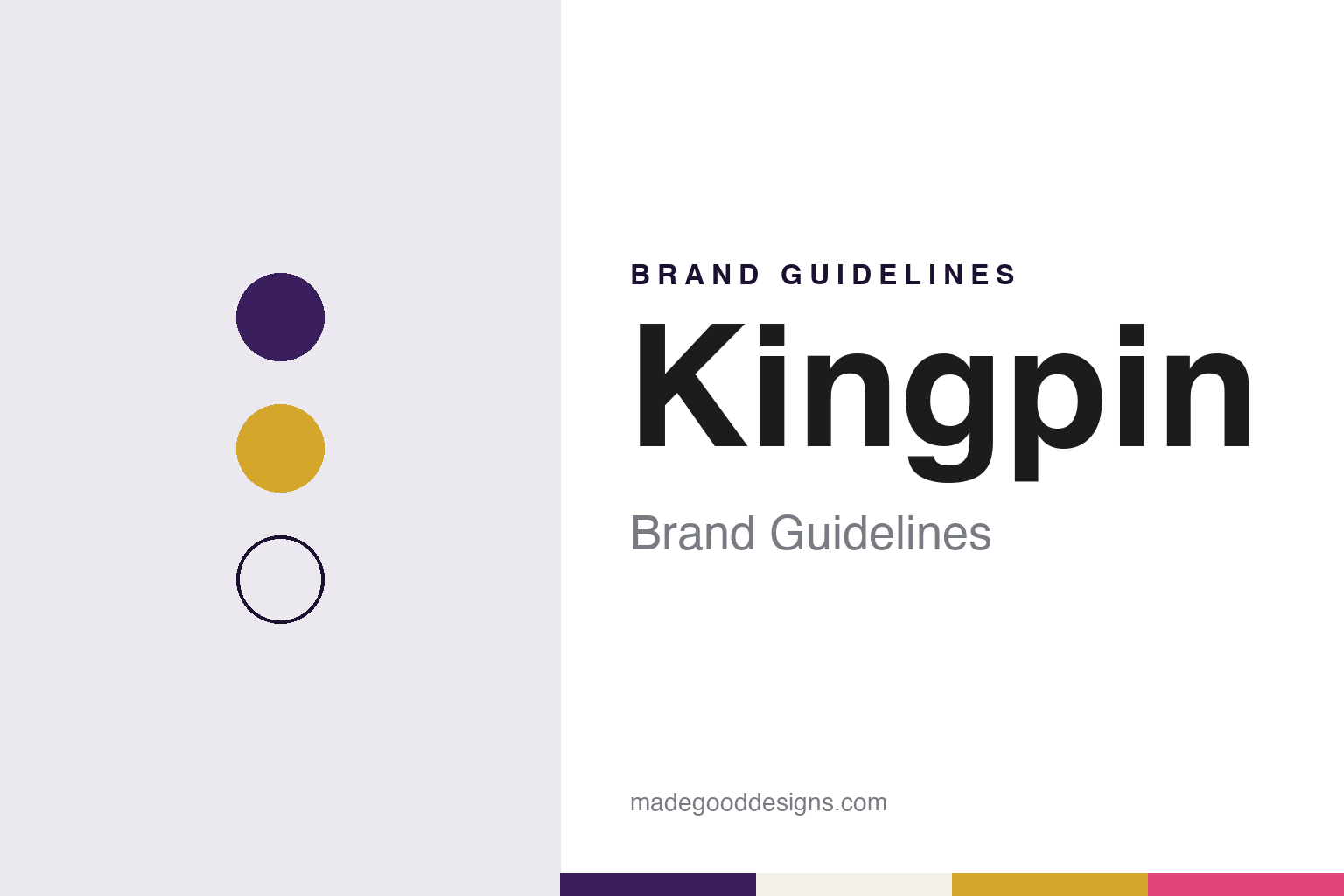
Kingpin Brand Guidelines
An Australian bowling brand that tells guests to roll like a royal.
Aa
Two constants: a royal violet, gold and neon palette and a strike sans register. Abstract homage — not a Kingpin venue, product or mark; no logo, lane or signage is reproduced.
From Crown to a group of venues
A bowling centre in a Melbourne casino complex.
Kingpin is an Australian chain of bowling and entertainment venues. Its owner, TEEG (The Entertainment and Education Group), dates the brand in its group timeline to 2000, when, it says, the first Kingpin opened at Crown Casino in Melbourne.
The first documented change of hands came in 2006. The British trade title Leisure Opportunities reported on 22 June 2006 that Macquarie Leisure Trust, the listed owner of the AMF bowling centres in Australia and the Dreamworld theme park on the Gold Coast, had announced the purchase of several Kingpin Bowling properties in Melbourne. The deal took in two Kingpin bowling centres and two entertainment venues at the Crown complex associated with Kingpin, Galactic Circus and M9 Laser Wars. At the time Macquarie set out plans to add lanes at Crown and to build a further Kingpin on Sydney’s Darling Harbour; its entertainment development director described the combination of bowling, games, pool tables and food and drink as the centrepiece of the Sydney plan. Macquarie had bought the Australian arm of AMF Bowling only in February 2005, according to English Wikipedia.
Macquarie Leisure Trust later took the name Ardent Leisure, English Wikipedia’s article on Zone Bowling says, and Kingpin sat inside Ardent’s bowling and entertainment division alongside the AMF centres and the Playtime arcades. The theme-park news site Parkz noted in December 2017 that the listed group had begun life as Leisurewide Property Trust, later Macquarie Leisure Trust, and had joined the Australian stock exchange in 1998.
Colour
Timezone’s owners take over.
In December 2017 Ardent sold that division. The American trade magazine RePlay reported on 2 January 2018 that the Timezone Group, run by the Steinberg family, had partnered with Quadrant Private Equity in November 2017 to create TEEG, and that the purchase of Ardent’s bowling and entertainment business brought Timezone, AMF, Kingpin and Playtime under one roof. TEEG’s own account says Quadrant acquired half of the Timezone Group, forming a joint venture with the family’s LAI Group, whose first Timezone arcade had opened on Murray Street in Perth in 1978. TEEG says its founder, Malcolm Steinberg, began with a handful of pinball machines and later took Timezone into Singapore, Indonesia, the Philippines, India and Vietnam; by its own count the group now runs centres in seven countries, with its largest footprint in Australia. In 2018 TEEG told RePlay that it would focus on taking Kingpin and Playtime into South East Asia. Parkz reported that the sale left Ardent with Dreamworld and Main Event, its American chain of bowling-based entertainment centres.
Under TEEG the AMF centres were renamed Zone Bowling in April 2018, the company says, while Kingpin kept its own name. TEEG describes Kingpin as “not just about Bowling” but a full entertainment experience, with fully licensed bars, food menus and a range of activities that includes laser tag, arcades, pool, TopSpin table tennis, Cryptology escape rooms and karaoke.
The brand was redrawn before the sale. Mumbrella, the Australian marketing trade site, reported on 14 February 2017 that Kingpin had unveiled a new positioning, a refreshed logo and a refit of the Crown Melbourne centre, all created by the agency DDI. The work covered what the agency called “visual and verbal branding.” The new logo, it said, used the slash symbol that marks a spare in bowling inside the word Kingpin, and the brand line became “Roll like a Royal.” The royal theme still runs through the company’s copy, which promises guests that they will feel like royalty.
Typography
Venues, games and the night out.
Bowling, competitive-socialising and indoor-leisure operators sell an evening out rather than a product, so their identities live mostly in rooms and on screens. Their own websites lead with venue interiors: lanes lit in neon, bars set beside the games, and photographs of groups mid-throw or mid-putt. Some build a whole venue around one period theme; Swingers, according to The Caterer, styles its crazy golf clubs on 1920s English country golf clubs.
Naming does a lot of the work. Swingers names its venues after their districts, such as the West End or Back Bay, and operators give house names to games that turn familiar pastimes into branded attractions: an arcade called Carnival, a shuffleboard called Supercharged Shuffle, a shooting game called HotShots. Kingpin’s 2017 identity, Mumbrella reported, put a bowling spare mark inside the name and adopted the line “Roll like a Royal.”
Booking is part of the identity too. Kingpin’s website, for example, opens with a venue picker, a date selector, party packages and gift cards, placed ahead of any story about the company. Some operators add a scoring tool inside the venue; Time Out listed a scorecard app among the features of one Swingers site.
Behind the venues sit owners that are often less visible than the brands. Kingpin belongs to TEEG, a group formed in 2017 by the family company behind Timezone and Quadrant Private Equity, and it is TEEG’s corporate website, rather than the venue site, that sets out the timeline and the brand list. This guide sets out what can be checked about each brand, from founding and ownership to how it presents its venues, and marks clearly what rests on the company’s own word.
Aa
A strong sans for a brand built on bowling’s spare mark. (Specimen set in Archivo, a sans STAND-IN; NOT the Kingpin logo.)
Kingpin
Escape Ordinary.
Kingpin’s booking page, in November 2026, listed ten venues: Macarthur and North Strathfield in New South Wales, Crown and Melbourne in Victoria, Canberra, Chermside and Townsville in Queensland, Norwood in South Australia, Darwin, and Queenstown in New Zealand, which TEEG lists as its only Kingpin outside Australia. The activity list on the same site has grown beyond bowling to darts, a batting cage, shuffleboard and a shooting game called HotShots.
The newest flagship is in central Melbourne. In December 2025 TEEG announced a 3,500-square-metre venue in Collins Arcade, presented as the next phase of the brand under a new proposition, “Escape Ordinary.” The company said the venue would add a batting cage for cricket and tennis, a shuffleboard game called Supercharged Shuffle and indoor lawn bowls to bowling, darts, table tennis, karaoke and more than ninety arcade games; its interior was designed with the long-term partner Ignite Architects, and the street artist Adnate was commissioned for a large mural, while other emerging Melbourne artists contributed to the rooms. The food is cooked on live-fire charcoal grills and in a wood-fired pizza oven in an open kitchen placed at the top of the entrance stairs, the company says. Kingpin Melbourne now appears among the brand’s bookable venues. TEEG also lists a 2024 PRCA Asia-Pacific digital and social media award for Kingpin Australia.
For a design guide, Kingpin shows how a bowling brand can lean on a single idea, royalty, from its logo’s spare mark to its venue copy, while its owner runs a family arcade brand alongside it. Compare Main Event, the American chain that Kingpin’s former owner kept, and Bowlero. For this guide we use a royal violet, a gold, a neon pink and a near-black with a sans, an unofficial interpretation; no product or logo is reproduced.
Explore & save
Keep Kingpin’s identity on hand — save it to a board in the Made Good inspiration library.
Kingpin identity set
Pin the Kingpin royal violet, gold and neon palette and the strike sans register to your own board.