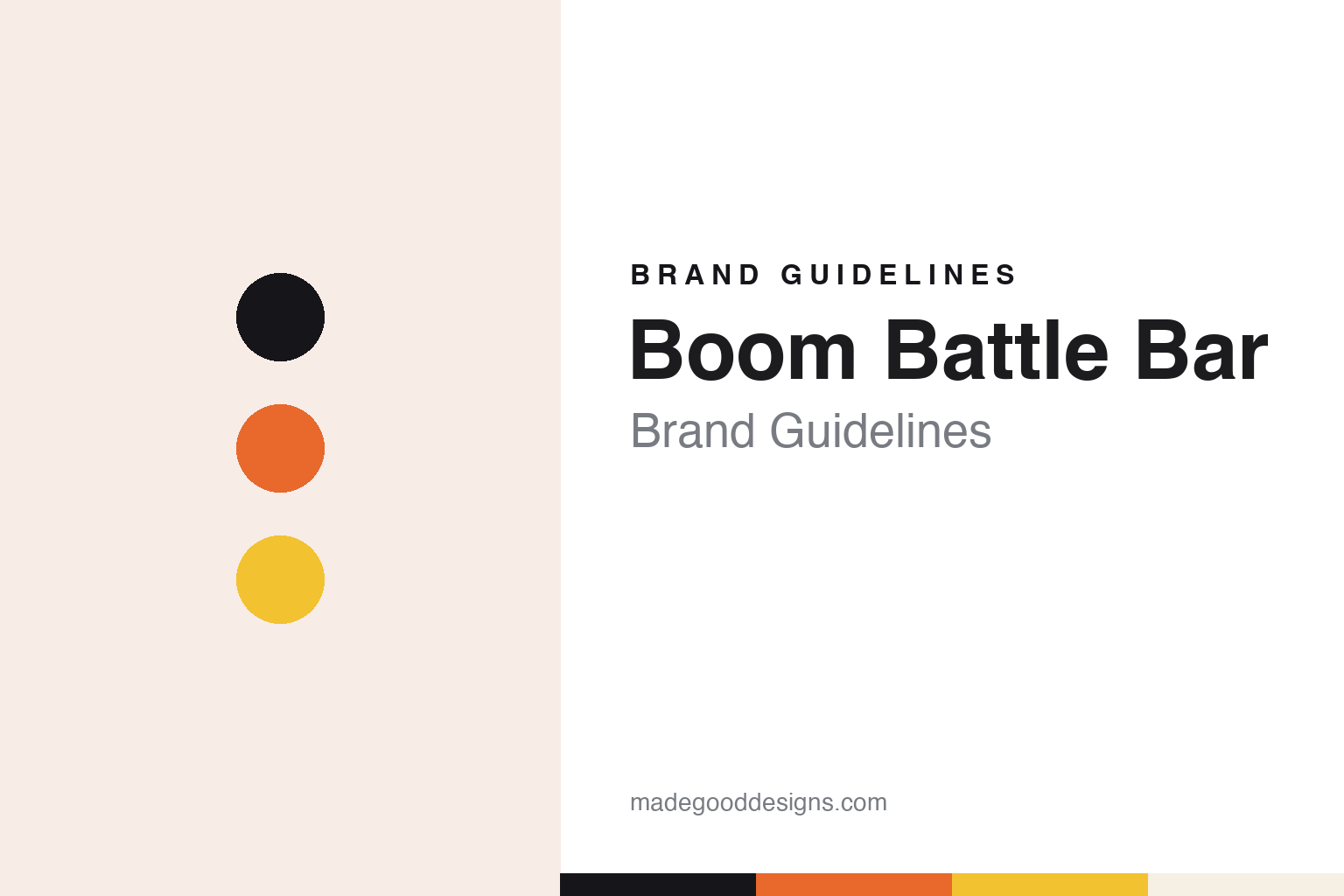
Boom Battle Bar Brand Guidelines
The Norwich battle bar that turned games into a night out.
Aa
Two constants: a battle black, blast orange and arcade yellow palette and a heavy display sans register. Abstract homage — not a Boom Battle Bar venue, product or mark; no logo or sign is reproduced.
Norwich, 2020
A battle bar in a shopping centre.
Boom Battle Bar opened its first venue in July 2020, on Level Two of the Castle Quarter shopping centre in Norwich. The Eastern Daily Press reported on 20 July 2020 that the 11,500 sq ft venue combined axe throwing, nine-hole “crazier” golf, shuffleboard and pool with other bar games, and quoted its owner calling it “the first Boom: Battle Bar to be opened in the UK” and the start of a national roll-out. The centre manager at Castle Quarter called the bar “another great addition to the leisure offering” there. English Wikipedia gives the operating company as BBB Franchise Ltd and the founding year as 2020.
Two founders are named in the trade press. Retail & Leisure International (RLI) interviewed Elliott Shuttleworth as founder and chief executive in April 2021. City AM wrote in September 2026 that Richard Beese, by then chief executive of the leisure group We Do Play, founded Boom Battle Bar in 2020. Beese’s earlier leisure business was Flip Out: Blooloop reported in March 2021 that he was a co-owner of the Flip Out indoor adventure park franchise, and quoted him describing Boom as “like Flip Out but for the bigger kids,” aimed at 18-to-30-year-olds.
The early press styled the name with a colon, Boom: Battle Bar, and the house beer was called Boom: Battle Beer, RLI reported in 2021. The company’s website now sets the name in capitals as BOOM BATTLE BAR and runs venue pages under it, from Cardiff and Coventry to Plymouth and Stevenage.
Colour
Axes, darts and a battleground.
The format is competitive socialising: games, a bar and street food in one room. In April 2021 RLI listed games under house names such as Bavarian Axe-Throwing, Crazier Golf and Electric Darts, alongside shuffleboard, beer pong and a zone called the Boom: Battleground. Shuttleworth told the magazine that the idea was to take games that are still popular and add a twist “through technology or experience,” and that the business focused on three things: “playability, happiness and loyalty.”
He also described the brand as experience-led from the first click: “Our venues provide a journey and this journey often starts online and guides you to where we think you’d like to be.” The company, RLI reported, treats its social media pages as a place of entertainment in their own right rather than only a way to sell games, and Shuttleworth said the aim was for guests to know they were “always welcome back.”
The chain grew quickly. RLI’s April 2021 interview listed sites in Cardiff, Eastbourne, Lakeside, Liverpool, Norwich, Oxford and Wandsworth. In December 2021 RLI reported a 17,000 sq ft venue at The O2 in Greenwich, the chain’s largest to date, with augmented-reality darts booths, axe-throwing lanes, beer pong tables, American pool and karaoke booths, and a bar serving “battleground themed” cocktails.
The venues run on a day-and-night pattern. The company says its bars are open to under-18s with an adult before 7pm and are for adults only after that, and that guests can walk in for food and drink while booking ahead is recommended for games. Its website also promotes a Boom Battle Bar app for points, offers and bookings, and sells set “Boom Bundles” of games, drinks and food.
One venue went overseas. What’s On in Dubai reported that the brand’s first international outpost opened in 2023 inside the DoubleTree by Hilton at Jumeirah Beach Residence, with axe throwing, augmented-reality darts, shuffleboard and karaoke, and that it closed for good in June 2026, when the venue announced “the difficult decision to close.”
Typography
Lanes, games and venues.
Bowling, competitive-socialising and indoor-leisure operators sell an evening out rather than a product, so their identities live mostly in rooms and on screens. Their own websites lead with venue interiors: lanes lit in neon, bars set beside the games, and photographs of groups mid-throw or mid-putt. Some build a whole venue around one period theme; Swingers, according to The Caterer, styles its crazy golf clubs on 1920s English country golf clubs.
Naming does a lot of the work. Swingers names its venues after their districts, such as the West End or Back Bay, and operators give house names to games that turn familiar pastimes into branded attractions: an arcade called Carnival, a shuffleboard called Supercharged Shuffle, a shooting game called HotShots. Kingpin’s 2017 identity, Mumbrella reported, put a bowling spare mark inside the name and adopted the line “Roll like a Royal.”
Booking is part of the identity too. Kingpin’s website, for example, opens with a venue picker, a date selector, party packages and gift cards, placed ahead of any story about the company. Some operators add a scoring tool inside the venue; Time Out listed a scorecard app among the features of one Swingers site.
Behind the venues sit owners that are often less visible than the brands. Kingpin belongs to TEEG, a group formed in 2017 by the family company behind Timezone and Quadrant Private Equity, and it is TEEG’s corporate website, rather than the venue site, that sets out the timeline and the brand list. This guide sets out what can be checked about each brand, from founding and ownership to how it presents its venues, and marks clearly what rests on the company’s own word.
Aa
A heavy display sans for a loud, game-led register. (Specimen set in Anton, a sans STAND-IN; NOT the Boom Battle Bar logo.)
XP Factory and back
Bought by a listed group, then sold to its founders’ company.
The chain changed hands within its second year. On 3 November 2021 the AIM-listed experiential leisure group XP Factory plc, whose other brand is the escape-room chain Escape Hunt, announced the proposed acquisition of the Boom Battle Bar business from MFT Capital Ltd, according to XP Factory’s own announcement of June 2023, which dealt with the deferred, performance-linked part of the price. By December 2021 RLI was quoting chief executive Richard Harpham on the O2 opening.
Under XP Factory the brand spread across the country. By 2026 it ran 29 venues in the UK, City AM and RLI reported, with venues in London’s Oxford Street, Liverpool Street and Ealing as well as Manchester, Leeds, Glasgow, Edinburgh and Southampton on its own venue list.
Then the founders took it back. On 28 September 2026 XP Factory announced that it had agreed to sell BBB Franchise Ltd, its Boom Battle Bar business, to F.O Twenty-Four Ltd, saying the transaction “sharpens strategic focus on Escape Hunt.” The Frasers Group-backed leisure operator We Do Play announced the acquisition of Boom Battle Bar from XP Factory, RLI reported, and City AM wrote on 30 September 2026 that We Do Play had “bought back the business its bosses founded.” We Do Play also runs Flip Out, Laser Quest, Rumble Rooms and Activate, according to RLI. Beese said: “It is incredibly exciting to have our brand back.”
For a design guide, Boom Battle Bar shows how a short, loud name and a set of house game names can make a chain of shopping-centre and high-street units feel like one brand. Compare Flip Out, its sister brand under We Do Play, and Electric Shuffle, another UK competitive-socialising bar. For this guide we use battle black, a blast orange and an arcade yellow with a heavy display sans, an unofficial interpretation; no product or logo is reproduced.
Explore & save
Keep Boom Battle Bar’s identity on hand — save it to a board in the Made Good inspiration library.
Boom Battle Bar identity set
Pin the Boom Battle Bar battle black, blast orange and arcade yellow palette and the heavy display sans register to your own board.