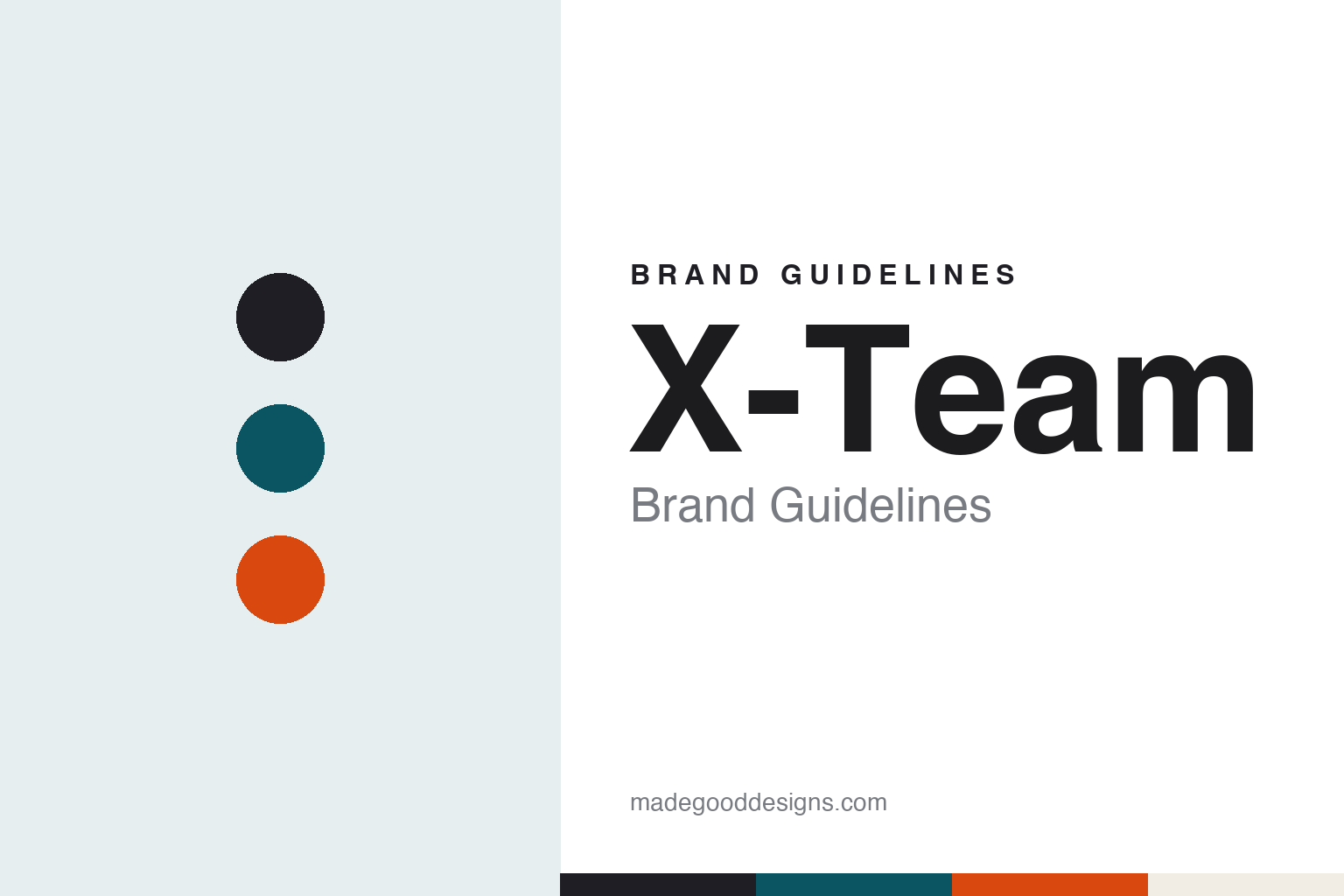
X-Team Brand Guidelines
A remote team that turned its culture into the brand.
Aa
Two constants: a charcoal, deep teal and ember orange palette and a grotesque sans register. Abstract homage — not an X-Team asset; no logo, collectible or screen is reproduced.
X-Team
A remote company from Melbourne.
X-Team is a developer-staffing company that places senior software engineers inside its clients’ teams. Its engineers work remotely, and the company presents itself as a community as much as a supplier. A case study published by Slack says X-Team was founded in Melbourne, Australia, and that its people first worked together over Skype and in-house collaboration apps before moving the whole company onto Slack. In 2026 the company’s homepage points to a “20 Year History.”
The earliest independent account of its structure comes from the WordPress trade site Post Status. On 29 May 2014 it reported that X-Team’s then chief executive had announced on the company blog that X-Team was being split into two separate companies “to remain focused and agile.” X-Team International Pty Ltd would concentrate on developer resourcing, supplying developers to agencies and development shops, while X-Team WP Pty Ltd would concentrate on enterprise WordPress work.
The reason given, Post Status reported, was size. Rather than handle growth by adding structure, management layers and meetings, the company chose to keep each business small enough for everyone to stay in step. In a reply below the article, the company said both businesses were service companies doing very different work, and that its WordPress plugin, Stream, ran as a company of its own. It added that the developer-resourcing model would be the first to gain more clarity.
That developer-resourcing business is the X-Team that trades today. Its website no longer speaks of WordPress as a separate line; it describes a talent network serving companies of every size, from fast-growing start-ups to large enterprises, and it lists more than 100 technologies and programming languages that its engineers work in.
Colour
Four ways to hire, one network.
X-Team’s offer is set out on its “How It Works” page as four engagement models. In staff augmentation, its developers join a client’s existing team and work alongside the in-house engineers. In permanent placement, X-Team finds and presents candidates whom the client then hires directly. Through RPO, or recruitment process outsourcing, it runs sourcing and shortlisting for a client’s engineering roles. In project-based work it brings a complete team to scope and deliver a defined initiative, from front end to back end, DevOps and testing.
The company describes its engineers as senior and “AI-certified,” matched to clients for technical skill, domain expertise and cultural fit, and it publishes figures of its own: a talent retention rate of 98 percent and a Net Promoter Score of 69, both on its homepage. Its newsroom says it reached the AWS Select Tier Services Partner level in September 2026, and that in August 2026 it relaunched X-Academy, its training platform for developers, so that the courses follow live job-posting data.
Its about page names a chief executive, a chief financial officer and a chief client officer, and describes a set of company values: “Keep Moving Forward,” “Communicate Actively,” “Promote Empathy,” “Take Ownership,” “Show Compassion” and “Not Done Yet.” The first of those doubles as the brand’s motto. It appears in capitals above the headline on the homepage, at the foot of magazine articles and in the title of the company’s podcast, and the about page calls it the company’s “heartbeat.”
The company’s website loads the Outfit and Inter type families for its pages. Its homepage groups the technologies its engineers cover into families — front-end and back-end languages, data and machine learning, AI tools, and DevOps and testing — rather than leading with client names.
Typography
Talent networks and how they present themselves.
Tech-talent networks and developer marketplaces sell access to people, so their identities lean on a few recurring ideas: the size of a pool, the reach of a map and the rigour of a test. Andela says its network speaks more than 300 languages and that more than 650 organisations have built with it; Turing’s website counts more than 5 million domain experts. Such figures are the companies’ own, and they move quickly: in December 2021 Turing told TechCrunch it had 1 million engineers and developers, and in March 2025 it said it worked with some 4 million coders.
Vetting usually gets a name of its own. Turing called its platform the “Talent Cloud,” and Andela later launched the Andela Talent Cloud. English Wikipedia describes Andela’s technical, soft-skills and leadership assessments feeding a “match fitness score,” and Andela has bought assessment and practice tools such as Qualified and Codewars, which it presents as a source of behavioural data from millions of developers.
The matching itself tends to be described as a sequence. TechCrunch wrote in 2021 that Turing used AI to source, evaluate, hire, onboard and then manage engineers remotely, and in the same year described Andela as evaluating technical and soft skills before matching engineers with the teams they fitted most closely.
Corporate pages put founders, investors and milestones up front. Andela’s about page runs a dated timeline of funding rounds, cohorts and acquisitions, illustrated with photographs of its own events, and introduces its leadership team; Turing’s company page lists its two co-founders by title. This guide sets out what can be checked about each company, separating dated reporting from what the company says about itself.
Aa
A sturdy grotesque for a motto-led brand. (Specimen set in Archivo, a sans STAND-IN; NOT the X-Team logo.)
X-Team
Seasons, coins and outposts.
What sets X-Team’s brand apart is how much of it is built for its own developers rather than for clients. A magazine article on the company’s site, dated 20 February 2020, explains its Seasons: themed periods of several months, each with community events, “bounties” that X-Teamers complete in exchange for Vault coins, and collectibles they can spend those coins on. The article says the company does not believe in ordinary company swag and instead releases designed collectibles at intervals; it names events such as GameCon, STARCON and the X-Summit, and says taking part is always optional.
The Slack case study describes the same system from the outside. It says X-Team’s community is divided into “Houses,” whose members show their House’s sigil in their Slack status, and that the company built games inside Slack, including The Arena, a battle-royale contest between players called “hunters.” Coins earned through challenges such as exploring a new hiking trail can be spent on collectibles, including X-Team’s own apparel line, or donated to charities, the case study says. X-Team’s about page adds “Hero Drops,” volunteering projects that form part of its annual X-Mas celebration.
The company also brings remote workers together in person. A magazine article dated 9 August 2019 describes the X-Outpost of July 2019 in Argentina, where X-Teamers met in El Calafate, worked together on weekdays and explored Patagonia at weekends. The article presents meeting colleagues face to face, rather than over Slack, as one of the main reasons people join an outpost.
The result is a brand with its own vocabulary — X-Teamers, Seasons, Houses, Vault coins, outposts — layered over a plain corporate offer. The client-facing pages talk about retention, engagement models and senior engineers; the community pages talk about quests, lore and collectibles. Both share the same short motto.
For a design guide, X-Team shows how a remote company can use a motto, a recurring calendar of themed seasons and physical collectibles to give a dispersed workforce a shared identity. Compare Toptal, another vetted remote talent network, and Andela. For this guide we use charcoal, deep teal and ember orange with a sans, an unofficial interpretation; no product or logo is reproduced.
Explore & save
Keep X-Team’s identity on hand — save it to a board in the Made Good inspiration library.
X-Team identity set
Pin the X-Team charcoal, deep teal and ember orange palette and the grotesque sans register to your own board.