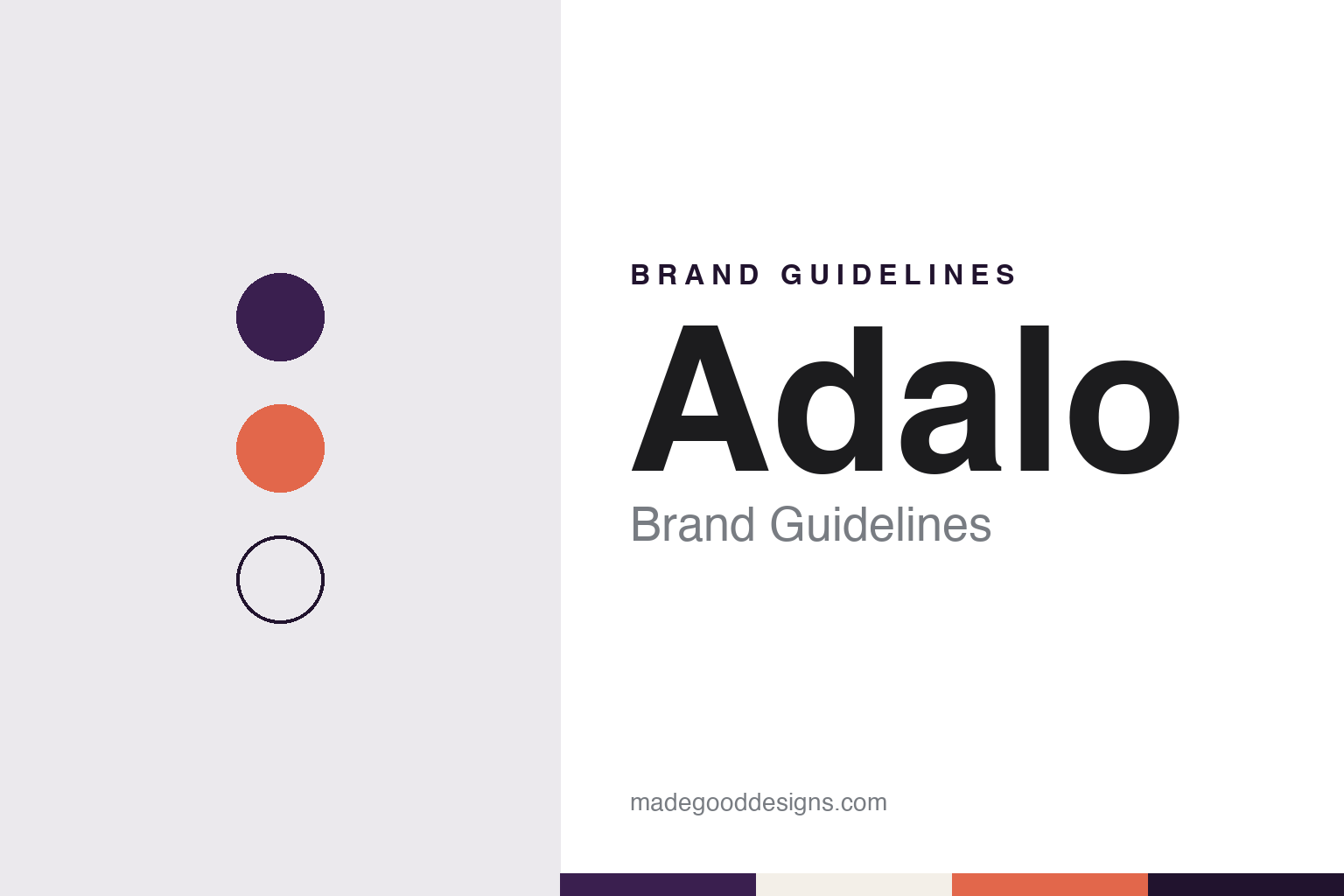
Adalo Brand Guidelines
A St. Louis app builder that moved from drag and drop to describing an app.
Aa
Two constants: a deep plum, coral and oat palette and a rounded geometric sans register. Abstract homage — not an Adalo product or mark; no screen, logo or interface is reproduced.
St. Louis, 2018
An architect’s view of design as the skill of the century.
Adalo is a no-code app builder based in St. Louis, Missouri. Crunchbase News, reporting in May 2021, gave its founding year as 2018, described it as St. Louis-based and named David Adkin as its co-founder and chief executive. The company launched its platform in late 2019, the same report said, and Adalo’s own blog in October 2026 described its visual editor as having been “our pride since 2019.”
Adkin came to software from architecture. Arch Grants, the St. Louis startup-competition organisation that lists Adalo among its companies, says that while finishing a master’s degree in architecture he formed the belief that design is the most important skill of the 21st century, then left the field to join a St. Louis tech startup, where he worked across user experience, product, marketing and branding. The same profile describes Adalo as a platform that makes building apps “as easy as putting together a slide deck,” and names entrepreneurs, small businesses, digital marketing agencies and freelance designers as its users.
The thinking behind the company is set out on its “Inside Adalo” page. Adalo says it started because “technology should be a lever for everyone, not a gate that keeps most people out,” and gives its mission as tools that let anyone, “regardless of technical background,” design, build and launch real apps for iOS, Android and the web. The page lists five principles, Community, Trust, Inclusion, Growth and Action, each with a short motto such as “Never stop learning” for Growth and “Always solve the problem” for Action. In the 2021 report Adkin compared the moment with the website boom of a decade earlier: “What happened with websites 10 years ago is happening with applications and software now.”
Colour
Screens, a database and the app stores.
Adalo’s product is a visual builder for multi-screen apps that publish to the Apple App Store, Google Play and the web. Its website in November 2026 describes native iOS and Android builds “signed and submitted for you,” with most updates shipped over the air, and lists built-in connections to Stripe payments, Google Maps, Firebase notifications and Google and Apple sign-in, plus custom actions for other services. A branding panel lets a maker set colours and fonts once so that every component and screen changes together; the company says this makes an app look “like a product, not a prototype.”
Sample apps carry much of the presentation. The homepage shows template apps that a visitor can open on a phone by scanning a code, among them a property marketplace, a café ordering app, a barber booking app and a bill-splitting app, grouped as marketplaces, booking apps, small business tools and social apps. Each is shown as a finished product with its own name and short description rather than as a wireframe. The homepage headline, “Your Next App Starts With One Sentence,” puts a text box for describing an app above everything else, and for makers who would rather not build at all the company offers a done-for-you service it calls Adalo Blue. The site itself is offered in English, Spanish, French, Portuguese, Japanese and Russian.
The customer base has changed over time. In 2021 Adkin told Crunchbase News that Adalo had begun by selling to smaller businesses but that larger companies with their own software teams were using it too, usually for internal or external communication apps that replace documents and email. The same report said the platform then had more than 1,000 paying customers, more than 220,000 users and a staff of 20. By October 2026 the company’s blog put its own figures at close to 3 million apps published for 2 million people.
Typography
How app builders present themselves.
No-code and low-code app builders sell a promise that is easy to state and harder to show: that a working app can be made without writing code, or while writing very little of it. Their websites tend to make the promise visible. Homepages often lead with the editor itself, shown as screens being assembled from ready-made components such as lists, buttons, forms and maps, with a properties panel beside them for colour, type and spacing.
Template and showcase apps do much of the persuading. Builders publish galleries of sample apps sorted by use, such as marketplaces, booking tools, internal dashboards or community apps, and some let visitors open a sample on a phone or copy it into a new project. Customer stories and lists of apps made on the platform play the part that a portfolio plays for a design studio.
Plan and feature naming follows a familiar pattern. Tiers usually climb from a free starter level to team and enterprise levels, and features are named for what they unlock: publishing to the app stores, custom domains, code export, user seats or workflow runs. In recent years several builders have added AI assistants or rebuilt their products around them, and product names now often describe how much of the work the software does, from hands-on visual editing to describing an app in a sentence.
Corporate pages are usually brief. About pages tend to state a mission about widening who can build software, introduce the founders, and name investors or accelerators. Funding rounds, takeovers and, for open-source builders, licence terms are the dated facts that give each company its history, and the guides in this series set them out where a source records them.
Aa
A rounded geometric sans for a friendly builder. (Specimen set in Outfit, a sans STAND-IN; NOT the Adalo logo.)
Adalo
From drag and drop to describing an app.
The company has been funded by venture investors. Crunchbase News reported in May 2021 that Adalo had closed a Series A round led by Tiger Global, with Oceans Ventures and OldSlip Group among the other backers, alongside individual investors from Zapier, GitHub and Makerpad. Zapier’s chief executive, Wade Foster, told the publication that Adalo “gives the power of the 1 percent who can code to the 99 percent who wish they could.” Adalo said then that it planned to grow its team and create an “academy” to guide users through building an app.
The product has since been rebuilt in stages, according to the company. Its October 2026 post “The new Adalo” lists a database overhaul, deep linking from April 2025 and a performance release, Adalo 3.0, in September 2025. The same post explains a larger change: Adalo says a drag-and-drop editor on its own was “no longer enough” as AI tools changed what people expected, and that it chose to rebuild around Ada, an AI builder. Adalo now calls itself an “AI No-Code App Builder”: a user describes an app in a sentence, Ada builds the screens, the database and the logic, and the result can be changed by asking Ada or by editing it visually. Source code is offered as a separate service, the company says.
For a design guide, Adalo shows how a no-code brand can keep one promise, that anyone can build and publish an app, while its tools move from hand-placed components to plain-language prompts. Compare Bubble, another visual app builder, and Thunkable, a mobile app builder. For this guide we use a deep plum, a coral and warm oat tones with a rounded geometric sans, an unofficial interpretation; no product or logo is reproduced.
Explore & save
Keep Adalo’s identity on hand — save it to a board in the Made Good inspiration library.
Adalo identity set
Pin the Adalo deep plum, coral and oat palette and the rounded geometric sans register to your own board.