Appsmith Brand Guidelines
Open-source internal tools, built by developers for developers.
Aa
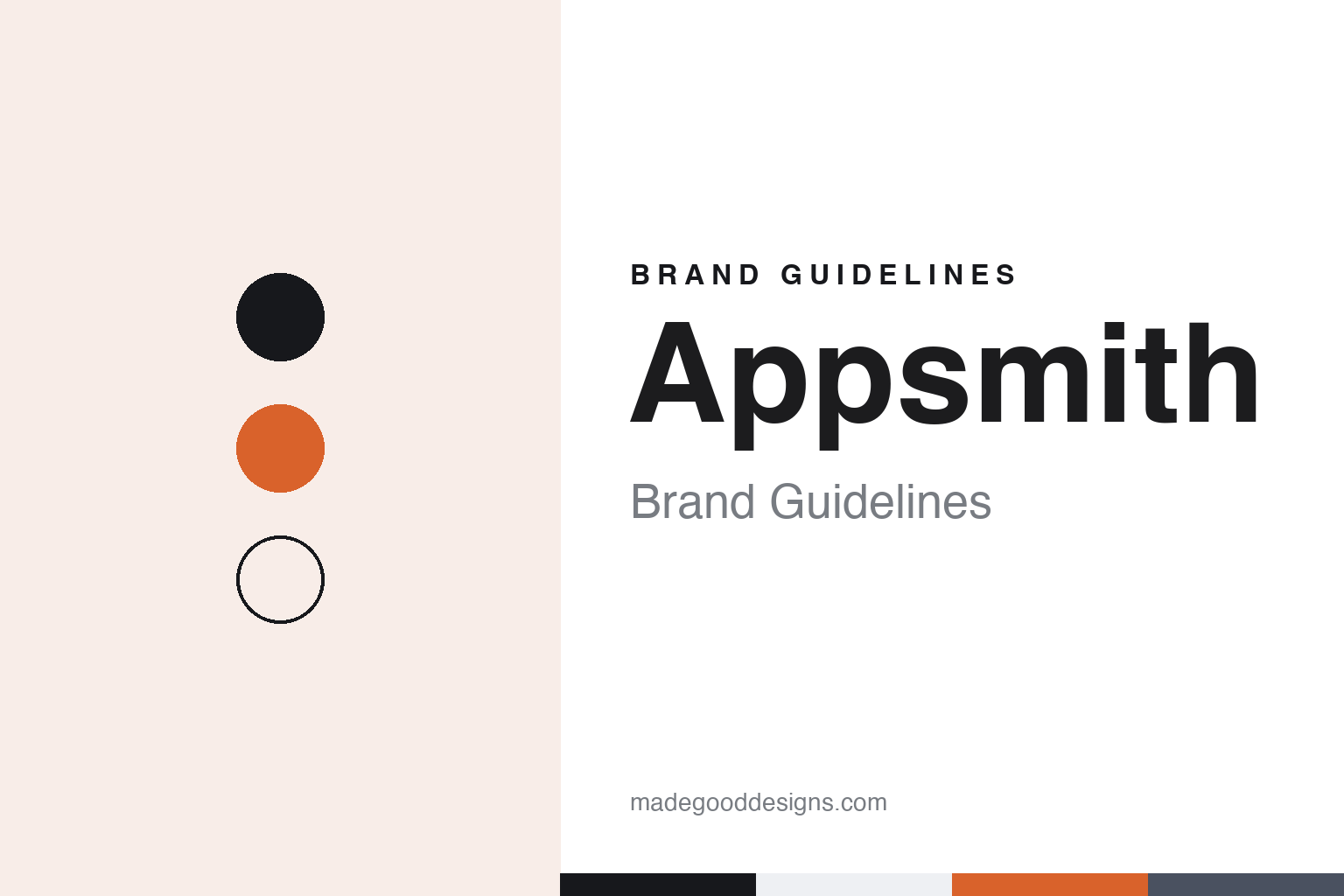
Two constants: an ember orange, ink and slate palette and a geometric sans register. Abstract homage — not an Appsmith product or mark; no screen, logo or interface is reproduced.
Three co-founders
An internal-tools company that chose open source from the start.
Appsmith was founded in 2019 by Abhishek Nayak, Arpit Mohan and Nikhil Nandagopal, the Indian startup publication Inc42 reported in June 2022, describing it as a “US and India-based” company. The company’s own about page tells the same story in a sentence: the three co-founders started Appsmith to help engineers build apps for their teams “while avoiding repetition and monotony.” Nayak is the co-founder and chief executive, according to the company’s careers page and to TechCrunch.
The public code followed within a year. The project’s main repository on GitHub was opened on 30 June 2020, and from the start the company treated open source as the route into its customers’ technology stacks. TechCrunch reported in October 2021 that the founders wanted Appsmith to become part of how companies build software, and that open code was the way to do it: easier to inspect, and less exposed to the fortunes of a single startup. By then, the magazine said, the open-source project had more than 100 external contributors.
That October 2021 article covered a Series A round led by Canaan, with Accel and Bessemer taking part, following an earlier seed round. Nayak told TechCrunch that the company had been in touch with Canaan from its early days, and that rising use of the service and a wish to support more uses, mobile among them, were behind the timing. At that point Appsmith offered a hosted version of its open-source code but no paid product.
In June 2022 SiliconANGLE reported that Appsmith had closed a Series B round led by Insight Partners, joined by Accel, Canaan, OSS Capital and angel investors; it called the company San Francisco-based. Inc42, reporting the same round, put the team at 95 people working across 16 countries.
Colour
Admin panels, dashboards and the code behind them.
Appsmith builds software for a narrow and unglamorous job: the internal applications that companies need but rarely want to build from scratch. The company’s site lists the uses plainly — admin panels, back-office apps, CRUD front ends and dashboards — and the GitHub description says the same: a platform “to build admin panels, internal tools, and dashboards.” SiliconANGLE gave practical examples in 2022: a tool that lets a supply-chain team track stock levels, or one that handles technical support requests.
From the beginning Appsmith has aimed at people who write code. TechCrunch noted in 2021 that, unlike some rivals in the internal-tools market, Appsmith did not lead with a no-code pitch but targeted traditional developers, offering interface components that connect to business data sources and can be combined into calendars, dashboards and other apps. SiliconANGLE described the toolkit in more detail: pre-built connectors for SQL and NoSQL databases and for cloud storage such as Amazon S3; more than 45 ready-made interface elements, including buttons, menus, charts and forms; application templates for supply chain, customer support and marketing; and customisation in JavaScript, with a dedicated code editor offering debugging and autocomplete, and links to continuous-delivery pipelines.
The company’s current homepage keeps that developer framing while adding newer language. It describes drag-and-drop widgets for assembling responsive interfaces, custom widgets written in JavaScript, HTML and CSS or generated from natural-language prompts, version control and merges through Git, connections to databases, SaaS tools, REST and GraphQL APIs and large language models, and self-hosting, so that apps can reach internal data on a company’s own servers.
The code is published under the Apache License 2.0, according to the project’s GitHub repository. In 2022 SiliconANGLE reported that Appsmith said its platform had been downloaded more than 10 million times and was used by more than 10,000 organisations, and that it planned to earn revenue through support services and a commercial edition with extra features not included in the open-source version.
Typography
How app builders present themselves.
No-code and low-code app builders sell a promise that is easy to state and harder to show: that a working app can be made without writing code, or while writing very little of it. Their websites tend to make the promise visible. Homepages often lead with the editor itself, shown as screens being assembled from ready-made components such as lists, buttons, forms and maps, with a properties panel beside them for colour, type and spacing.
Template and showcase apps do much of the persuading. Builders publish galleries of sample apps sorted by use, such as marketplaces, booking tools, internal dashboards or community apps, and some let visitors open a sample on a phone or copy it into a new project. Customer stories and lists of apps made on the platform play the part that a portfolio plays for a design studio.
Plan and feature naming follows a familiar pattern. Tiers usually climb from a free starter level to team and enterprise levels, and features are named for what they unlock: publishing to the app stores, custom domains, code export, user seats or workflow runs. In recent years several builders have added AI assistants or rebuilt their products around them, and product names now often describe how much of the work the software does, from hands-on visual editing to describing an app in a sentence.
Corporate pages are usually brief. About pages tend to state a mission about widening who can build software, introduce the founders, and name investors or accelerators. Funding rounds, takeovers and, for open-source builders, licence terms are the dated facts that give each company its history, and the guides in this series set them out where a source records them.
Aa
A geometric sans for a developer tool. (Specimen set in Plus Jakarta Sans, a sans STAND-IN; NOT the Appsmith logo.)
Appsmith
A brand that leads with its repository.
Appsmith presents itself less through a mascot or a slogan than through its code. The header of its website carries a live count of the project’s GitHub stars — 41,229 in November 2026 — and the same figure appears on the repository itself. Releases arrive steadily: version 2.6.0 was published on GitHub on 28 October 2026. The about page sets out a mission “to delight developers” and says that around 20 million developers worldwide spend billions of hours building admin panels, dashboards and other internal apps; the careers page describes cross-functional “pods,” a Demo Day and a customer-solutions rotation that, the company says, everyone takes part in.
The company’s figures are its own. The about page claims more than 100,000 users in more than 100 countries and a developer community of more than 5,000; those are Appsmith’s numbers, and they sit beside the dated ones that independent reporters gave in 2021 and 2022. What the press record does show is a consistent arc: a 2019 founding by three co-founders, open code from 2020, a Series A led by Canaan in October 2021 and a Series B led by Insight Partners in June 2022, with the same open-source licence throughout.
The register of the brand follows its audience. Pages are written for engineers — connectors, widgets, JavaScript, Git, self-hosting — rather than for business users looking for a drag-and-drop shortcut, and the company keeps describing its open-source edition as the front door. TechCrunch framed that choice in 2021 as a bet that open code is both easier to adopt and easier to trust, and the company still leads with it on its homepage.
For a design guide, Appsmith shows how a developer tool can make its public repository the centre of its identity. Compare Retool, another internal-tools builder, and Budibase, an open-source low-code platform from Belfast. For this guide we use an ember orange, ink and slate with a sans, an unofficial interpretation; no product or logo is reproduced.
Explore & save
Keep Appsmith’s identity on hand — save it to a board in the Made Good inspiration library.
Appsmith identity set
Pin the Appsmith ember orange, ink and slate palette and the geometric sans register to your own board.