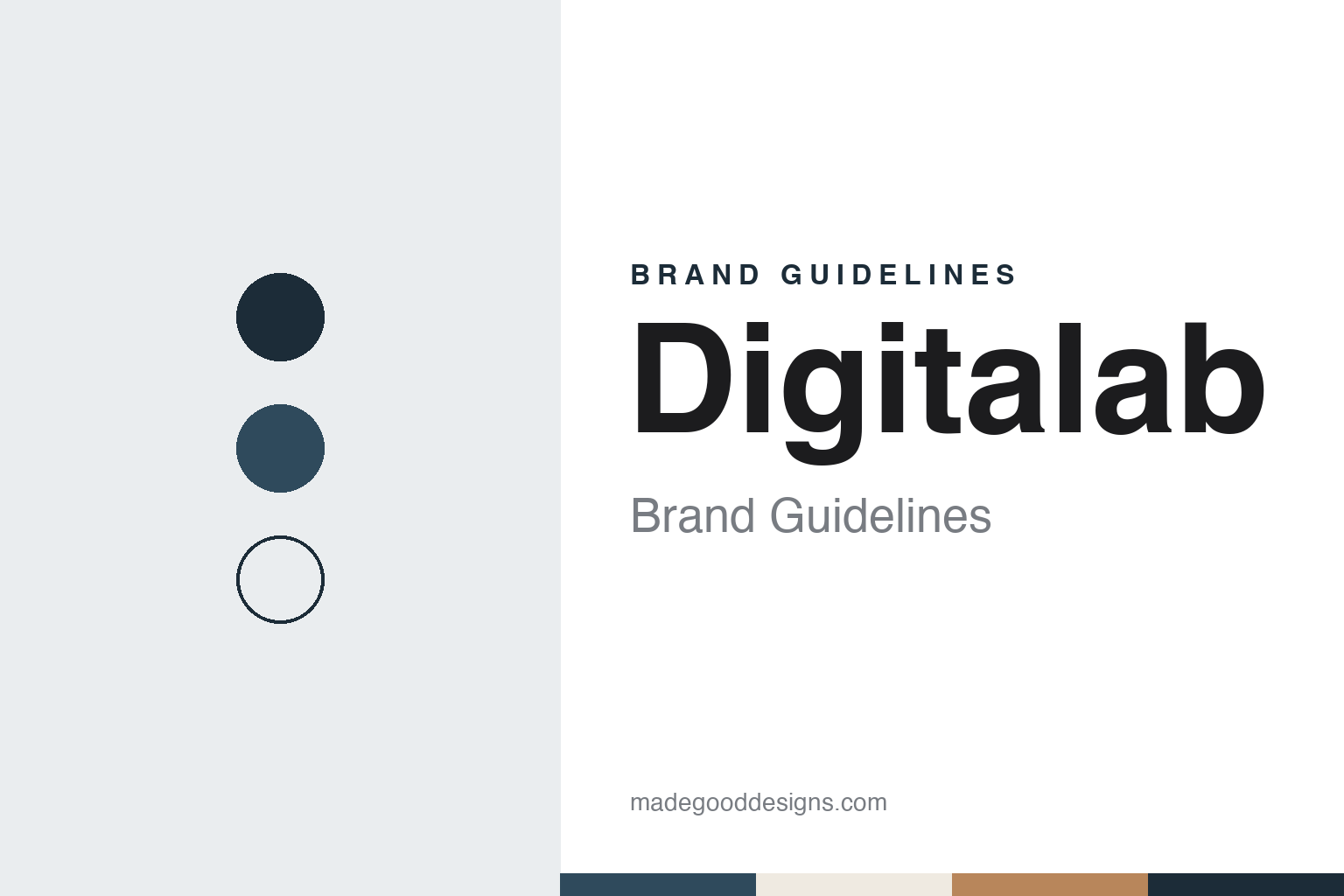
Digitalab Brand Guidelines
A North East pro lab that prints, frames and binds for photographers.
Aa
Two constants: a slate, mount-board and birch palette and a clean workshop sans register. Abstract homage — not a Digitalab product or mark; no print, frame or logo is reproduced.
A family lab in the North East
A trade lab that says it dates from 1949.
Digitalab is a professional photographic lab in the North East of England. It prints, mounts, frames and binds work for photographers, who then sell the finished products to their own clients. The company says it was originally established in 1949 and that it has 75 years of experience in the photographic industry. It also calls itself a third-generation, family-run business. These are the company’s own statements. The trading company that carries the name today is younger: Companies House lists Digitalab Limited as a private limited company incorporated on 11 December 2015, classed under printing not elsewhere classified, and shows it as active in November 2026, with accounts filed up to March 2026.
For most of its recent history the lab was in Newcastle upon Tyne. Companies House records that the company’s registered office moved from Newcastle’s Ouseburn district to North Shields on 1 September 2022. The website still describes some wall-art pieces as made “in our Newcastle workshop” or “in the heart of Newcastle,” and says that every product bearing the Digitalab name is handcrafted by its team in the North East of England. The lab says its prints are produced by skilled printing technicians in its own custom-built lab, and that its hand-made frames are made in the UK.
Digitalab sells to the trade rather than to the general public. Its website talks to photographers about their clients and their margins. It offers discounted samples of wall art, framed prints and albums, product discovery calls, a loyalty reward scheme and a resource kit of marketing templates and sales material. A UK sales manager visits studios with samples. The lab also lists itself as a trade partner of The Xperience Group, which it describes as an independent group of more than 100 professional portrait photographers in the UK and Ireland, and it links to the Instaproofs gallery platform for photographers who sell prints online.
Colour
Two North East labs become one company.
A major change in Digitalab’s recent history came in 2022. On 18 February 2022 Photography News reported that Digitalab and Colorworld, both multi-award-winning professional print labs, had announced their decision to merge. The new business would be called Digitalab Ltd and would draw on a combined trading history of more than 120 years, the magazine said, offering wall art and framing, albums and books, schools photography services and print products. It quoted Jill Roe, managing director of Digitalab, and Mike Brydon, managing director of Colorworld. Both described the merger as a way to widen the two companies’ product ranges, and they said they meant to invest in new equipment and better ordering platforms.
Companies House filings show how the change took effect. A holding company, Digitalab Holdings Ltd, was incorporated on 26 January 2022, and from 1 April 2022 it is listed as holding 75 per cent or more of the shares in Digitalab Limited. Colorworld Limited, a company incorporated in August 1967, has the same North Shields registered office, and Digitalab Limited moved its own registered office there in September 2022.
The merger also shows in the product range. Digitalab’s album cover swatches bring together materials from four lines whose names it keeps: Fountain, Colorworld, Wee Album Co and MTA Albums. The albums themselves are described as hand-crafted, with options such as translucent pages, personalised covers and smaller duplicate copies for parents and guests. Presentation products include winged folios in suede, vegan leather or linen covers and print boxes holding slip-mounted prints.
Prints remain the core. The lab lists photographic prints on Fujifilm papers, among them Crystal Archive Maxima, which it calls an ultra-HD paper for high-end prints; Crystal Archive Professional Velvet, a deep-matte paper with no surface shine; and Fujifilm Pearl paper for its metallic prints. Alongside these it offers giclée fine art prints, including deckled-edge versions, matted and mounted prints, panoramic prints and large-format display prints from 20×16 inches upwards. The large-format service can work from digital files or from high-resolution scans of colour negatives, colour transparencies and black-and-white negatives, the company says. A separate schools service covers printing, add-ons and framed school photographs.
Typography
How pro labs present themselves.
Professional photo labs and film-processing labs sit between the photographer and the finished object. Most present themselves chiefly through the print: the paper it is made on, the process that made it and the size it comes in. Lab websites typically sort their catalogues by paper surface — glossy, lustre, matt, pearl or metallic — and separate photographic prints exposed on light-sensitive paper from inkjet or giclée prints made for fine-art work.
Around the print sit albums, photo books, cards and wall pieces. Labs name these ranges plainly, usually by material and construction: lay-flat books, hard and soft covers, mounted prints, framed prints, acrylic, metal and wood. Film labs add a second vocabulary of development and scanning, listing film formats, scan resolutions and turnaround times so that a photographer can compare one service with another before sending a roll.
Ordering is part of the brand. Many labs describe their software in practical terms: a web editor for families, a mobile app for quick prints, and downloadable ordering programs or proofing tools for professionals who send large batches. Service promises — remakes, colour correction, shipping deadlines and guarantees — are usually written as short named policies rather than long explanations.
Corporate pages tend to carry the history. Labs that began as a single printer or a small darkroom often tell that story in their About pages, alongside the names of their owners, the towns where their production sits and any group they now belong to. For a design reader, the category is a study in restraint: the identity frames the customer’s pictures and names the materials, and it rarely competes with the images it prints.
Aa
A clean workshop sans for a trade lab’s catalogue. (Specimen set in Manrope, a sans STAND-IN; NOT the Digitalab logo.)
Digitalab
Spheres, birch blocks and named frames.
Much of Digitalab’s catalogue is wall art, and it gives its products short, memorable names. Round pieces form a Sphere family: birch spheres, acrylic spheres face-mounted on clear acrylic, aluminium dibond spheres and a Chromaluxe sphere printed directly onto a thin aluminium disc. Square Birch Blocks are precision cut in the Newcastle workshop, the company says, and its Ladder Triptychs fix three blocks into a small set of wooden steps. Acrylic prints, aluminium prints and an acrylic octagon complete the hard-surface range, and gallery-wall collections group several pieces for one room.
Frames follow the same naming habit. Ranges carry place and style names such as the Manhattan and Camden tray frames, the Sovereign and the Brooklyn, with desk-frame versions of several wall frames. Window mounts come in twelve colours, from ice white and ivory to dark green and china red, and the lab says it can reproduce a photographer’s signature on a mount. A Fine Art Naturals range pairs etched fine art prints with frames from its Naturals line, and box frames hold the print level with the front of a deep frame.
This is a catalogue written for a professional reseller. Product pages lead with materials, finishes and sizes, and with the idea that a photographer can show samples and sell up from a print to a framed piece. The tone is warm and direct, the lab addresses photographers as partners, and the story of a long-running family business sits beside the product pages rather than in front of them. Customer-facing names, such as Sphere or Birch Block, are simple enough for a photographer to use with their own clients.
For a design guide, Digitalab shows how a trade lab builds a brand on product naming, sample programmes and a long local history rather than on a consumer-facing campaign. Compare Loxley Colour, another British professional lab, and Fujifilm, whose papers Digitalab lists. For this guide we use a slate blue, a deep ink blue, a mount-board cream and a birch tan with a sans, an unofficial interpretation; no product or logo is reproduced.
Explore & save
Keep Digitalab’s identity on hand — save it to a board in the Made Good inspiration library.
Digitalab identity set
Pin the Digitalab slate, mount-board and birch palette and the clean workshop sans register to your own board.