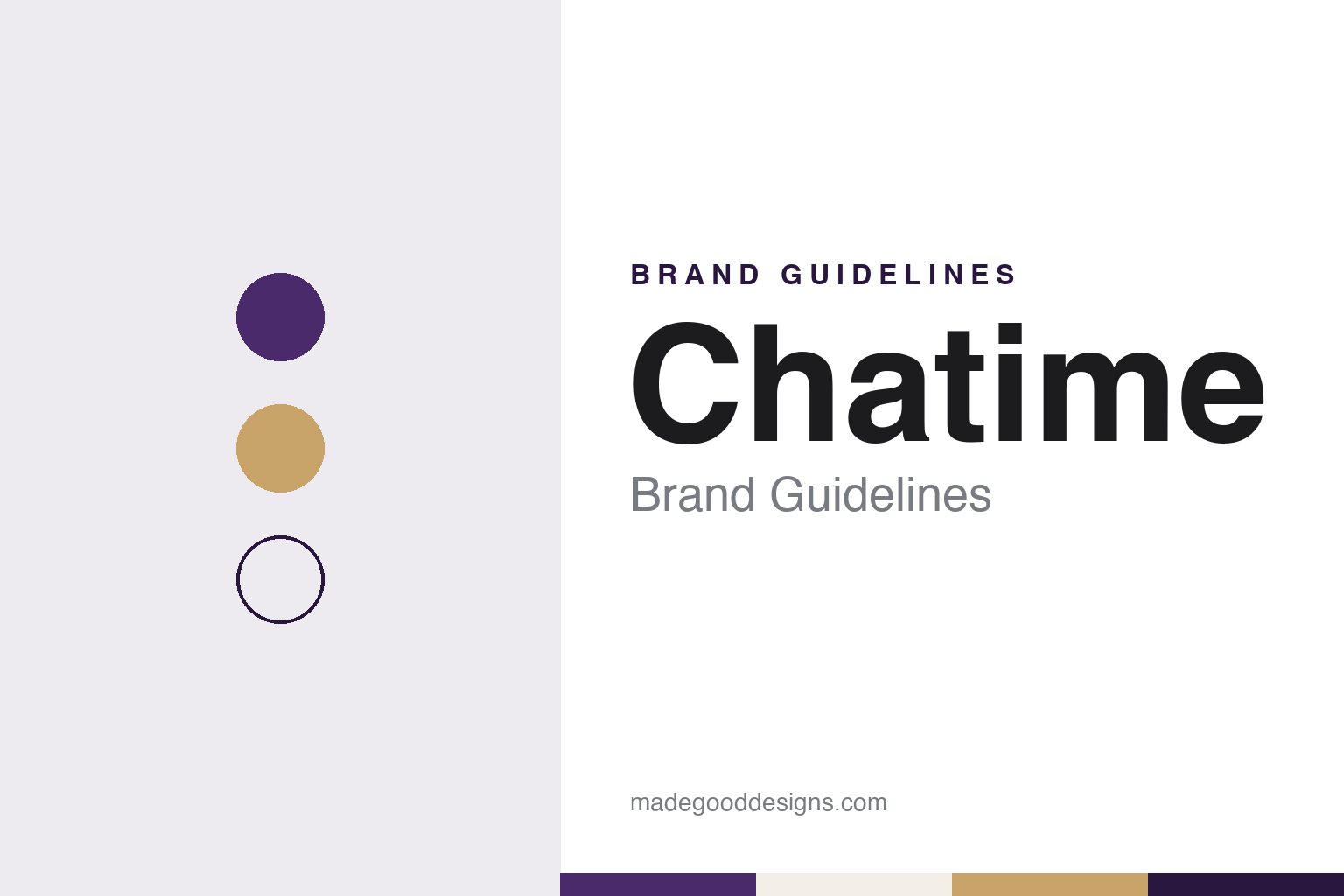
Chatime Brand Guidelines
The Hsinchu tea brand that turned “time for tea” into a franchise.
Aa
Two constants: a purple, cream and brown-sugar palette and a rounded sans register. Abstract homage — not a Chatime product or mark; no cup, logo or store-front is reproduced.
Time for tea
A Hsinchu coffee company that added a tea brand.
Chatime began in Hsinchu, Taiwan, not in the capital. English Wikipedia says Henry Wang founded the brand in 2005 under his company La Kaffa, and Chinese Wikipedia describes it as a hand-shaken drinks brand that started in Hsinchu County. The brand’s US website gives an earlier starting point, describing its “bubbling beginnings in Taiwan in 2003.” In Chinese the brand is called 日出茶太.
The parent company came first. La Kaffa International says on its own website that it was set up in 2004, and Chinese Wikipedia dates its registration to April 2004 in Hsinchu City, where it opened a takeaway coffee business under the La Kaffa name. Chatime followed in 2005, and a dessert brand, ZenQ, in 2007, according to the same Chinese Wikipedia article, which also says the group opened an office in Shanghai in 2008 to develop Chatime in China.
The name is a simple bilingual pun. The US website explains that “Cha” means tea, so Chatime reads as “time for tea”; Chinese Wikipedia gives the same derivation, splitting the word into the Chinese for tea and the English “time.”
La Kaffa is now based in Zhubei, the county seat of Hsinchu County, and Henry Wang remains its chairman. The Taipei Times quoted him in that role in August 2020, when it described the Hsinchu-based group as the owner of the Chatime bubble milk tea brand. English Wikipedia records that La Kaffa’s shares made their debut on Taiwan’s Emerging Stock Market in December 2012, and the company says it moved to a full listing on the Taipei Exchange, the island’s over-the-counter market, in 2015, joining its tourism sector.
Colour
Franchising from Taiwan to six continents.
Chatime grew by franchising rather than by opening its own stores abroad. English Wikipedia says the first store outside Taiwan opened in California in 2006, followed by Australia in 2009 and Malaysia in 2010, and that a store at the Mall of America in Minnesota opened in March 2012. La Kaffa’s website says the group’s brands now trade in more than 60 countries and regions on six continents, and the Chatime Taiwan website links to regional sites from Indonesia, the Philippines and Japan to Canada, the United Kingdom, Sweden and Mauritius.
La Kaffa describes its model in its own strategy pages: it licenses its brands to regional partners and franchisees and supports them with operating guidance, store design and planning, product development, training and marketing, and it says it supplies raw materials and packaging. It also presents itself as a platform that takes Taiwanese brands abroad and brings foreign brands into Taiwan.
The group is more than Chatime. In August 2020 the Taipei Times listed its other chains as Kingza Pork Chop, DCZ Beef Noodles, Osaka Ohsho Taiwan and Kyoto-katsugyu, the last two run in Taiwan under licence. La Kaffa’s brand page adds the Bake Code bakery and the Chun Sun pudding cake shop, and in January 2025 the company announced on its website that the Tainan tea house Hanlin Tea Room had joined the group, which Chinese Wikipedia describes as an acquisition.
The menu is built around milk tea with tapioca “pearls,” fresh tea and fruit tea, with smoothies, juices and coffee alongside, English Wikipedia says; its toppings include “QQ” jelly, a mix of pearls and nata de coco. The US website sorts its drinks into ranges such as Signatures, Milk Tea Classics, Fruity and Cold Brew, and lists drinks including Brown Sugar Boba Milk Tea and Taro Milk Tea. It calls its counter staff “T-Ristas” and says its teas are brewed every four hours.
Drinks are made to order in the stores. La Kaffa says Chatime uses a simplified, standardised preparation process and machines run on fixed single settings, which it calls “tech tea,” so that each cup comes out the same wherever it is made. Some flavours are local: English Wikipedia notes Malaysian drinks made in a collaboration with Horlicks, and records that the airline AirAsia announced in 2012 that it would serve Chatime drinks on some of its flights.
Typography
How tea-drink chains present themselves.
Bubble tea and tea-drink chains sell a drink that is made in front of the customer, so most of their public image is built around the cup. On their own websites, Taiwanese brands such as Chatime and Gong Cha lead with pictures of individual drinks and group them into named ranges and short lists: Gong Cha calls its top five drinks worldwide the “Famous Five,” and Chatime’s US website sorts its menu into ranges such as Signatures, Milk Tea Classics and Fruity.
Drink and staff names do much of the brand work. Chatime’s US website builds its copy on tea puns, calling its counter staff “T-Ristas,” while Gong Cha names drinks by their tea, fruit and toppings, from milk foam to “QQ” jelly. Store fronts and menu boards appear in the companies’ franchise pages and news posts, where a new store design or a first store in a new country is presented as an event.
Ordering apps and online shops are now part of the picture. In 2020 the Taipei Times reported that Chatime’s parent, La Kaffa International, had begun taking orders through an app with a software partner, and in 2026 Nation’s Restaurant News reported that Gong Cha was rolling out a “digital kitchen.” For a designer, these tools are part of the brand as much as the cup or the counter.
Behind the cups are corporate histories that are often more complicated than the store fronts suggest. Many chains grew through franchising, with regional partners running whole countries, and some have changed owners several times. This guide sets out what can be checked about each brand — who founded it, who owns it now, and how it is sold — and marks clearly what rests only on the company’s own word.
Aa
A rounded, friendly sans for a brand built on a pun. (Specimen set in Fredoka, a sans STAND-IN; NOT the Chatime logo.)
Chatime
Cups of Joy, an app and a brand award.
Chatime’s own pages present the brand with a short line and a bigger ambition. The Chatime Taiwan website uses the phrase “Cups of Joy” and describes the aim of taking pearl milk tea from Taiwan to drinkers around the world while developing new local flavours in each market. The US website leans on wordplay, with menu and recruitment copy built on puns such as “possibili-teas,” “communi-tea” and “Royal-tea.”
La Kaffa says Chatime was named Brand of the Year at the World Branding Forum’s World Brand Awards, held at a London hotel in 2015, and Chinese Wikipedia records the same award. English Wikipedia adds that the Taiwanese actress Ariel Lin was announced as the brand’s ambassador in 2012.
Ordering has moved onto phones. In August 2020 the Taipei Times reported that La Kaffa had begun a digital push with the retail software provider 91APP, with Cathay United Bank handling payments, so that customers could order the group’s products through an app for next-day delivery. La Kaffa’s own announcement that month described the plan as “Offline-Merge-Online,” bringing Chatime alongside its noodle and bakery brands in a single online shop. The Taipei Times also reported Henry Wang’s remark that overseas markets were the larger part of the business, and that the company’s drinks were popular in China, Indonesia, the Philippines, Japan and North America.
For a design guide, Chatime shows how a franchise brand can travel on a pun, a cup and a consistent recipe rather than on a single flagship store. Compare Gong Cha, another Taiwanese tea-drink brand that grew abroad through franchising, and CoCo, a Taipei chain. For this guide we use taro purple, cream and brown sugar with a rounded sans, an unofficial interpretation; no product or logo is reproduced.
Explore & save
Keep Chatime’s identity on hand — save it to a board in the Made Good inspiration library.
Chatime identity set
Pin the Chatime taro purple, cream and brown-sugar palette and the rounded sans register to your own board.