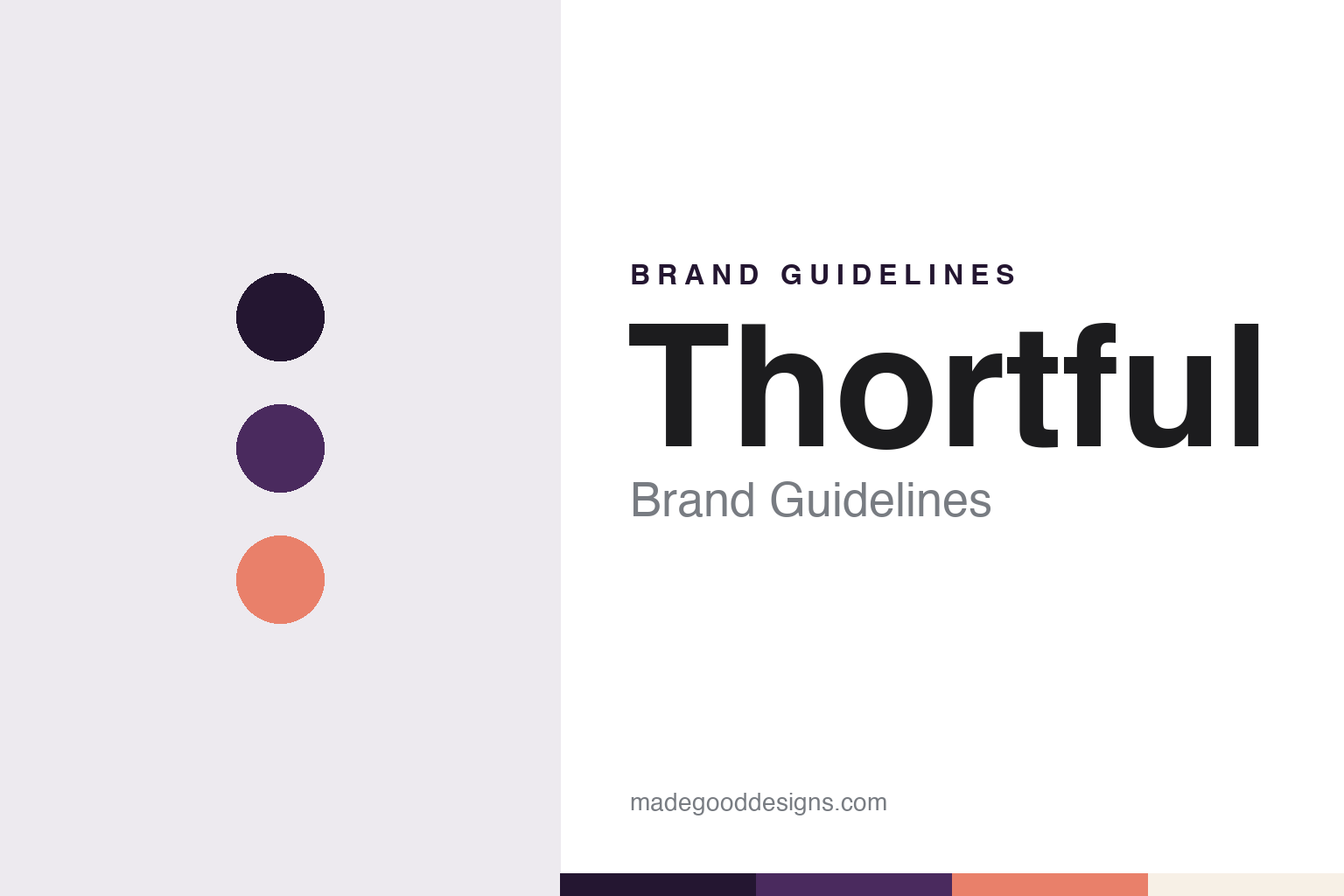
Thortful Brand Guidelines
Andy Pearce’s London card marketplace for independent creators.
Aa
Two constants: a plum, coral and cream palette and a rounded geometric sans register. Abstract homage — not a Thortful product or mark; no card, logo or app screen is reproduced.
A marketplace for card makers
A serial entrepreneur, an app and a call for creators.
Thortful is a London-based online greeting card marketplace; the company writes its own name in lower case, as “thortful”. Companies House lists Thortful Limited as incorporated in April 2015, first under the name Pelson Limited and renamed Thortful that June, with internet retail and artistic creation as its registered activities. The business magazine GrowthBusiness reported in August 2017 that the service had launched to the public in June 2016, after the company spent around two years building its technology.
Its founder is Andy Pearce, who appears in some reports as Andrew Pearce. GrowthBusiness described him as a serial entrepreneur and set out his earlier businesses: a wheelie-bin cleaning company that was franchised across the country, the call-centre company Inkfish, and the conference-calling service Powwownow, which he built over ten years and sold to PGI. Companies House lists Pearce as one of two individuals who each hold more than a quarter of Thortful’s shares.
The idea, Pearce told the magazine, was to give illustrators, graphic artists and photographers a new way to sell their designs and to be recognised for them. He contrasted high-street card companies, which he said order designs six to twelve months ahead, with an online catalogue that can respond to events and trends quickly, and said that Thortful works with its creators to bring their designs closer to what customers buy.
On Boxing Day 2017 Pearce pitched the business on the BBC programme Dragons’ Den. Startups.co.uk reported in January 2018 that he presented Thortful as a mobile app through which people upload original card designs and earn a royalty on each copy sold; the programme described the business as twelve months old, with 65,000 customers. Pearce agreed terms on air with two of the Dragons, Tej Lalvani and Jenny Campbell, after the other three declined to invest.
The questions in the Den were about the category as much as the company. Startups.co.uk reported that Jenny Campbell asked whether social media would reduce demand for physical cards and that Peter Jones questioned what set the brand apart; the site said Pearce answered both points well. Most of the Dragons who declined, it added, were put off by the small share of the company on offer and by the likelihood that their stakes would later be diluted.
Colour
Creators first, cheeky cards and same-day post.
Thortful’s product is a catalogue of other people’s work. In 2017 GrowthBusiness reported that around 1,500 creatives sold through the platform, which held more than 40,000 designs and had served more than 125,000 customers; about 12,000 designs were catalogued for featured designers, so that the site worked like a storefront for their work. Pearce said then that around 70 per cent of the creators on the platform were exclusive to Thortful.
The range followed what customers bought. Pearce told the magazine that the company had expected more artistic work to sell, but that the most popular cards were cheeky, funny designs that tease the recipient, and that relatability mattered more than polish. He also said that most sales came from people buying several cards for themselves to use later, rather than sending a single card straight to a friend.
In 2017 Pearce said the company outsourced its printing, and that the run-up to Father’s Day had been its busiest period, with more than 10,000 cards ordered a day. He said Thortful had also started to look at what else it could make from its designs, such as keepsake cards, notebooks with printed messages and gift boxes that combine a card with a present.
The app shows how the service presents itself today. Its App Store listing in the UK offers original designs “from independent creatives all over the globe” and says that 70 per cent of its cards are not found anywhere else. Buyers can send a card straight to the recipient or to themselves to post later; the company says cards ordered before 5pm on weekdays are sent the same day by Royal Mail First Class. Messages can carry emojis or the buyer’s own handwriting, and a card can be swapped for one of its “Card Gifts”, which add items such as chocolates, socks or a cake mix, or be paired with flowers.
Typography
How card brands present themselves.
Greeting card brands sell something small and personal, and the way they present themselves follows from that. Card shops lean on the card wall: rows of designs grouped by occasion, from birthdays and anniversaries to weddings and Christmas, with signage that sets the tone before a shopper reaches the shelves. When The Guardian compared two British card chains on the same London afternoon in January 2012, it judged them on range, pricing, staff and the feel of the shop as much as on the cards themselves.
Online card services present the same product through photographs and screens. Each card appears as the company chooses to photograph it, and the design often matters more than the brand around it. Some services credit the illustrators and photographers behind their cards, and a marketplace such as Thortful builds its whole offer around independent creators, presenting the range by maker as well as by occasion.
Personalisation is the shared interface. Websites, apps and in-store kiosks let buyers add names, photos and messages, choose whether a card goes straight to the recipient or to themselves, and see a posting cut-off for same-day dispatch. Several companies describe these steps plainly on their own sites and app listings, together with how and where cards are printed, which paper they use and whether cards are sold wrapped.
Behind the shop fronts sit corporate pages and public records. Company registers show who owns a card business, when it was incorporated and what it was once called, and they can tell a quieter story than the brand voice: a cheeky high-street name may be a founder-held family company, and a young app may sit on a company formed a year before its public launch. This guide sets out what can be checked about each brand and marks what rests on the company’s own word.
Aa
A friendly, rounded sans in the lower-case spirit of the name. (Specimen set in DM Sans, a sans STAND-IN; NOT the Thortful logo.)
Thortful
A brand that puts the card maker in front.
For designers, Thortful is interesting because its brand has to sit around thousands of designs that it did not draw. The lower-case name, the promise of cards found nowhere else and the language of “creators” all point attention to the people behind each card rather than to a house style. Pearce described that choice to GrowthBusiness in 2017 as putting creators first, in contrast with online services such as Moonpig, which he said were almost always about personalisation.
The service also depends on plain interface promises: a same-day posting cut-off, a choice between sending to the recipient or to yourself, and a handwritten-message option that brings the buyer’s own hand onto a printed card. Those details, rather than a single illustration style, are the constants a customer meets on every order.
For a design guide, Thortful shows how a marketplace can build a brand by framing other people’s work, with a light, lower-case voice and clear ordering rules. Compare Moonpig, the online card company Pearce named in 2017, and Funky Pigeon, another British online card service. For this guide we use plum, coral and cream with a rounded sans, an unofficial interpretation; no product or logo is reproduced.
Explore & save
Keep Thortful’s identity on hand — save it to a board in the Made Good inspiration library.
Thortful identity set
Pin the Thortful plum, coral and cream palette and the rounded geometric sans register to your own board.