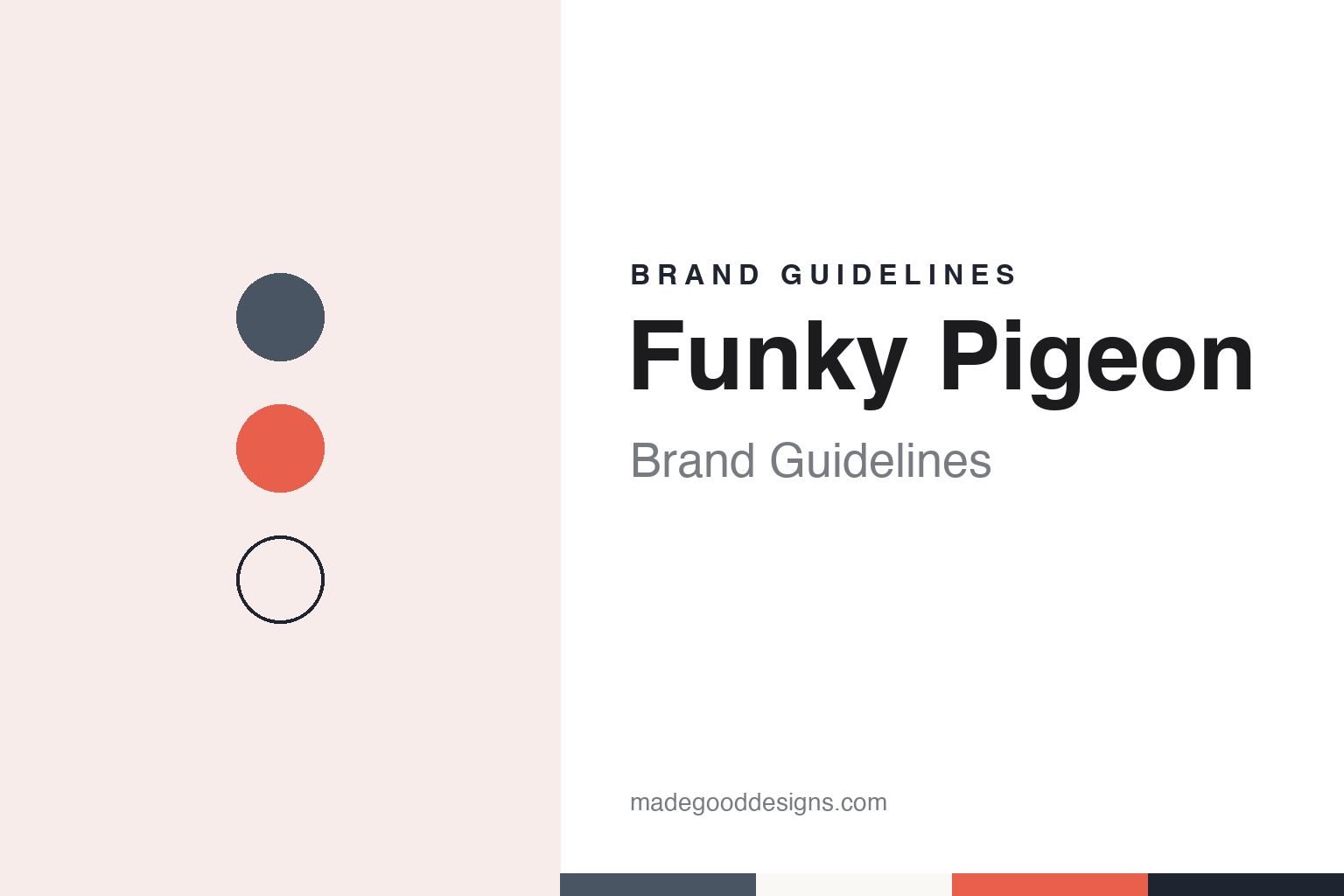
Funky Pigeon Brand Guidelines
A Bristol card website, fifteen years inside WHSmith and a new home at Card Factory.
Aa
Two constants: a slate, coral and card-white palette and a rounded sans register. Abstract homage — not a Funky Pigeon product or mark; no card, logo or illustration is reproduced.
A card website
Bristol, Guernsey and a personalised card.
Funky Pigeon is a British online card shop built around personalisation. It trades through the funkypigeon.com website, and Retail Gazette described it in July 2025 as a business specialising in personalised cards and attached gifting services. The same report placed it in Bristol and Guernsey, and City AM called it, that month, a Bristol- and Guernsey-based “novelty greeting cards line.”
By the standards of the card trade the business is young. TheBusinessDesk reported in September 2026 that Funky Pigeon was founded in 2009 by the Bristol entrepreneur Richard Pepper, and that it was bought just a year later by the Swindon-based retail group WH Smith. English Wikipedia also places that purchase in 2010, the same year WHSmith bought The Gadget Shop, and the legal news site Non-Billable reported in August 2025 that the law firm TLT, which acted for WHSmith when it later sold the business, had also acted on the original acquisition in 2010.
Funky Pigeon then stayed with WHSmith for some fifteen years. WHSmith at the time ran both high street shops and travel outlets in railway stations, airports and motorway services, according to English Wikipedia, and Funky Pigeon sat alongside them as the group’s online card and gift business, trading under its own name rather than the WHSmith one.
When the business changed hands in 2025, the trade press still reported it under its own name and web address: Greetings Today wrote that Card Factory had bought “the WHSmith-owned site,” and Card Factory’s own statements continued to use the Funky Pigeon name.
Colour
Personalised cards, sent direct.
The idea at the centre of the brand is the personalised card ordered online. When Card Factory agreed to buy the business in 2025 it described the market it was entering as “direct-to-recipient” card and gifting: cards and presents ordered on a website and sent straight to the person they are meant for, rather than bought in a shop and posted by the customer. Funky Pigeon’s gifts are sold to go with the cards, which is what the trade press means by “attached gifting.”
That kind of personalised online card became a field of its own in Britain. English Wikipedia notes that when Card Factory relaunched its own website in August 2020 so that customers could personalise their cards, the change matched what was already offered by Moonpig and Funky Pigeon; the comparison shows where Funky Pigeon stood in that market several years before its sale.
The work behind each order happened offshore as well as in Bristol. Retail Systems reported in July 2025 that Funky Pigeon’s order fulfilment was carried out in Guernsey, one of the Channel Islands, while the business itself was described as operating from both Bristol and Guernsey.
The business has also had to deal with the risks of running entirely online. In April 2022, Infosecurity Magazine reported that Funky Pigeon, then owned by WHSmith, had suffered a cyber-attack and had taken its systems offline as a precaution, temporarily suspending new orders on its website. The company said it had informed regulators and law enforcement, that it did not believe payment data was at risk, and that it was investigating, with outside experts, whether names, addresses, email addresses and personalised card and gift designs had been accessed. It said it would write to customers from the previous twelve months.
Typography
Cards, shops and screens.
Greeting card brands sell something small and personal, and the way they present themselves follows from that. Card shops lean on the card wall: rows of designs grouped by occasion, from birthdays and anniversaries to weddings and Christmas, with signage that sets the tone before a shopper reaches the shelves. When The Guardian compared two British card chains on the same London afternoon in January 2012, it judged them on range, pricing, staff and the feel of the shop as much as on the cards themselves.
Online card services present the same product through photographs and screens. Each card appears as the company chooses to photograph it, and the design often matters more than the brand around it. Some services credit the illustrators and photographers behind their cards, and a marketplace such as Thortful builds its whole offer around independent creators, presenting the range by maker as well as by occasion.
Personalisation is the shared interface. Websites, apps and in-store kiosks let buyers add names, photos and messages, choose whether a card goes straight to the recipient or to themselves, and see a posting cut-off for same-day dispatch. Several companies describe these steps plainly on their own sites and app listings, together with how and where cards are printed, which paper they use and whether cards are sold wrapped.
Behind the shop fronts sit corporate pages and public records. Company registers show who owns a card business, when it was incorporated and what it was once called, and they can tell a quieter story than the brand voice: a cheeky high-street name may be a founder-held family company, and a young app may sit on a company formed a year before its public launch. This guide sets out what can be checked about each brand and marks what rests on the company’s own word.
Aa
A friendly rounded sans for a card website. (Specimen set in Nunito, a sans STAND-IN; NOT the Funky Pigeon logo.)
Funky Pigeon
From WHSmith to Card Factory.
The change of owner came out of WHSmith’s decision to concentrate on travel retail. In 2025 the group sold its high street shops to the private equity firm Modella Capital, which rebranded them as TG Jones, City AM reported in July 2025. On 29 July 2025, Card Factory agreed to buy Funky Pigeon from WHSmith, subject to regulatory approval, Retail Gazette reported, and WHSmith described itself as a “pure play global travel retailer.”
The sale was completed in August 2025. Retail Gazette reported on 15 August that WHSmith had completed the disposal, which it said “now completes the move to becoming a pure play global travel retailer.” Non-Billable reported the same day that the deal made Card Factory the UK’s second-largest online card and gifting retailer, and TheBusinessDesk repeated that description in September 2026.
Card Factory, the Wakefield card chain that English Wikipedia says opened its first shop in 1997, and which ran more than 1,000 shops according to Retail Systems, set out its plans when the deal was announced. It said it expected Funky Pigeon’s platform to become the core digital offering for its UK and Ireland business over time, Retail Gazette reported, and Retail Systems reported that it planned to bring Funky Pigeon’s order fulfilment in Guernsey together with its own facilities at Baildon, in West Yorkshire. Its chief executive, Darcy Willson-Rymer, praised Funky Pigeon’s “high-quality technology platform and digital expertise” on completion. A year on, TheBusinessDesk reported in September 2026 that the acquisition had helped Card Factory increase its revenue.
For a design guide, Funky Pigeon shows how an online card brand can keep its own name through two owners while its technology becomes the base for a larger retailer’s website. Compare Card Factory, its owner since 2025, and Moonpig, another British personalised card website. For this guide we use slate, coral and card white with a rounded sans, an unofficial interpretation; no product or logo is reproduced.
Explore & save
Keep Funky Pigeon’s identity on hand — save it to a board in the Made Good inspiration library.
Funky Pigeon identity set
Pin the Funky Pigeon slate, coral and card-white palette and the rounded sans register to your own board.