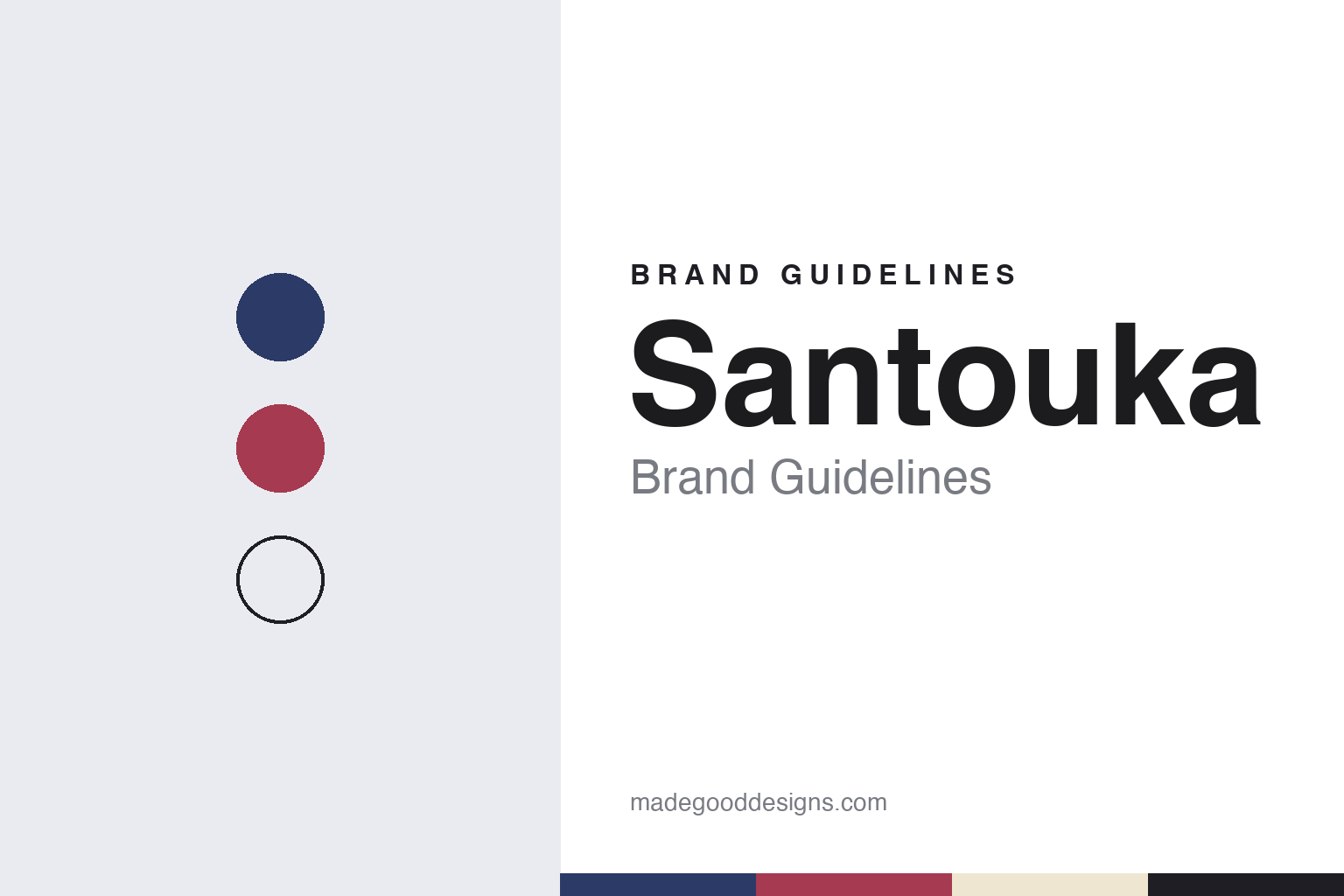
Santouka Brand Guidelines
The Asahikawa shio ramen served in an indigo bowl.
Aa
Two constants: an indigo, plum and broth-cream palette and a Mincho serif register. Abstract homage — not a Santouka product or mark; no bowl, logo or shop front is reproduced.
Nine seats in Asahikawa
A ramen shop opened on a date that spells its name.
Santouka began with a single bowl in Asahikawa, in Hokkaido. The company says its founder, Hitoshi Hatanaka, was let down by the ramen his family ate at a shop after watching Tampopo, the film set around a ramen shop, and told them he would make a better bowl himself. Boston University’s independent student newspaper, The Daily Free Press, quoted Hatanaka in September 2022 dating that start to mid-November 1987.
The first shop opened on 10 March 1988, with nine seats and one dish, shio ramen, according to the company’s history. The date was tied to the name. Hatanaka told The Daily Free Press that “san” means three and “tou” means ten, so the shop had to open on 10 March even if it was not ready. The company says the first weeks were quiet, and that friends were asked to fill the seats, until television and magazines began featuring “the ramen shop with the strange name that is always full,” helped, it says, by a wave of interest at the time in the haiku poet Taneda Santōka, whose name is written with the same characters.
The business that followed is a franchise system. The company’s timeline says it set up a company called April Foods in 1995 to develop franchising in earnest, then set up ab-out in Sapporo in 1999 and converted it to a joint-stock company in 2001. Ab-out runs Santouka restaurants in Japan and abroad, directly and through franchise partners, and its website names Hatanaka as chairman. It also runs two newer names, the Sapporo-style miso ramen shop Ezo Fukurou and the tsukemen shop Menya Takejiro, alongside ramen events in department stores and products developed with other companies under the Santouka name.
Colour
An indigo bowl and a small pickled plum.
Santouka’s signature is easy to describe, because the company describes it closely. Its shio ramen is a cloudy pork-bone broth, a tonkotsu paitan, with thin noodles, soft chashu and a single small pickled plum on top. The menu says the bowl was conceived with the image of a slender, fair-skinned woman wearing a touch of rouge, and it sets the shio ramen beside shoyu, miso and spicy miso versions on the same pork-bone base.
The bowl itself is part of the identity. The company says its bowls have been made to order since the start: compact but heavy, with thick walls so the broth keeps its heat, and without the outward flare of a typical ramen bowl. It calls their indigo colour a symbol of Santouka. It also says the broth is simmered for a long time and not brought back to the boil, to keep its aroma, and that the soup is made from scratch in every shop, in Japan and abroad; those are its own descriptions.
The other signature is toro-niku, chashu made from pork cheek. The company’s history says it was created in the early years for hungry students, and its menu offers it as a special toro-niku ramen in which the meat arrives on a separate plate to be added to the bowl. Rice topped with green onion, bonito flakes and nori, a soft-boiled egg and pan-fried dumplings make up the side menu.
Abroad, the same names travel. In May 2020 Rappler reported that Santouka in Manila was selling cook-at-home kits for three of its ramen — the Shio, the spicy pork-broth Karamiso and the soy-based Awaseaji — from its Glorietta 4 branch in Makati.
Typography
Ramen chains and their shops.
Ramen chains often present themselves through the room before the bowl. Ichiran, the Fukuoka chain, seats diners in what Brooklyn Magazine described in October 2016 as “flavor concentration booths”: single stools walled on three sides, with each bowl passed through a rolled bamboo blind. Other chains publish photographs of wooden counters, open kitchens and shop fronts hung with noren, the short split curtains that hang across a doorway.
Menus are usually named plainly. Many chains build their offer around one broth and say so: tonkotsu, the pork-bone broth associated with Hakata in Fukuoka, or the shio, shoyu and miso styles. Bowls often carry short house names; Ippudo, for example, names its two main tonkotsu bowls after white and red circles. Order forms or ticket machines may let diners choose the firmness of the noodles, the richness of the soup and the amount of garlic or chilli sauce, as Ichiran’s paper form does.
The corporate side is published separately. Company pages list founding years, founders and head offices. Some chains are private firms run from their home city; others sit inside listed holding companies that also run udon, soba or other restaurant brands. Overseas branches can be run by the company itself or by local partners, and shop counts change, so the figures in this guide are given with their date and source.
Packaging has become a second shop front. Chains sell boxed noodles, sauces and cup noodles under their own names, some made for them by instant-noodle manufacturers, and those products carry the restaurant names and colours onto shop shelves far from the restaurants.
Aa
A Mincho serif for a name written in Japanese characters. (Specimen set in Shippori Mincho, a serif STAND-IN; NOT the Santouka logo.)
From Asahikawa to Allston
A nine-seat shop that crossed the Pacific.
Santouka’s overseas list is long for a chain that began with nine seats. In November 2026 the company’s overseas shop page listed restaurants in the United States, Canada, Hong Kong, Taiwan, Malaysia, the Philippines and Thailand. In the United States many sit inside Mitsuwa Marketplace food courts in California, Illinois and New Jersey; others are standalone shops around Boston and Seattle, in Hawaii and in Virginia, and one is in the Tom Bradley international terminal at Los Angeles International Airport. Canada has shops in the Vancouver and Toronto areas.
The Daily Free Press reported in September 2022, as Santouka prepared to open in Allston near Boston University, that the chain had about 55 locations across nine countries. It quoted Hatanaka as having opened 13 restaurants in Japan and 40 abroad, said the Harvard Square shop had opened in 2015, and reported that Hatanaka flew in from Japan for a celebration of the new shop that month.
The name changes slightly as it travels. The Japanese site trades as Ramen Santouka, while overseas reports in Rappler and The Daily Free Press use the longer Hokkaido Ramen Santouka, which also appears on the company’s own pages and ties the brand to the island where it started. The company’s Japanese story page says it wants to bring Santouka to people abroad as well as at home, with soup made from scratch in every shop.
For a design guide, Santouka shows how one object — a flat-rimmed indigo bowl with a single plum — can carry a brand from a nine-seat counter to shopping centres across Asia and North America. Compare Ichiran and Afuri, two more Japanese ramen chains in this series. For this guide we use indigo, a pickled-plum red and a pale broth cream with a serif, an unofficial interpretation; no product or logo is reproduced.
Explore & save
Keep Santouka’s identity on hand — save it to a board in the Made Good inspiration library.
Santouka identity set
Pin the Santouka indigo, pickled plum and broth cream palette and the Mincho serif register to your own board.