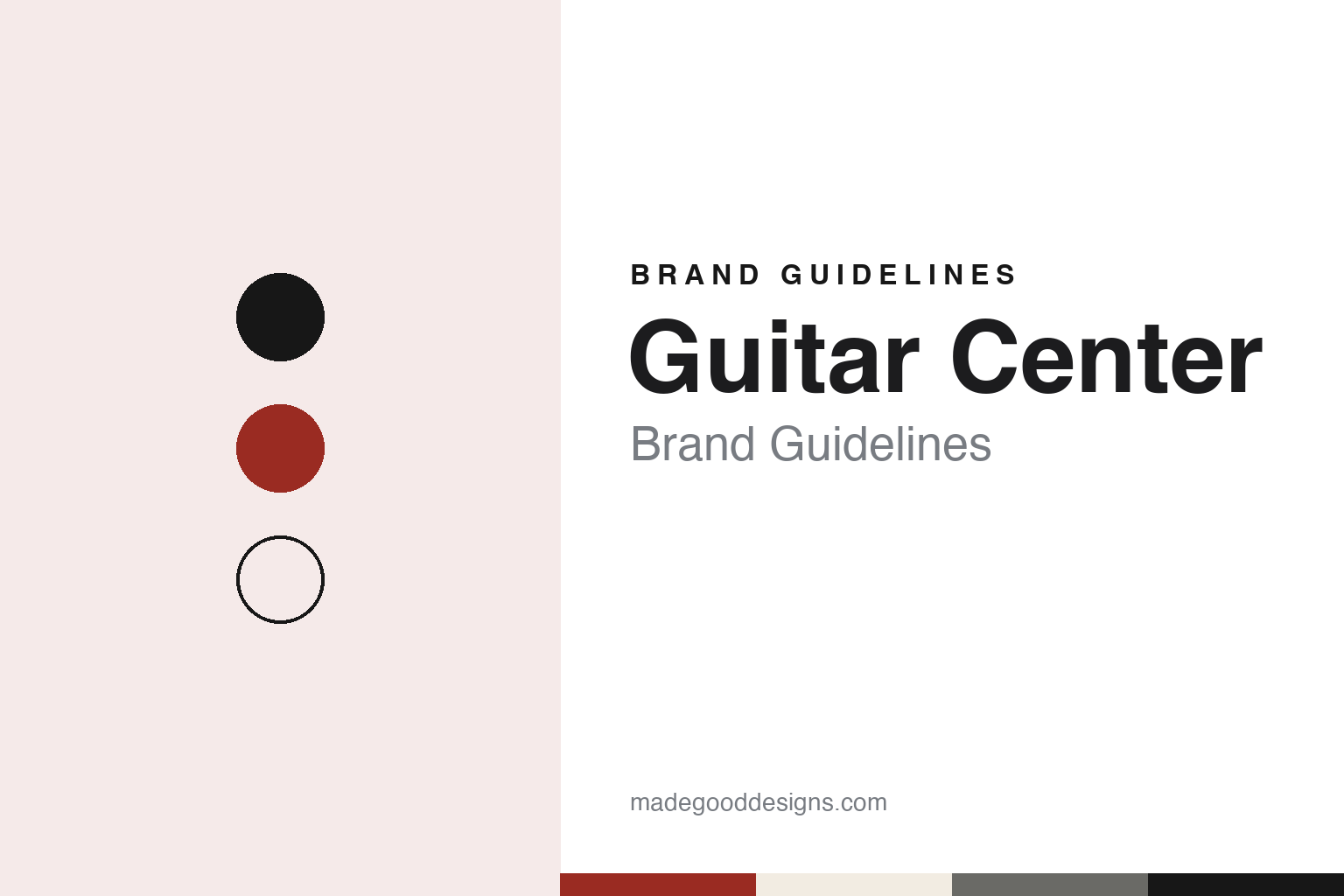
Guitar Center Brand Guidelines
From a Hollywood organ shop to a national music chain.
Aa
Two constants: a Guitar Center amp red and stage black palette and a Condensed sans register. Abstract homage — not a Guitar Center product or mark; no instrument, logo or storefront is reproduced.
The Organ Center
An organ shop that changed its stock.
Guitar Center began in Hollywood in 1959, but not as a guitar shop. English Wikipedia says Wayne Mitchell founded it as The Organ Center, a store selling electronic organs for homes and churches. In 1964, it says, a supplier required him to stock Vox guitar amplifiers if he wanted to keep receiving organs; he added the amplifiers and renamed the shop The Vox Center, drawing on the Beatles’ link with the Vox brand. In the late 1960s, as other amplifier makers such as Marshall grew popular, the store took the name Guitar Center.
The new name stayed while the business spread. By 1972 there were eight stores, English Wikipedia says, including shops in San Francisco, San Diego and the suburbs of Los Angeles. In the late 1970s Ray Scherr, who had been general manager of the San Francisco store, bought the company from Mitchell. Scherr sold it in 1996, and in 1997, with 30 stores on the West Coast and in Michigan, Ohio and Florida, Guitar Center made an initial public offering of its shares and opened more locations.
The company is now headquartered in Westlake Village, California. Its Sunset Boulevard store in Los Angeles hosts Hollywood’s RockWalk, a hall of fame founded in 1985 in which invited musicians press their handprints into cement blocks that are then displayed at the store, according to English Wikipedia.
Colour
Acquisitions, owners and a reorganisation.
Growth came through acquisitions as well as new stores. In 2000 Guitar Center bought Musician’s Friend, the mail-order and online retailer then based in Medford, Oregon, which became a wholly owned subsidiary; in 2005 it bought Music & Arts, a band and orchestra dealer, and merged it with its own American Music Group stores under the Music & Arts name. In February 2007 the Musician’s Friend division bought the assets of an Indiana company that included the band and orchestra retailer Woodwind & Brasswind. English Wikipedia lists Musician’s Friend, Music & Arts, Woodwind & Brasswind, Giardinelli and AVDG among its subsidiaries.
Ownership changed several times. In 2007 the private equity firm Bain Capital agreed to buy the listed company; shareholders approved the deal on 18 September and it closed on 9 October 2007, English Wikipedia says. In 2009 the chain opened a rehearsal and lessons studio in Woodland Hills, California, and in 2011 it began renting equipment from a store in San Diego. In April 2014 Ares Management took a controlling stake, with Bain keeping a partial holding and representation on the board. That August the chain opened a flagship store in Times Square, New York.
The deepest change came in 2020. On 13 November 2020 Guitar Center announced that it planned to file for Chapter 11 bankruptcy protection after negotiating a deal to cut its debt with key investors and lenders, and it emerged from Chapter 11 on 23 December 2020 after a reorganisation that added equity and debt capital, English Wikipedia says. The Times Square store closed that year.
The company also built programmes around players. From 1988 to 2016 it ran the Drum-Off, an annual search for undiscovered drummers that began with rounds in its stores and ended in a final in Los Angeles before a panel of judges. In 2004 it began a “Legends Collection” of guitars bought at charity auctions, including Eric Clapton’s “Blackie” Stratocaster and Stevie Ray Vaughan’s “Lenny,” and the collection has been shown at music events and in its stores, English Wikipedia says. In August 2014 the Clapton guitars moved to a permanent home at the new Times Square store.
Typography
How music retailers present themselves.
Musical-instrument retailers often present themselves through places as much as products. Guitar Center’s Sunset Boulevard store in Los Angeles hosts Hollywood’s RockWalk, a hall of fame begun in 1985 in which musicians’ handprints are set in cement, and Sweetwater has built a campus in Fort Wayne, Indiana, with a retail store, recording studios and a performance theatre, according to English Wikipedia. Guitar Center’s website groups its stock by department: guitars, amplifiers and effects, keyboards, drums and recording gear.
Names in the trade tend to be plain. Guitar Center took its name in the late 1960s after starting as The Organ Center and then The Vox Center, and its group includes Musician’s Friend, Music & Arts and Woodwind & Brasswind, names that state the trade directly. Retailers also commission their own lines: in January 2025 Guitar World reported a set of three pedals made by Keeley Electronics as Sweetwater exclusives, and in 2026 the magazine reported Guitar Center’s plan for an in-house guitar brand developed with customer input.
Corporate histories in this trade usually begin with one person: a musician recording bands from a Volkswagen bus in 1979, as CNN Business reported of Sweetwater’s Chuck Surack, or an organ seller in Hollywood in 1959, as English Wikipedia says of Guitar Center’s Wayne Mitchell. Later chapters often involve investors, with private equity firms investing in both companies, and in Guitar Center’s case a Chapter 11 reorganisation in 2020.
The trade has also contracted. In August 2025 Guitar World reported, in an article on the pressure that online selling puts on physical shops, that Sam Ash had closed all of its stores the previous year. This guide sets out what can be checked about each retailer — founders, owners, stores and own-brand lines — and attributes each claim to the source that makes it.
Aa
A condensed sans — a store name set large. (Specimen set in Oswald, a sans STAND-IN; NOT the Guitar Center logo.)
Guitar Center
A chain with its own guitar project.
The current chief executive, Gabe Dalporto, was appointed in 2023, Guitar World reported in an August 2025 interview, which described his plan as reworking inventory, investing in staff training and turning stores into destinations for players. In March 2026 he announced, in a social-media video, that Guitar Center would build its own guitar brand with input from customers, Guitar World reported in April 2026; by June the magazine was describing the project as Guitar Labs, an online forum in which players debate pickups, hardware, body shapes and other details of a new design. The April report noted that some readers questioned asking players to contribute ideas for a product that would later be sold, and that the video carried a legal statement under which contributors waive their rights in any idea they submit.
In May 2026 Guitar World reported that David Kalt, who founded the online marketplace Reverb in 2013, had joined Guitar Center’s board, that the chain had more than 300 stores across the United States, and that Musician’s Friend was being relaunched. The same report linked the appointment to the chain’s interest in used and vintage instruments.
The name itself records a change of stock: the business sold organs first, then Vox amplifiers, and named itself after guitars only in the late 1960s. Its website now groups guitars, amplifiers and effects, keyboards, drums and recording gear, and its group reaches band and orchestra instruments through Music & Arts and Woodwind & Brasswind.
For a design guide, Guitar Center shows how a retailer’s name can carry the history of what it sold. Compare Musician’s Friend, the online retailer it bought in 2000, and Sam Ash, another American music-store chain. For this guide we use an amp red and a stage black with a condensed sans, an unofficial interpretation; no product or logo is reproduced.
Explore & save
Keep Guitar Center’s identity on hand — save it to a board in the Made Good inspiration library.
Guitar Center identity set
Pin the Guitar Center amp red and stage black palette and the Condensed sans register to your own board.