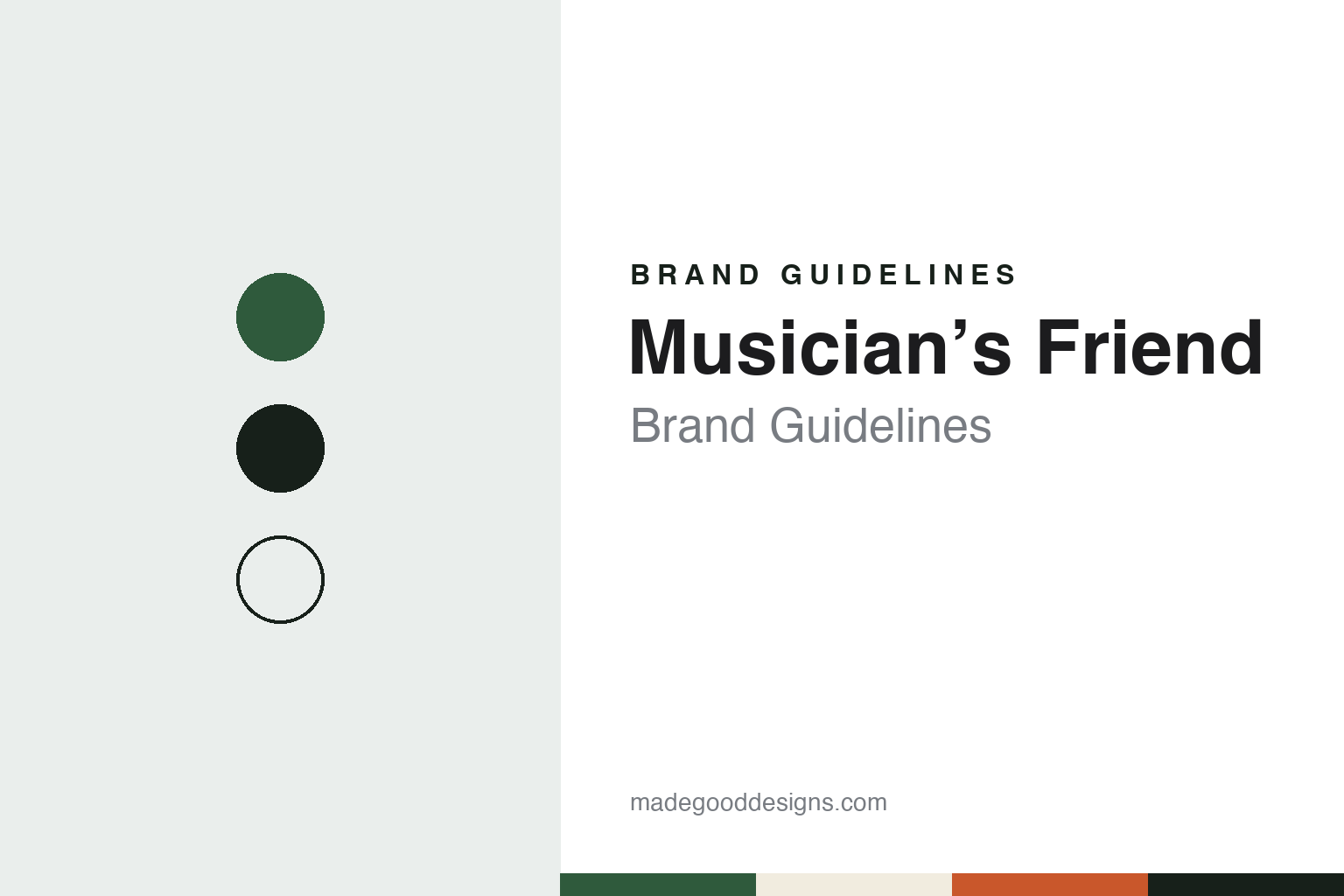
Musician’s Friend Brand Guidelines
A garage catalogue that became a mail-order name.
Aa
Two constants: a pine green, ink and newsprint palette and a catalogue sans register. Abstract homage — not a Musician’s Friend product or mark; no catalogue, logo or page is reproduced.
A garage catalogue
A married couple, a flyer and a box of strings.
Musician’s Friend was founded in 1983 by Rob and DeAnna Eastman. The company’s own history says the newly married couple funded the start with a loan from Rob’s parents and ran the business from their garage in suburban California; the NAMM oral-history collection, kept by the music-products trade association, gives the same founders and year.
The business grew out of an earlier one. NAMM’s notes say Rob’s father, Bud Eastman, opened a music store in San Jose in the mid-1960s and wrote a newsletter for its customers that became Guitar Player magazine in 1967; the following year he added a mail-order side, which Rob began running at 17. When his father closed that business, Rob and DeAnna started a new company of their own: Musician’s Friend.
The company says its first catalogue was a simple two-colour flyer offering discounted guitar strings and a handful of accessories. NAMM’s notes describe some of the early lines: guitar strings sold in bulk and left straight rather than wound into coils, the company’s own straps and picks, and Cry Baby effects pedals. The same notes say the company was selling over the internet as early as 1995.
The move north came next. The company says it shifted its headquarters from San Diego to a dairy barn in southern Oregon, and that the Eastmans built the business there together with their brother-in-law, Al Dinardi, into a large direct marketer of music gear. Its base became Medford, Oregon, which Gale’s International Directory of Company Histories gives as the company’s home at the end of the 1990s.
Colour
From Medford mail order to a Guitar Center division.
By the late 1990s Musician’s Friend had outgrown the flyer. Gale’s International Directory of Company Histories, in its entry on Guitar Center, calls it the largest mail-order and e-commerce retailer of musical instruments of its day. It also ran a number of music stores of its own, the directory says.
Guitar Center had sold shares to the public in March 1997, the directory says, and the listing pushed it to grow faster. In May 1999 it bought Musician’s Friend in an all-stock deal, the same directory says, citing the Los Angeles Times; English Wikipedia dates the purchase to 2000. Musician’s Friend became a wholly owned subsidiary and kept its headquarters in Medford, and most of its shops were turned into Guitar Center stores for the chain’s new smaller-market format, according to the directory.
Inside Guitar Center the catalogue business took on other names. In February 2007 the Musician’s Friend division bought the assets of the Indiana company Dennis Bamber, Inc., which included the band and orchestra retailer Woodwind & Brasswind, Music123 and Lyons Music, English Wikipedia says. Rob Eastman retired from the company in 2009, according to NAMM’s notes, and in 2011 Musician’s Friend’s headquarters operations moved from Oregon to Guitar Center’s offices in Westlake Village, California, English Wikipedia says.
Today the company names Westlake Village as its corporate headquarters, with support centres in Salt Lake City, Utah, and Indianapolis, Indiana, and a distribution centre in Kansas City, Missouri. Its longest-running feature is the Stupid Deal of the Day, a single discounted item offered each day, which the site still carries. No official colour or type specification for the Musician’s Friend name appears in the sources used for this guide, so the palette here is our own.
Typography
How music retailers present themselves.
Musical-instrument retailers often present themselves through places as much as products. Guitar Center’s Sunset Boulevard store in Los Angeles hosts Hollywood’s RockWalk, a hall of fame begun in 1985 in which musicians’ handprints are set in cement, and Sweetwater has built a campus in Fort Wayne, Indiana, with a retail store, recording studios and a performance theatre, according to English Wikipedia. Guitar Center’s website groups its stock by department: guitars, amplifiers and effects, keyboards, drums and recording gear.
Names in the trade tend to be plain. Guitar Center took its name in the late 1960s after starting as The Organ Center and then The Vox Center, and its group includes Musician’s Friend, Music & Arts and Woodwind & Brasswind, names that state the trade directly. Retailers also commission their own lines: in January 2025 Guitar World reported a set of three pedals made by Keeley Electronics as Sweetwater exclusives, and in 2026 the magazine reported Guitar Center’s plan for an in-house guitar brand developed with customer input.
Corporate histories in this trade usually begin with one person: a musician recording bands from a Volkswagen bus in 1979, as CNN Business reported of Sweetwater’s Chuck Surack, or an organ seller in Hollywood in 1959, as English Wikipedia says of Guitar Center’s Wayne Mitchell. Later chapters often involve investors, with private equity firms investing in both companies, and in Guitar Center’s case a Chapter 11 reorganisation in 2020.
The trade has also contracted. In August 2025 Guitar World reported, in an article on the pressure that online selling puts on physical shops, that Sam Ash had closed all of its stores the previous year. This guide sets out what can be checked about each retailer — founders, owners, stores and own-brand lines — and attributes each claim to the source that makes it.
Aa
A plain catalogue sans in the spirit of a mail-order page. (Specimen set in Work Sans, a sans STAND-IN; NOT the Musician’s Friend logo.)
Guitar Center’s outlet
An owner through two buyouts, and a new role in 2026.
Musician’s Friend’s story since 1999 has followed its owner’s. Guitar Center began in Hollywood in 1959 as the Organ Center, a single store selling organs, and turned to guitars in the 1960s, Retail Dive reported in December 2020. English Wikipedia says the private equity firm Bain Capital bought Guitar Center in a deal completed in October 2007, and Retail Dive says Ares Management took control in a 2014 restructuring.
Guitar Center filed for Chapter 11 in November 2020 with a pre-negotiated reorganisation plan and emerged on 23 December 2020, Retail Dive reported, with new equity and debt capital; after the deal Brigade Capital Management and The Carlyle Group joined Ares among its owners, the same report says. Musician’s Friend stayed inside the group throughout. In that report Retail Dive described Guitar Center as the largest musical instrument retailer in the United States, and in July 2024 the same publication put its chain at about 300 stores nationwide.
In May 2026 Guitar Center relaunched Musician’s Friend as an off-price online outlet, Guitar World reported on 8 May 2026. The relaunched site gathers overstock, close-out and open-box gear sourced from manufacturers, across guitars, pianos, drums, recording, synthesisers, live sound and DJ equipment, from makers including Gibson, Fender, Yamaha and Shure, with stock that rotates and is topped up from the brands. Guitar Center’s chief executive, Gabe Dalporto, described the aim as pulling discounted premium gear “into one place, sourced directly from the brands,” Guitar World quoted him as saying. The Stupid Deal of the Day stayed, Guitar World reported.
For a design guide, Musician’s Friend shows how a mail-order name can keep its voice through changes of ownership and purpose. Compare Guitar Center, its owner since 1999, and Sam Ash, the New York chain whose name moved online in 2024. For this guide we use pine green, ink and newsprint with a sans, an unofficial interpretation; no product or logo is reproduced.
Explore & save
Keep Musician’s Friend’s identity on hand — save it to a board in the Made Good inspiration library.
Musician’s Friend identity set
Pin the Musician’s Friend pine green, ink and newsprint palette and the catalogue sans register to your own board.