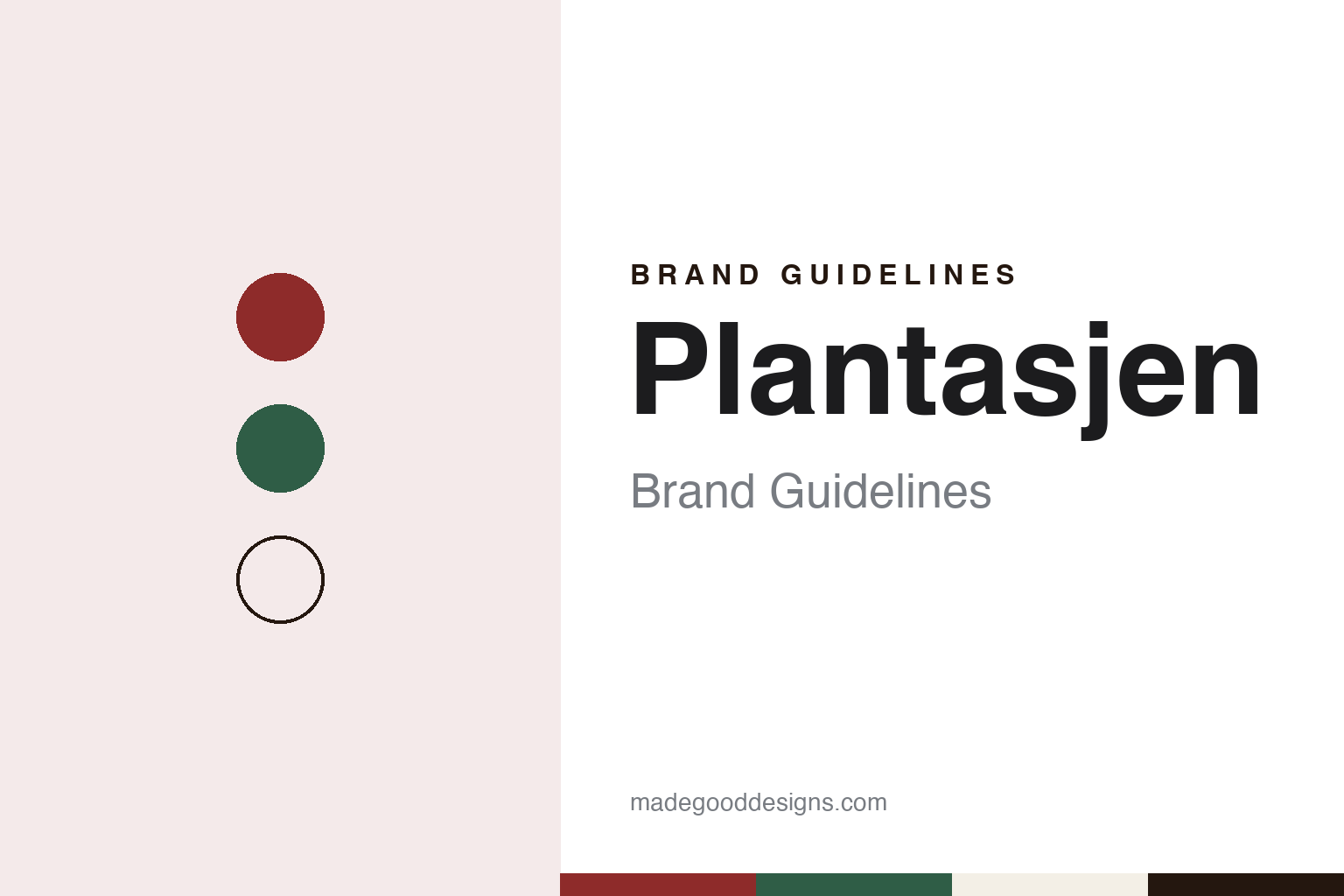
Plantasjen Brand Guidelines
A Norwegian garden-centre chain with a Swedish twin name.
Aa
Two constants: a barn red, spruce green and birch white palette and a friendly sans register. Abstract homage — not a Plantasjen product or mark; no store, logo or sign is reproduced.
A Kongsvinger start
One chain, two spellings.
Plantasjen is a Nordic chain of garden centres selling plants, growing products, garden furniture and, more recently, pet food, according to Norwegian Wikipedia. It trades as Plantasjen in Norway and as Plantagen in Sweden; Swedish Wikipedia gives the Norwegian name in brackets after the Swedish one.
Norwegian Wikipedia says the company was set up on 1 September 1985 in Kongsvinger by Karl Ragnar Rimfeldt, and that the first store opened at Hvamkrysset in Skedsmo on 17 April 1986. The company’s own website gives 1985 as its founding year. The encyclopedia adds that the chain started a new store concept in 1995.
Norwegian Wikipedia also describes how the business is shaped by the seasons. Most of the chain’s sales fall in spring and early summer, and trade depends on the weather, it says; to even out sales across the year, the range has been widened beyond summer goods to include Christmas decorations, firewood and products such as pet food that sell in every season. In most stores, according to the same article, the floor is divided into sections for garden furniture, indoor plants, outdoor plants and pet food. It counted 73 garden centres and smaller shops in Norway as of 2022.
The chain has kept two bases in Norway. When it announced store closures in September 2024, E24 reported, staff cuts were also planned in central functions at its offices in Kongsvinger and Skedsmo.
Colour
Three investors in fifteen years.
Plantasjen’s growth across the Nordic region came under private-equity owners. Swedish Wikipedia says the investment firm EQT bought the Norwegian chain in 2001, and that in 2002 EQT bought the Swedish garden-centre chain Växus, which was renamed Plantagen on 14 March 2002; a nursery business in Askim, Gothenburg, had also been bought and re-branded Plantagen that February. On the same March day, the encyclopedia says, Plantagen opened a garden centre in Uppsala. When the Nordic expansion began in 2002, it says, the group had 20 stores in Norway and 11 in Sweden.
In December 2006 it became public that EQT was selling the chain to Apax Partners, Swedish Wikipedia says; by then the group had grown to 72 stores across Norway, Sweden and Finland. In autumn 2016 Apax sold its whole holding to Ratos, when the chain had 124 stores in the three countries. E24, the Norwegian business news site, describes Ratos as a Swedish listed buyout firm and dates its purchase of the chain to 2016.
Leadership has changed often. Swedish Wikipedia lists six chief executives since 2013, one of them in an acting role, and Norwegian Wikipedia says Jesper Lien was appointed chief executive in August 2022; he spoke for the company in E24’s reports on the 2024 reconstruction.
By September 2024, E24 reported, the chain had 121 stores in Norway, Sweden and Finland and around 2,400 employees and seasonal workers over the course of a year, and it described the business as founded more than 35 years earlier in Norway.
Typography
How garden-centre chains present themselves.
Garden-centre chains present themselves through the places they run rather than through a single product. Their own pages lead with the centres: glasshouse aisles and outdoor plant tables, indoor plants, garden furniture, gifts and homewares, and seasonal ranges that change through the year. Court papers filed by Dobbies in 2024 describe that mix plainly, listing horticultural, food, homewares and seasonal products alongside restaurants, cafés and concessions let to other retailers.
Food is part of the format. Many centres run restaurants or cafés, and some add food halls; Dobbies has stocked supermarket-branded ranges and later launched food halls under its own name, according to Retail Gazette and English Wikipedia. Notcutts says each of its centres has a permanent display garden, and it runs a loyalty scheme, the Privilege Club, that ties its centres to a customer list.
Naming is usually plain. Notcutts’s website lists most of its centres by town, alongside a few with names of their own, such as Wheatcroft and Garden Pride. Smaller formats can carry a variant of the main name, as Dobbies did with its Little Dobbies urban shops, which had all ceased trading by December 2024, according to the Court of Session.
Corporate history pages carry much of the brand story. Family-owned groups such as Notcutts set out founders, nurseries, show medals and successive generations of the family, while chains that have changed hands have their owners and deals recorded in the trade and business press. The guides in this series follow those published records: founding dates, owners and centre counts as dated sources give them, and colours and typefaces treated as unofficial interpretations rather than official brand assets.
Aa
A friendly sans for a plant-and-garden chain. (Specimen set in Figtree, a sans STAND-IN; NOT the Plantasjen logo.)
Reconstruction
Fewer stores, two countries.
The chain went through a court-supervised reconstruction. On 22 August 2024, E24 reported, Ratos announced that Plantasjen Norge, Plantasjen Sverige and Plantasjen Finland were seeking reconstruction and opening talks with creditors to avoid bankruptcy; the stated aims were fewer stores, better lease terms and changes to the organisation, while the group’s purchasing and logistics companies were not part of the process. The Romerike og Glåmdalen district court approved the start of reconstruction for Plantasjen Norge AS, the report said, and Ratos pointed to high inflation, which had raised costs and reduced consumers’ spending power.
The cuts followed within weeks. In mid-September 2024 the chain stopped taking new orders in its online shop, E24 reported, and on 19 September 2024 it said it would close 14 of its 69 Norwegian stores, with the last trading day set for 23 December 2024; the list included Grünerløkka, Asker, Mandal, Mo i Rana and Steinkjer. In August 2026 Dagens PS summed up the outcome: since the reconstruction began, Plantagen had left Finland and closed 13 stores in Norway and 11 in Sweden. In Sweden the first to go was Eskilstuna, after a dispute over rent, the paper said, followed by stores including Ludvika, Kalmar, Bäckby in Västerås, Hässelby and a Garden Outlet on Hisingen in Gothenburg. Some of the empty units found new tenants, the same report said, with Blomsterlandet taking over the site in Motala. In July 2026 the trade magazine Market reported that Blomsterlandet had signed for seven further sites where Plantagen was then trading, without taking over Plantagen’s business, staff or leases.
Ratos still owns the chain. It describes the business as selling plants, flowers and related products for growing indoors and outdoors, along with garden furniture and other products for outdoor living. Its website lists Plantasjen among its “non-core companies” and says the chain has 90 stores in Norway and Sweden, with its headquarters in Norway.
For a design guide, Plantasjen shows how one chain can carry two spellings of a single name across a border. Compare Blomsterlandet, the Swedish chain moving into some of its former sites, and Intratuin, a Dutch garden-centre chain. For this guide we use a barn red and a spruce green on birch white with a sans, an unofficial interpretation; no product or logo is reproduced.
Explore & save
Keep Plantasjen’s identity on hand — save it to a board in the Made Good inspiration library.
Plantasjen identity set
Pin the Plantasjen barn red, spruce green and birch white palette and the friendly sans register to your own board.