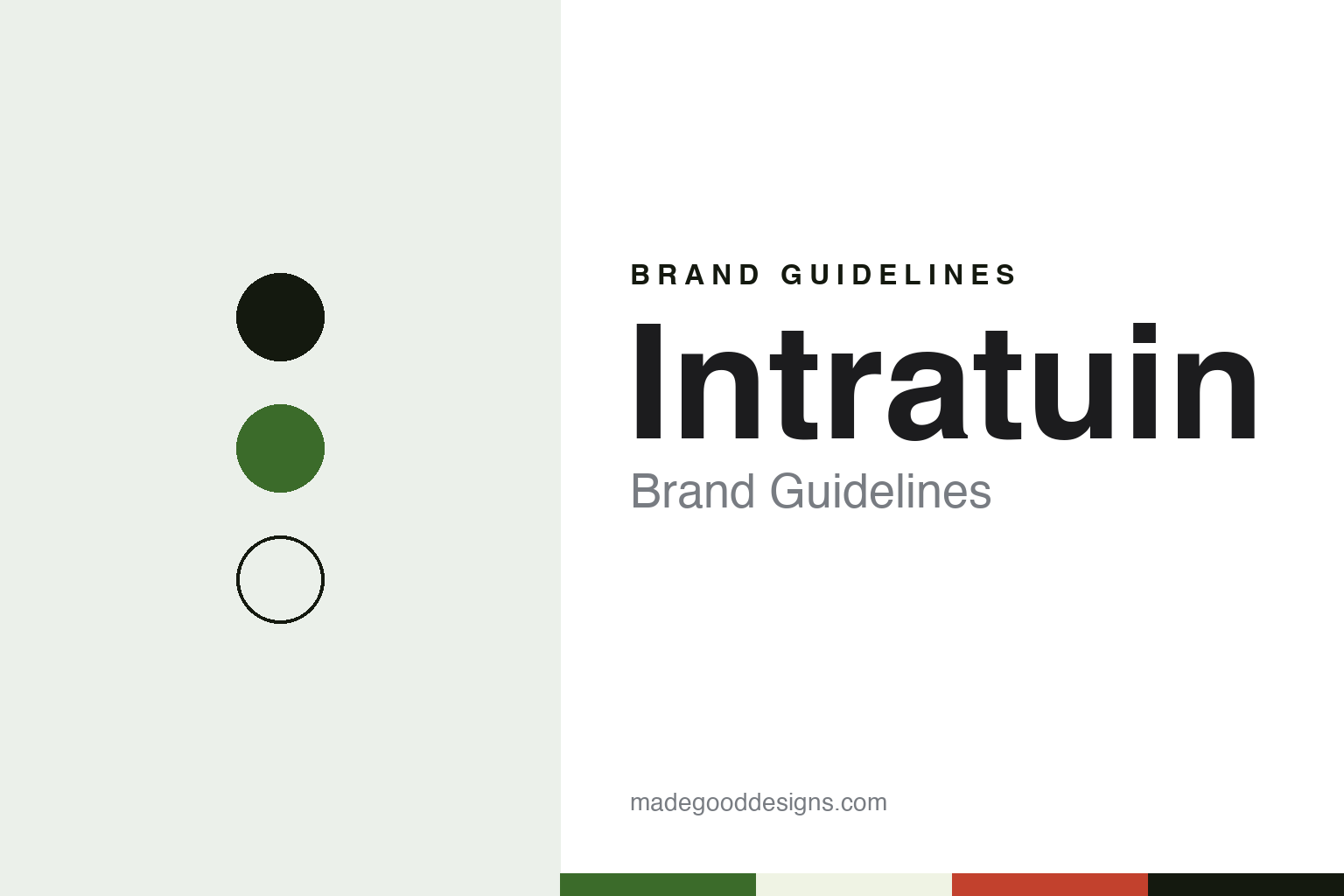
Intratuin Brand Guidelines
Eight Dutch entrepreneurs, a buying group and Abel the rooster.
Aa
Two constants: an Intratuin glasshouse green and comb red palette and a Friendly sans register. Abstract homage — not an Intratuin product or mark; no rooster, logo or sign is reproduced.
Eight entrepreneurs
A buying group that became a brand.
Intratuin did not start as one company with one founder. By its own account it began in 1980, when eight garden-centre entrepreneurs joined forces to buy stock together. The joint buying worked, the company says, so they took a second step: a uniform sales formula, promoted under the shared name Intratuin, and the group of owners kept growing. Dutch Wikipedia also gives 1980 as the founding year.
The company places that start inside a longer trade history. It says the Nederlandse Vereniging Tuincentra, the Dutch garden-centre association and forerunner of today’s Tuinbranche Nederland, was set up in 1970, and that in 1975 a central buying organisation for garden centres, Covatuin, was founded, in which the future Intratuin members played a prominent part. Intratuin Nederland was separated from Covatuin in 2001, the company says, the same year it set up its own plant distribution centre at Aalsmeer. Dutch Wikipedia says Intratuin has been organised as a holding company since 2001.
In Dutch, tuin means garden. From the beginning, the company says, the brand had a mascot as well as a name: in 1980 Intratuin was launched with Abel, a rooster, as its emblem.
Colour
A formula, not a chain of branches.
Intratuin describes itself as a “soft franchise” formula. The garden centres belong to independent owners who join the formula; on its page for prospective franchisees the company calls itself a cooperative and says members contribute to the cooperative’s fixed costs and must meet some firm conditions, among them a garden centre of at least 4,000 square metres. In return it lists national and local marketing campaigns, a webshop, a shared formula and product range, ordering through a central purchasing portal, and regular meetings between owners.
The centre of the network is small. The company says its branches are supported by a service office in Woerden, a distribution centre for hard goods in Den Bosch and the plant distribution centre at Aalsmeer. It gives its branches a combined floor area of more than 464,000 square metres, more than 3,300 staff and around 80,000 different products.
The shared look came a decade after the name. The company says the joint brand formula and appearance of Intratuin were developed in 1990 and 1991. It dates its first Belgian store to 1998, its first German store to 2013 and the launch of its webshop to 2017.
Counts of branches have moved steadily. In March 2008 the regional broadcaster RTV Utrecht described Intratuin as a Woerden garden-centre chain with 57 branches in the Netherlands and quoted its director, Marcel van Brakel, saying the company wanted to grow to about a hundred. In March 2019 the trade site RetailTrends counted 52 branches in the Netherlands, three in Belgium and ten in Germany. The company’s own about page now gives 71 branches, 55 in the Netherlands, three in Belgium and 13 in Germany, while its franchise page gives 72.
Typography
Design and documentation.
Garden-centre chains present themselves through the places they run rather than through a single product. Their own pages lead with the centres: glasshouse aisles and outdoor plant tables, indoor plants, garden furniture, gifts and homewares, and seasonal ranges that change through the year. Court papers filed by Dobbies in 2024 describe that mix plainly, listing horticultural, food, homewares and seasonal products alongside restaurants, cafés and concessions let to other retailers.
Food is part of the format. Many centres run restaurants or cafés, and some add food halls; Dobbies has stocked supermarket-branded ranges and later launched food halls under its own name, according to Retail Gazette and English Wikipedia. Notcutts says each of its centres has a permanent display garden, and it runs a loyalty scheme, the Privilege Club, that ties its centres to a customer list.
Naming is usually plain. Notcutts’s website lists most of its centres by town, alongside a few with names of their own, such as Wheatcroft and Garden Pride. Smaller formats can carry a variant of the main name, as Dobbies did with its Little Dobbies urban shops, which had all ceased trading by December 2024, according to the Court of Session.
Corporate history pages carry much of the brand story. Family-owned groups such as Notcutts set out founders, nurseries, show medals and successive generations of the family, while chains that have changed hands have their owners and deals recorded in the trade and business press. The guides in this series follow those published records: founding dates, owners and centre counts as dated sources give them, and colours and typefaces treated as unofficial interpretations rather than official brand assets.
Aa
A friendly sans — a shared name over many owners. (Specimen set in Inter Tight, a sans STAND-IN; NOT the Intratuin logo.)
Intratuin
A green lifestyle, aisle by aisle.
The formula has been redesigned in the shop itself. In March 2019 RetailTrends reported that Intratuin had opened a new branch of nine thousand square metres in Deventer as the flagship of a new formula built around what it called “a literally green lifestyle,” after more than five years of work. The store was arranged as a series of concept stores meant to feel like walking through the sections of a lifestyle magazine, with its own vegetable and flower shop, a short route for shoppers in a hurry, an audio tour and workshops.
What the centres sell follows the same pattern across the network. Dutch Wikipedia describes a range led by plants, trees and shrubs for garden and home, with garden goods such as tools, soil, paving and ponds, pet supplies and home accessories; many branches have a florist’s counter, the centres have a café or restaurant area, and in the last four months of the year Christmas goods dominate. Dutch Wikipedia calls Intratuin the market leader in the Netherlands and the largest garden-centre group in the Benelux. On its mission page the company says it commits to the United Nations Sustainable Development Goals, naming goals 12, 13 and 15.
The brand speaks in three languages and on three national websites. The Dutch site, intratuin.nl, delivers only in the Netherlands and points Belgian shoppers to intratuin.be, which carries the same Dutch-language company history; the German site, intratuin.de, presents the formula as “Alles für Garten, Haus & Wohnaccessoires,” everything for garden, house and home accessories, with pages for its Café & Bistro and for prospective franchise partners. Around the shops the company runs a monthly benefits scheme called Intratuin Extra, an app, gift cards, store leaflets, a plant guide and workshops.
For a design guide, Intratuin shows how a buying group of independent owners can become one consumer brand through a shared name, a mascot and a store formula. Compare Dehner, a garden-centre chain in Germany, where Intratuin also has branches, and Hornbach, a German retailer whose story also includes a garden store. For this guide we use a glasshouse green and a comb red with a sans, an unofficial interpretation; no product or logo is reproduced.
Explore & save
Keep Intratuin’s identity on hand — save it to a board in the Made Good inspiration library.
Intratuin identity set
Pin the Intratuin glasshouse green and comb red palette and the Friendly sans register to your own board.