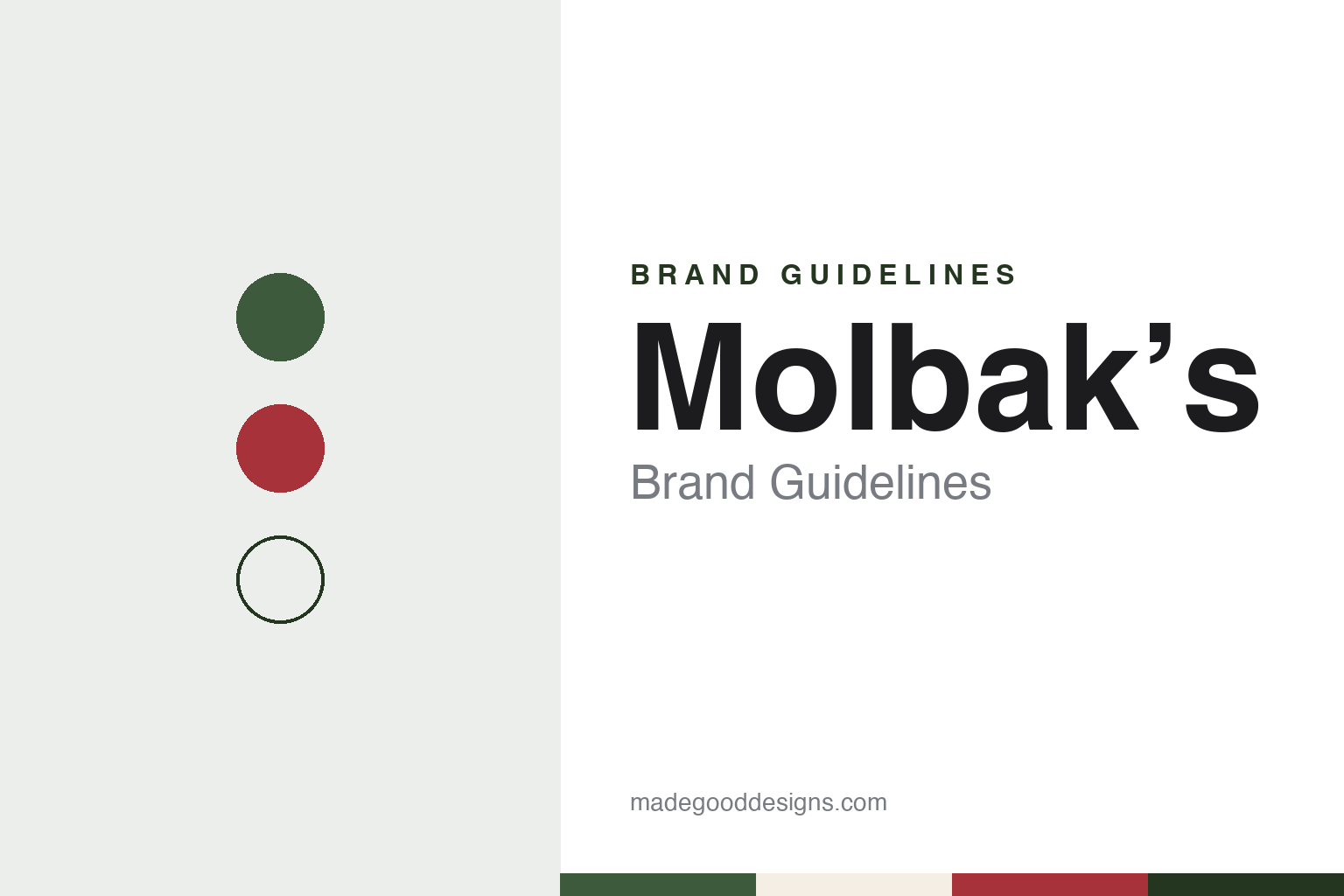
Molbak’s Brand Guidelines
A Danish nurseryman’s greenhouse that a town grew around.
Aa
Two constants: a greenhouse green, poinsettia red and linen palette and a warm old-style serif register. Abstract homage — not a Molbak’s product or mark; no store, logo or sign is reproduced.
A nursery for sale
From Denmark to rural Woodinville.
Molbak’s began with a small nursery in Woodinville, Washington, then a rural, unincorporated part of King County. The Seattle Times, in a piece for the business’s 50th anniversary in December 2006, told the story. Egon Molbak, who held a degree in horticulture, first came to the United States from Denmark in 1948 on an exchange programme run by the American-Scandinavian Foundation and worked for Crissey’s Florist in Seattle. In 1950 he and Laina Molbak travelled to Seattle together, and in December 1956 they bought a small nursery for sale in Woodinville; the paper said it came with a tiny house and a blue panel truck.
At first the nursery grew carnations, chrysanthemums and sweet peas for the cut-flower market. The Molbaks added potted and bedding plants, and The Seattle Times credited Egon with a technique for growing shorter chrysanthemums, so that mums could be sold as container plants rather than only as cut flowers, which the paper called a boon to the nursery trade. Retail sales started as an experiment, open only from April to June, with plants sold in front of the building and in the first greenhouse. The couple rebuilt the greenhouses in 1970, opened the store all year, and added garden tools and supplies and then cards and gifts.
The business spread for a time beyond Woodinville. In the early 1980s, the 2006 article said, the family bought the Seattle Garden Center at Pike Place Market and land in Redmond for off-site greenhouses, and from 1998 to 2002 it ran a store at University Village in Seattle. All four Molbak children worked in the company at various times. In 2002 their son Jens Molbak, who had founded the coin-counting company Coinstar, stepped in to reorganise the business, and the paper said his work had revitalised it.
Recognition followed Egon personally: The Seattle Times reported that he was inducted into the National Floricultural Hall of Fame in 1991 and received the Great American Gardener Award from the American Horticultural Society in 2003. KUOW, Seattle’s public radio station, noted in November 2023 that the town of Woodinville had grown up around the garden centre.
Colour
Poinsettias, a glasshouse store and a festival.
By the 2000s Molbak’s was a single large garden and home store in the centre of Woodinville, later trading as Molbak’s Garden + Home. Its signature event was the Poinsettia Festival. The Seattle Times reported in 2006 that Laina Molbak helped start it in 1971 as a one-weekend party for vendors, that it opened to the public by 1975, and that buses brought visitors from California, Idaho and Oregon. That year the festival showed some 42,000 poinsettias in 52 varieties, with free coffee and samples of Danish kringle, a nod to the founders’ roots. The paper put the store’s yearly visitors at about one million.
KUOW, reporting in November 2023, described the store’s poinsettia tree as a hallmark of its holiday decorations. The family kept a link to plant names too: in 2006 Jens Molbak surprised his mother by naming a new dahlia after her, The Seattle Times said.
The end came through a property deal. The Molbak family sold the land under the store to the developer Green Partners in 2008, FOX 13 Seattle reported, and the business spent the next fifteen years working with the developer on The Gardens District, a planned 19-acre housing and retail scheme for downtown Woodinville in which a new Molbak’s was to be the centrepiece, according to The Daily Herald of Everett. In November 2023 the developer told Molbak’s it was no longer part of the project, and the developer then said it was shelving the Gardens District. The two sides gave differing accounts, which KUOW reported; mediation followed and failed. In December 2023 Molbak’s announced it would close, and FOX 13 said the business then had 70 full-time and 45 part-time or seasonal staff.
The store’s last day of business was January 28, 2024, The Daily Herald reported, after a going-out-of-business sale. In April 2024 Molbak’s announced Green Phoenix Collaborative at Molbak’s, a proposed community hub for gardening and green living on its old site, backed by a crowdfunding appeal, FOX 13 Seattle reported. The garden store has not reopened. The molbaks.com website now runs a small online shop and says the company is preparing a gardening-advice service called Trellis by Molbak’s.
Typography
Design and documentation.
Garden-centre chains present themselves through the places they run rather than through a single product. Their own pages lead with the centres: glasshouse aisles and outdoor plant tables, indoor plants, garden furniture, gifts and homewares, and seasonal ranges that change through the year. Court papers filed by Dobbies in 2024 describe that mix plainly, listing horticultural, food, homewares and seasonal products alongside restaurants, cafés and concessions let to other retailers.
Food is part of the format. Many centres run restaurants or cafés, and some add food halls; Dobbies has stocked supermarket-branded ranges and later launched food halls under its own name, according to Retail Gazette and English Wikipedia. Notcutts says each of its centres has a permanent display garden, and it runs a loyalty scheme, the Privilege Club, that ties its centres to a customer list.
Naming is usually plain. Notcutts’s website lists most of its centres by town, alongside a few with names of their own, such as Wheatcroft and Garden Pride. Smaller formats can carry a variant of the main name, as Dobbies did with its Little Dobbies urban shops, which had all ceased trading by December 2024, according to the Court of Session.
Corporate history pages carry much of the brand story. Family-owned groups such as Notcutts set out founders, nurseries, show medals and successive generations of the family, while chains that have changed hands have their owners and deals recorded in the trade and business press. The guides in this series follow those published records: founding dates, owners and centre counts as dated sources give them, and colours and typefaces treated as unofficial interpretations rather than official brand assets.
Aa
A warm old-style serif in the spirit of a family nursery. (Specimen set in Fraunces, a serif STAND-IN; NOT the Molbak’s logo.)
Molbak’s
A family name on one big store.
Molbak’s was never a chain in the usual sense. After brief branches at Pike Place Market and University Village, it came back to one place, and the brand was the store, the family name above it and the seasons inside it. The Poinsettia Festival made the business a winter destination as well as a spring one, which is the problem every garden centre has to solve.
Its ending is also part of the brand story. A business that sold its land and planned its future around a redevelopment found itself without a site when that plan collapsed, and closed after 67 years in January 2024. The name now lives on in a small online shop rather than a garden store.
For a design guide, Molbak’s shows how one family store can carry a place’s identity through a single seasonal ritual. Compare Calloway’s, a Texas nursery chain founded in 1986, and Notcutts, a garden-centre chain in England. For this guide we use a greenhouse green, a poinsettia red and a warm linen with a serif, an unofficial interpretation; no product or logo is reproduced.
Explore & save
Keep Molbak’s’s identity on hand — save it to a board in the Made Good inspiration library.
Molbak’s identity set
Pin the Molbak’s greenhouse green, poinsettia red and linen palette and the warm old-style serif register to your own board.