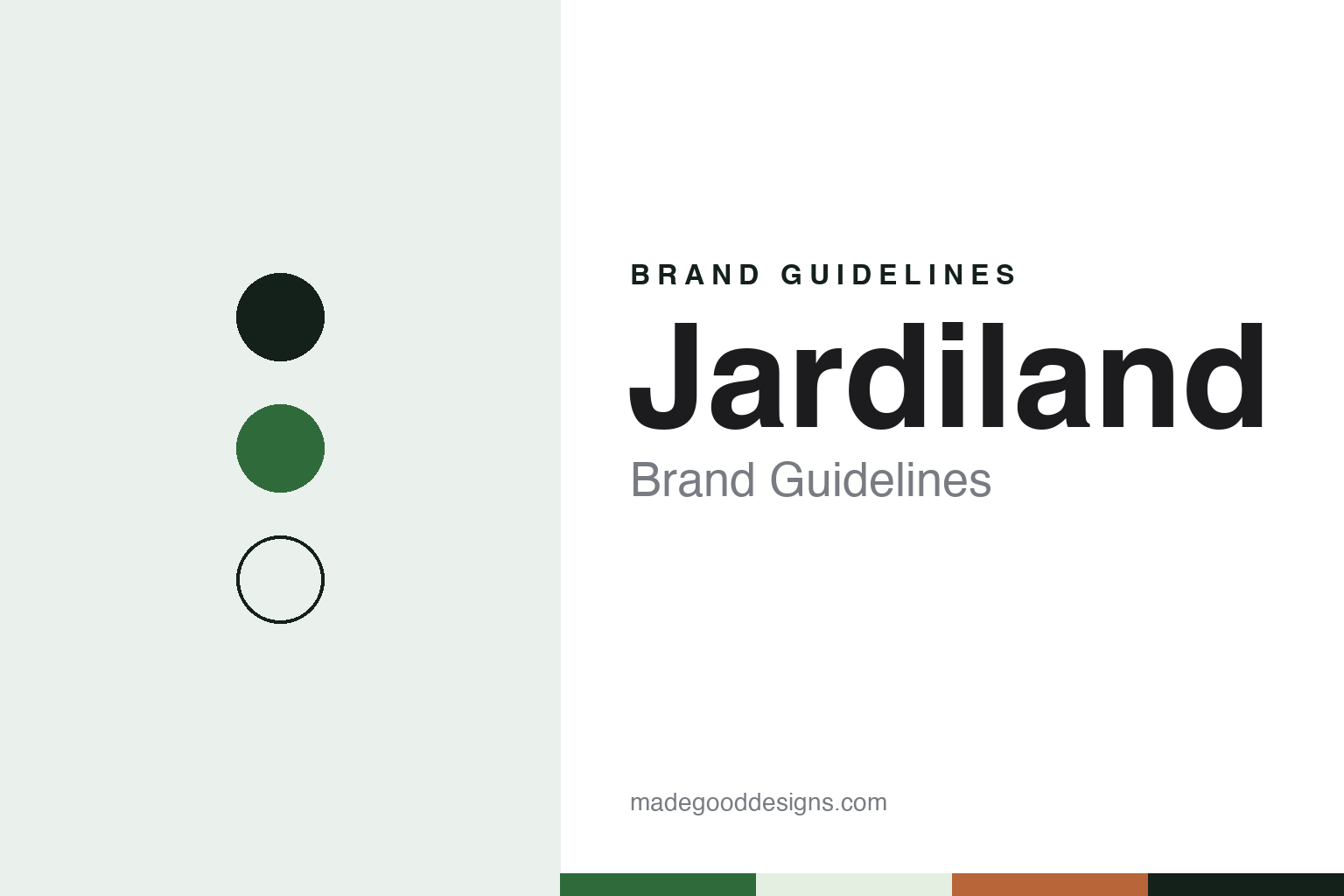
Jardiland Brand Guidelines
A 1973 French buying group turned InVivo garden chain.
Aa
Two constants: a Jardiland glasshouse green and terracotta palette and a Rounded sans register. Abstract homage — not a Jardiland product or mark; no store, logo or sign is reproduced.
Tripode
Four garden-trade founders and a buying office.
Jardiland began as a buying group. French Wikipedia says that in 1973 four men from the garden trade, Jacques Derly, Gérard Lecoq, Étienne Bordet and Charles Monot, pooled their skills to set up a central purchasing office for what was then a young market in garden products. They called it Tripode. Nurseries and landscape firms joined as affiliates, and the founders travelled abroad to study how the trade worked elsewhere, drawing in particular on American garden-centre trends, the same article says. The network then traded as Jardinery.
The name came in the 1980s. As the network grew, it needed national advertising, and in 1982 Jardiland replaced Jardinery, according to French Wikipedia. A second banner arrived in the same decade: in 1984 the group Sémaphor created Vive le Jardin, and in 1997 Jardiland sealed an alliance with Sémaphor Vive le Jardin. By then, French Wikipedia says, Jardiland counted 87 stores in mainland France, and a Spanish subsidiary had been set up during the 1990s.
For most of its history Jardiland was a network of franchisees rather than a single owner of shops. French Wikipedia describes a reorganisation from 2003 that aimed to turn the franchise network into a group combining franchised stores, company-run “integrated” stores and production nurseries. The project stalled in June 2005, the article says, and was restarted in 2006, when the network counted 215 stores, of which 85 were run by the group itself; 115 traded as Jardiland and 70 as Vive le Jardin. The franchise banner in use in 2018 was L’Esprit Jardiland, which the French competition authority named that year alongside the company-owned Jardiland stores.
Colour
A fund, then a farm cooperative.
Ownership changed several times in the 2010s. French Wikipedia says that early in 2014 the company was bought by the investment fund L-GAM, which set out to relaunch it. In December 2016 the group agreed with the Prieux group to take over 14 stores in the Grand Est region, bringing the number of company-owned branches to 100, according to the same article.
The next buyer came from farming. In October 2017 InVivo Retail, the retail arm of the French agricultural cooperative union InVivo, which ran the Gamm Vert and Delbard chains, entered exclusive talks with Jardiland, French Wikipedia says. InVivo itself, English Wikipedia says, was formed from a union of 167 member agricultural cooperatives, and in May 2017 it had bought 90 Gamm Vert stores from two of its franchisees, Axéréal and Terrena. InVivo Retail notified the French competition authority, the Autorité de la concurrence, of the purchase on 29 June 2018. In its decision of 24 August 2018, the authority found that the deal raised no concern with suppliers at national level but would have given the new group very high market shares, above 60 percent, in several local catchment areas. It cleared the purchase on condition that InVivo part with 11 stores: six outlets to be sold to rival chains and five franchise contracts to be ended, so that the stores would change banner rather than close. The authority described the parties as retailers of garden, DIY, pet and landscaping products, and said it would approve each buyer as a credible alternative in its area.
macommune.info, reporting the decision on 27 August 2018, listed the affected sites, among them Jardiland stores in Limoges, Montélimar and Vendôme and L’Esprit Jardiland franchises in Clamecy and Cosne-sur-Loire, and gave the Jardiland group at the time as 189 stores with about 5,000 staff. French Wikipedia dates the completed purchase by InVivo to September 2018.
Typography
How garden-centre chains present themselves.
Garden-centre chains present themselves through the places they run rather than through a single product. Their own pages lead with the centres: glasshouse aisles and outdoor plant tables, indoor plants, garden furniture, gifts and homewares, and seasonal ranges that change through the year. Court papers filed by Dobbies in 2024 describe that mix plainly, listing horticultural, food, homewares and seasonal products alongside restaurants, cafés and concessions let to other retailers.
Food is part of the format. Many centres run restaurants or cafés, and some add food halls; Dobbies has stocked supermarket-branded ranges and later launched food halls under its own name, according to Retail Gazette and English Wikipedia. Notcutts says each of its centres has a permanent display garden, and it runs a loyalty scheme, the Privilege Club, that ties its centres to a customer list.
Naming is usually plain. Notcutts’s website lists most of its centres by town, alongside a few with names of their own, such as Wheatcroft and Garden Pride. Smaller formats can carry a variant of the main name, as Dobbies did with its Little Dobbies urban shops, which had all ceased trading by December 2024, according to the Court of Session.
Corporate history pages carry much of the brand story. Family-owned groups such as Notcutts set out founders, nurseries, show medals and successive generations of the family, while chains that have changed hands have their owners and deals recorded in the trade and business press. The guides in this series follow those published records: founding dates, owners and centre counts as dated sources give them, and colours and typefaces treated as unofficial interpretations rather than official brand assets.
Aa
A rounded sans for a garden and pet chain. (Specimen set in Nunito Sans, a sans STAND-IN; NOT the Jardiland logo.)
Jardiland
One banner inside a cooperative’s retail group.
Today Jardiland sits inside a larger retail group. English Wikipedia says InVivo owns the garden centres Gamm Vert, Jardiland and Delbard, as well as the Louise bakeries, through the Teract group. Teract was listed on Euronext Paris, and in 2026 InVivo moved to take it off the stock market. Notices published by the French markets regulator, the Autorité des marchés financiers, record the steps: the offer was announced on 15 January 2026; on 5 February 2026 a bank acting for InVivo Group filed a public withdrawal offer for the Teract shares not already held by InVivo and the founders of the earlier listed company, acting in concert, at which point InVivo held about 80 percent directly; the offer closed on 13 May 2026, and on 19 May the regulator published the notice putting the compulsory buy-out of the remaining shareholders into effect.
French Wikipedia says that in March 2026 InVivo acknowledged difficulties at Jardiland and raised franchising as a way to lighten its costs. The same article gives the network as 193 stores, of which 98 are company-owned branches, 81 are run by franchise partners and 12 are in France’s overseas departments or abroad. The chain covers both the garden and pets, the two areas French Wikipedia names as its specialities.
For a design guide, Jardiland shows how a buying group of nurseries and landscape firms from the 1970s became one banner within an agricultural cooperative’s retail group, alongside Gamm Vert and Delbard, with company-run and franchised stores under related names. Compare it with the Bavarian family chain Dehner and the Dutch chain Intratuin. For this guide we use a glasshouse green, a pale leaf tint and a terracotta accent with a rounded sans, an unofficial interpretation; no product or logo is reproduced.
Explore & save
Keep Jardiland’s identity on hand — save it to a board in the Made Good inspiration library.
Jardiland identity set
Pin the Jardiland glasshouse green and terracotta palette and the Rounded sans register to your own board.