Silent Gliss Brand Guidelines
The Swiss curtain-track maker that built a brand on quiet.
Aa
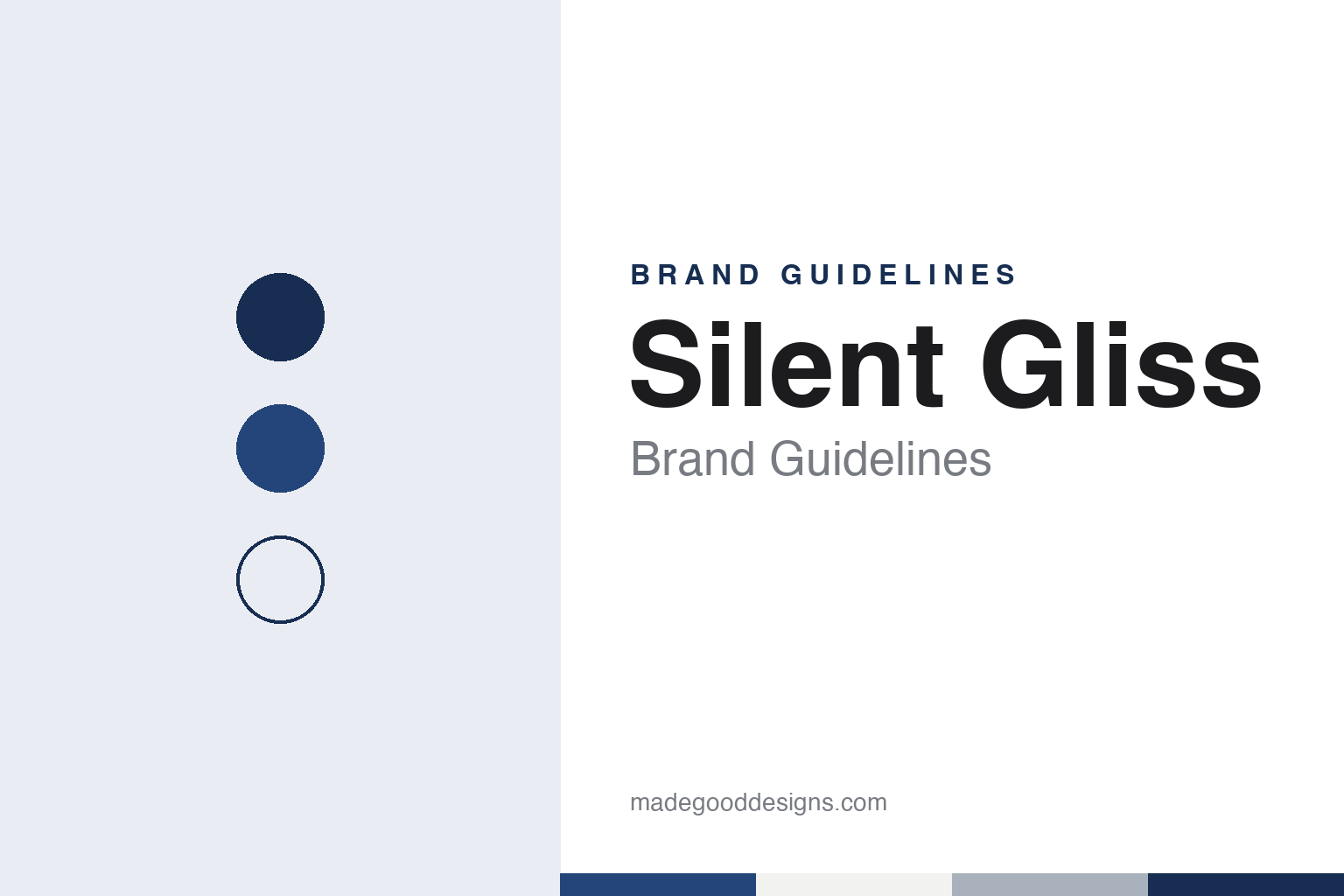
Two constants: a blue, white and aluminium palette and a Swiss sans register. Abstract homage — not a Silent Gliss product or mark; no track, logo or cat emblem is reproduced.
A quiet track
An engineer’s idea that gave the company its name.
Silent Gliss grew out of a single product: a curtain track that made less noise. The Swiss business magazine Bilanz wrote in November 2003 that the engineer Alexander Weber invented the silent curtain rail in the early 1950s and named his firm after it. The German home-textile trade journal BTH Heimtex gave the founding year as 1952 and described the idea in 2001: aluminium curtain tracks combined with gliders made of polyamide, a hard-wearing plastic, so that curtains ran quietly along the rail. The patented invention, the journal said, led to the founding of a family company, and the name means, loosely translated, “silent gliders”.
The business soon changed hands within its own staff. According to Bilanz, Konrad Bratschi, Weber’s first employee, bought the company from him in 1964. German Wikipedia adds that bent track profiles followed the original quiet rails, and the company’s own history says it went on to make tracks that could be curved and curtains that ran electrically at the push of a button.
From Switzerland the company spread abroad through its own subsidiaries. BTH Heimtex reported that the German subsidiary was founded in 1966 at Weil am Rhein, on the German side of the border near Basel, and that by 2001 the group had its own companies in 15 countries and exclusive partners in a further 35. The journal listed subsidiaries in countries including Canada, the United States, Britain, France, Italy, Sweden and Japan, and said the holding company was entirely in Swiss ownership.
Colour
Tracks, poles, blinds and its own fabrics.
The range widened from tracks into a complete set of interior window furnishings. BTH Heimtex wrote in 2001 that the company had added roller blinds, venetian blinds, pleated blinds, vertical-strip and panel curtains and shading for conservatories to its curtain tracks, and that it concentrated on systems made to measure for each order. The group was organised so that each subsidiary worked largely on its own and produced every product group for its home market; the German company, the journal said, made all its products at Weil am Rhein and at branches in Hamburg, Cologne and Munich.
Today the company’s British website groups the range into curtain track systems, the Metropole curtain pole, panel glide systems for sliding fabric panels, roller blind and pleated blind systems, and a fabric collection of its own, with sections on wave-style and Swiss pleat curtains. In a recent product announcement the company introduced a motorised version of the Metropole pole with a 38-millimetre profile in 13 colours, which it says can be bent for bay windows and run from a switch, a remote control, an app or a building control system.
Much of the work is for buildings rather than single homes. BTH Heimtex said the German company sold about 60 per cent through specialist furnishing retailers and the rest through contract business won with architects and fitters, and that the company’s list of reference projects included the Sydney Opera House. The British website now divides its market into offices, hospitality, healthcare, public buildings, transport and residential work.
The brand has a long-standing emblem. BTH Heimtex described the creeping cat in the company logo as the unmistakable mark of Silent Gliss and a symbol of the product: the curtains, it said, move as quietly and smoothly as the animal on its four paws. The same report noted that the walls of the expanded German plant were painted in the company’s own shade of blue as part of its corporate design. The group’s website today uses the line “The Architects of Silence”.
Typography
Design and documentation.
Blinds, shutters and awnings are sold on how a room looks once they are up, so the companies that make and sell them lean heavily on room-set photography. A typical product page shows a finished window in a kitchen, bedroom or conservatory, often in several light conditions, before it shows the mechanism. Ranges are usually grouped by blind type, such as roller, Roman, Venetian, pleated or vertical, and then again by room, feature and colour, so the menu itself becomes a kind of style guide.
Fabric is the second language of the category. Retailers publish swatches and sample cards, and many offer free samples by post so that customers can hold a fabric against their own walls and daylight. In the UK, the Competition and Markets Authority noted in 2017 that most made-to-measure blind and shutter sales involve a visit to the customer’s home, where an adviser brings product books and samples; online sellers instead rely on posted samples and measuring guides.
Shutters and awnings bring their own imagery. Shutter pages tend to dwell on louvres, frames and finishes in painted or natural wood, shown open, half-tilted and closed. Awning makers photograph patio canopies extended over terraces and gardens, with the fabric, frame and arm in view, and often show the same canopy retracted against the wall.
Behind the product pages, most of these companies keep a corporate side: a short history of a founder and a first workshop, a list of the brands a group owns, and notes on where things are made. Ownership in the category often runs through larger groups, so a brand page may sit inside a family of sister names that share factories, suppliers or a parent company.
Aa
A clean Swiss sans for a brand built on quiet engineering. (Specimen set in Inter Tight, a sans STAND-IN; NOT the Silent Gliss logo.)
Silent Gliss
A family-owned group run from Bern.
Silent Gliss has stayed in the hands of the family that bought it in 1964. Bilanz reported in 2003 that the business was to stay in family hands and that Konrad Bratschi’s son Bernhard Bratschi was already on the management board, and German Wikipedia, citing Bilanz, says Konrad Bratschi later passed his shares to his children. German Wikipedia names Bernhard Bratschi as chairman of the board of Silent Gliss International AG.
The group has also changed its shape. For many years its Swiss head office stood at Gümligen, near Bern, where BTH Heimtex placed it in 2001. German Wikipedia, citing the Zurich daily Tages-Anzeiger, says that in 2020 the head office of Silent Gliss International and the Swiss sales company moved into the city of Bern, that part of production was brought into a new main plant of the group at Bad Bellingen in southern Germany, and that the sites at Lyss and Gümligen were closed with the loss of jobs. The company’s website now gives Bern as the group headquarters. German Wikipedia puts the workforce at about 400 people in 2020, against about 800 that Bilanz reported in 2003.
For a design guide, Silent Gliss shows how a component maker can build a brand around a single quality, quiet, and carry it through a name, an animal emblem and a consistent blue. Compare Somfy, a maker of motors for blinds and curtains, and Hunter Douglas, another international window-covering group. For this guide we use a deep blue, a soft white and an aluminium grey with a sans, an unofficial interpretation; no product or logo is reproduced.
Explore & save
Keep Silent Gliss’s identity on hand — save it to a board in the Made Good inspiration library.
Silent Gliss identity set
Pin the Silent Gliss blue, white and aluminium palette and the Swiss sans register to your own board.