247 Blinds Brand Guidelines
The Huddersfield online blinds seller founded in 1997.
Aa
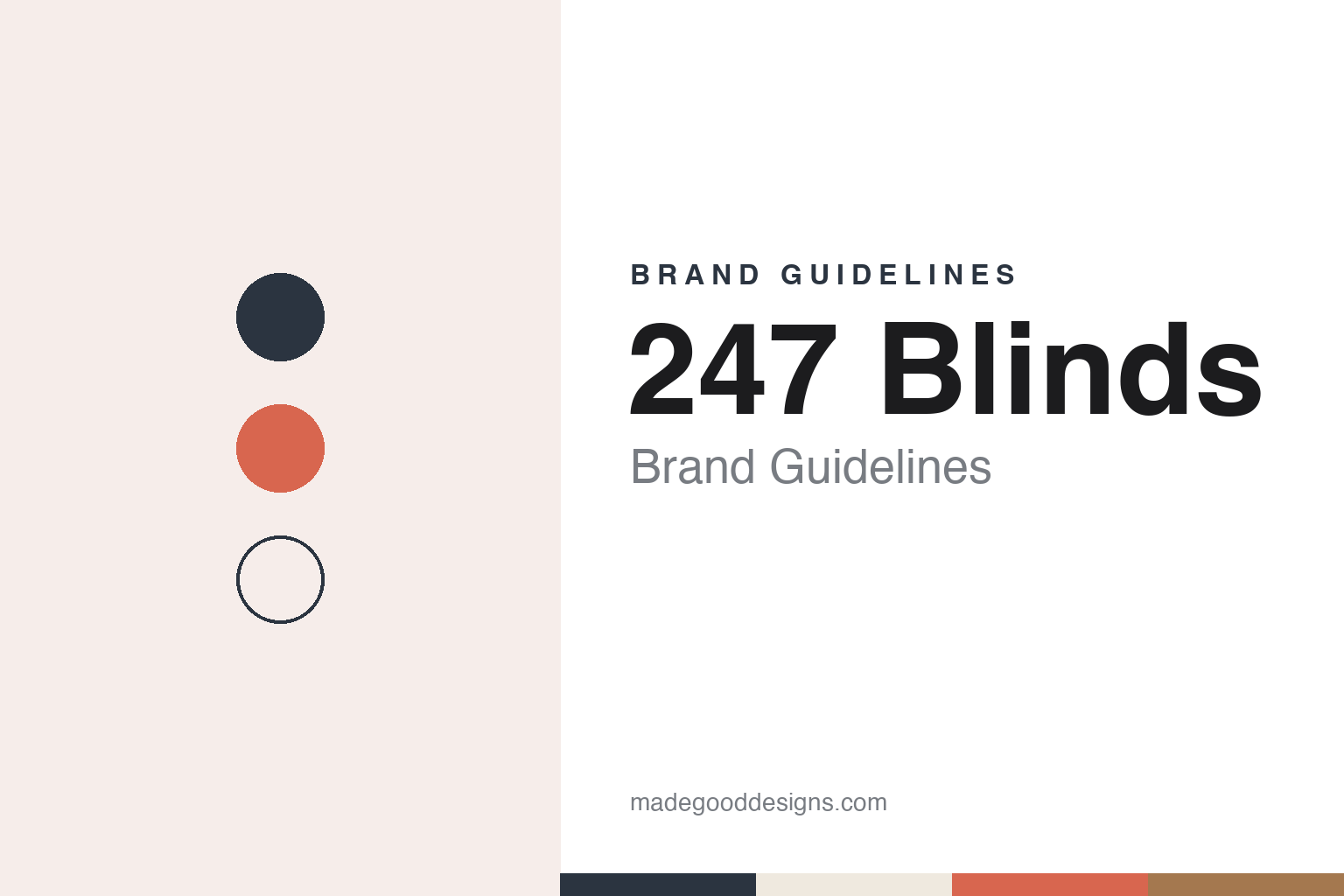
Two constants: a 247 Blinds slate, coral and oak palette and an online-retail sans register. Abstract homage — not a 247 Blinds product or mark; no blind, logo or web page is reproduced.
Mail order to made to measure
Eight years of mail order, then the web.
247 Blinds is the trading name of 247 Home Furnishings Ltd, an online seller of made-to-measure blinds, shutters and curtains based in Huddersfield, West Yorkshire. The company’s own pages date the business to 2005, the year it began selling blinds online, and the copyright line on its website starts in that year. A fuller account appears in a final report published by the Competition and Markets Authority (CMA) in September 2020: the company was founded in 1997 by Jason Peterkin and David Maher, and for its first eight years it was a mail-order business while the two founders built up its web design and e-commerce work.
According to the CMA, the founders launched their own in-house e-commerce project in 2005, and with it began offering made-to-measure blinds online. After two years of strong sales, in 2007 the company chose to concentrate entirely on selling made-to-measure blinds over the internet. The CMA described 247 in 2020 as operating only online in the UK, selling blinds, shutters and curtains to retail customers.
Peterkin has stayed at the head of the business. Furniture News, interviewing him in August 2019, described him as managing director of 247 Home Furnishings and the company as an online supplier of window blinds, shutters and curtains, and Companies House lists him as a director today. In that interview he said the last trade show he had attended was R+T in Stuttgart, in 2019, and that the company dealt with a large number of suppliers, depending on the type of window and the delivery time a customer wanted.
The company’s website gives its base as a business park in Huddersfield.
Colour
A stake, an inquiry and a sale.
The business took on a larger partner early. The CMA report says Hunter Douglas, the international window-coverings group, opened talks with the founders in September 2012 and in April 2013 bought convertible loan notes that carried rights in 247, including 49% of the voting rights. The CMA noted that this minority interest was not publicly disclosed at the time. In 2019 Hunter Douglas bought the remaining 51% of the shares, taking full ownership.
That purchase drew in the regulator. Hunter Douglas already owned the online retailer Blinds2go, which the CMA said was established in 2000, and Hillarys, which the CMA described as an in-home provider. The CMA opened a merger inquiry in November 2019, and on 16 July 2020 it provisionally found that the deal raised competition concerns in online sales of made-to-measure blinds, describing 247 and Blinds2go as close competitors with few effective alternatives.
Its final decision, published on 14 September 2020, required Hunter Douglas to sell the 51% stake it had bought in 2019. In its report the CMA described the deal as a merger between the first and third largest retailers in that online market, and said that other online rivals were much smaller. It took the view that selling the 2019 stake would restore the competition lost through that transaction.
The CMA accepted final undertakings from Hunter Douglas in December 2020. According to the CMA’s case page, the stake was sold to Cristobal Consulting Ltd, a buyer the CMA approved, and the sale was completed on 7 July 2021; the inquiry was closed on 3 August 2021. Companies House now lists Cristobal Consulting as holding more than half of the shares in 247 Home Furnishings, and Hunter Douglas N.V. as holding more than a quarter but no more than half. Hunter Douglas itself came under the control of the investment firm 3G Capital in February 2022, English Wikipedia says.
Typography
How blinds, shutters and awning brands present themselves.
Blinds, shutters and awnings are sold on how a room looks once they are up, so the companies that make and sell them lean heavily on room-set photography. A typical product page shows a finished window in a kitchen, bedroom or conservatory, often in several light conditions, before it shows the mechanism. Ranges are usually grouped by blind type, such as roller, Roman, Venetian, pleated or vertical, and then again by room, feature and colour, so the menu itself becomes a kind of style guide.
Fabric is the second language of the category. Retailers publish swatches and sample cards, and many offer free samples by post so that customers can hold a fabric against their own walls and daylight. In the UK, the Competition and Markets Authority noted in 2017 that most made-to-measure blind and shutter sales involve a visit to the customer’s home, where an adviser brings product books and samples; online sellers instead rely on posted samples and measuring guides.
Shutters and awnings bring their own imagery. Shutter pages tend to dwell on louvres, frames and finishes in painted or natural wood, shown open, half-tilted and closed. Awning makers photograph patio canopies extended over terraces and gardens, with the fabric, frame and arm in view, and often show the same canopy retracted against the wall.
Behind the product pages, most of these companies keep a corporate side: a short history of a founder and a first workshop, a list of the brands a group owns, and notes on where things are made. Ownership in the category often runs through larger groups, so a brand page may sit inside a family of sister names that share factories, suppliers or a parent company.
Aa
An online-retail sans for a business that sells only through its website. (Specimen set in Archivo, a sans STAND-IN; NOT the 247 Blinds logo.)
247 Blinds
Fittings with names, and a voice with jokes.
The range is built around made-to-measure products ordered online. The company’s website groups roller, Roman, vertical, Venetian, pleated and day-and-night blinds alongside shutters, curtains, electric blinds and awnings, and gives its no-drill fittings names of their own: Perfect Fit, Twist&Fit, Stick Fit and Clip Fit. The company says it sends free fabric samples by post and offers a five-year guarantee. It also says it is an accredited Real Living Wage employer.
In the 2019 Furniture News interview Peterkin said the company had long been known in the trade for wooden Venetian blinds, that natural, cream and white tones were the most popular colours, and that demand for grey had grown over the previous year. His own favourite was the day-and-night blind, which combines a Venetian blind with a roller. He said the business had spent the previous twelve months working on its brand image, aiming for the same experience on every channel where customers met it, and had invested in lifestyle photography so that shoppers could see what the blinds would look like in a home.
That brand voice leans on wordplay, and once it went too far for the regulator. On 4 September 2024 the Advertising Standards Authority upheld a complaint about a 247 Blinds web page, seen in July 2024, that paired a pun on the word “blinds” with an image of a person whose eyes were covered by stars and paint splatters. The ASA ruled that the advert was likely to cause serious offence to some people and told the company it must not appear again in that form; the company said the campaign had already ended.
For a design guide, 247 Blinds shows how an online-only seller can turn fitting methods into named sub-brands and rely on room-set photography to sell a product that shoppers cannot handle before they order. Compare Hunter Douglas, its former owner and still a shareholder, and Blinds2go, the online rival in the same 2020 inquiry. For this guide we use a deep slate, a coral, an oak brown and linen with a sans, an unofficial interpretation; no product or logo is reproduced.
Explore & save
Keep 247 Blinds’s identity on hand — save it to a board in the Made Good inspiration library.
247 Blinds identity set
Pin the 247 Blinds slate, coral and oak palette and the online-retail sans register to your own board.