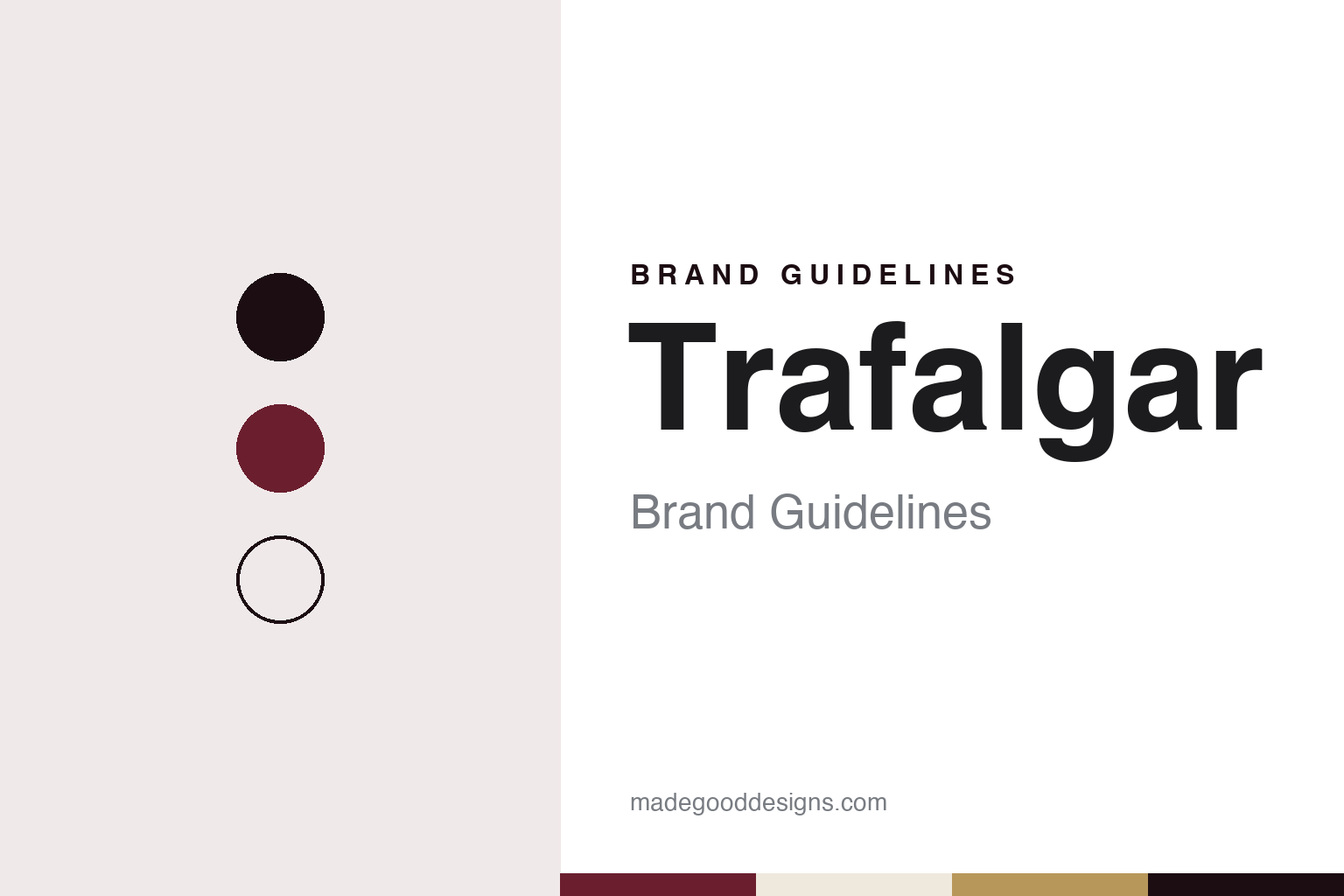
Trafalgar Brand Guidelines
A guided-touring brand named after a London square.
Aa
Two constants: a claret and Portland stone palette and a classic book serif register. Abstract homage — not a Trafalgar product or mark; no logo, coach livery or brochure is reproduced.
Trafalgar Square
A name taken from an office window.
Trafalgar takes its name from a place. Travel Weekly reported in February 2019 that the brand “was born in 1947, taking its name from its neighbourhood” when the business was located opposite South Africa House, overlooking Nelson’s Column in London’s Trafalgar Square. The company’s own site still gives 1947 as its founding year.
The South African link is part of the group history. Trafalgar belongs to The Travel Corporation, known as TTC, and Travel Weekly said in the same 2019 report that Trafalgar was TTC’s first tour-operator brand, and that the group traced its foundation to the fishing village of Paternoster in South Africa’s Western Cape in 1920. TTC’s own site describes the group as “driven by service since 1920”.
By 2019 the group around Trafalgar had grown large. The same Travel Weekly report gave TTC a presence in 70 countries, with 30 brands, more than 40 offices and 10,000 staff, and said it was headquartered in Victoria, London. Its brands ranged from escorted touring under Trafalgar, AAT Kings and Insight Vacations to the youth names Contiki and Busabout and the river cruise line Uniworld. Travel Weekly also quoted a 2016 description of TTC in Forbes as “the biggest travel company you’ve never heard of”.
Trafalgar sat at the head of a family of touring products. Travel Weekly described Costsaver as Trafalgar’s value brand in 2019, and reported that Trafalgar had begun selling tours of South Africa in the UK market for the first time in 2018. Before that, the magazine said, South Africa had been left out because of a possible conflict of interest with the inbound operator Cullinan Holdings, also part of TTC.
Colour
Family ownership, then Apollo.
For most of its life Trafalgar was owned by a family group. Travelnews in South Africa reported on 17 July 2024 that, after 104 years of Tollman family ownership, TTC had agreed to sell 18 of its global brands, including Trafalgar, Uniworld, Contiki and Insight Vacations, to funds managed by Apollo. The Red Carnation Hotel Collection and the Cullinan group of companies stayed with the family, the paper reported. travelBulletin in Australia carried the same account of the brands included.
The deal closed later that year. Canadian Lawyer’s deals listing records the transaction as closed on 31 October 2024, with financial terms not disclosed, and English Wikipedia says TTC was acquired by funds managed by Apollo Global Management in October 2024. The Trafalgar website describes Trafalgar Tours Limited as part of The Travel Corporation family of companies and gives St Peter Port, Guernsey, as its base.
The way Trafalgar sells its trips has long centred on people on the road. Its own pages describe Travel Directors and drivers who travel with each group, and list inclusions such as nightly accommodation, daily breakfast, coach transport and locally guided tours. In 2019 Gavin Tollman, then Trafalgar’s chief executive, told Travel Weekly that the company had begun its Be My Guest meals in local homes in 2009, and that an appointment made in 2010 had reshaped how its Travel Directors were trained, so that it now hired for personality rather than knowledge. He also told the magazine that reviews gathered through the feedback service Feefo were read every day by everyone in operations, and that he joined 10 to 15 of the company’s trips each year to speak to guests.
The group also runs a foundation. English Wikipedia says TTC set up the TreadRight Foundation, a not-for-profit organisation, in 2008, and TTC’s site says it has supported more than 70 organisations.
Typography
How tour operators present themselves.
Escorted and adventure tour operators sell a trip rather than a single product: a fixed route, a group of strangers travelling together and a guide who stays with them. Some build that around coaches and hotels on long touring circuits; others around small groups on trails, local buses and homestays. The operators in this guide sit at different points along that range, and their brands are built to signal which kind of trip a traveller is booking.
Group size and the guide are central to how these companies describe themselves. Intrepid Travel says its groups are usually 12 to 14 people with a local leader, while G Adventures sorts its departures into named travel styles, from Classic to Local Living and trips for travellers aged 18 to 39. These style names do the work that a range name does for a manufacturer: they let a catalogue of hundreds of itineraries be read at a glance.
Brochure and website naming in this sector tends to be plain and descriptive. Trips are usually titled by region, route or length, and the brand voice lives in the surrounding copy and in the names of collections, partnerships and community programmes. Some operators also run foundations or work with non-profit partners whose names appear beside the trips; Intrepid has The Intrepid Foundation, and G Adventures works with the Planeterra Foundation.
The corporate pages tell a second story, about founders and owners. Intrepid Travel began in Melbourne in 1989 and G Adventures in Toronto in 1990; both have since passed through outside investors, and Intrepid through a joint venture and a series of acquisitions. This guide sets out who founded each brand, who owns it now and when that changed, as dated sources report it, and keeps each company’s own claims clearly marked as its own.
Aa
A classic book serif with the poise of a printed brochure. (Specimen set in Libre Baskerville, a serif STAND-IN; NOT the Trafalgar logo.)
One Trafalgar
Three tiers under one name.
In 2026 Trafalgar became an umbrella brand. Travel Weekly in Australia reported on 31 August 2026 that TTC Tour Brands was bringing Insight Vacations and Costsaver under the Trafalgar name, with the transition starting in September 2026. Insight Vacations becomes Trafalgar Premium, Costsaver becomes Trafalgar Saver, and Trafalgar’s existing tours form the Classic tier, the magazine said. The products themselves were not being withdrawn: their 2027 itineraries stay as they were, and during the changeover Insight Vacations and Costsaver trips remain bookable alongside their Trafalgar versions through a code-share arrangement, Travel Weekly reported.
The same report set out a new structure of five travel categories, Tours, Small Groups, River Cruises, Rail Journeys and Group Sales, across the three value tiers, giving travel advisors more than 600 itineraries in 75 countries through a single brand. Travel Weekly said Trafalgar had launched river cruising in April 2026, and described the change as a shift from a traditional guided-touring brand to one portfolio covering several travel styles and budgets.
The consumer site already reflects that wider range. Its about page sorts trips into tours, small groups, river cruises and rail journeys, and the company says it travels to more than 75 countries across six continents. It also names its “Stays with Stories” hotels and Be My Guest meals among the experiences included on many trips.
For a design guide, Trafalgar shows how a name borrowed from a London square in 1947 can stretch to cover a whole family of touring products, from value trips to premium ones, while keeping one voice. Compare its youth sister brand Contiki, also part of TTC, and the escorted-touring brand Globus. For this guide we use claret, Portland stone and lion bronze with a serif, an unofficial interpretation; no product or logo is reproduced.
Explore & save
Keep Trafalgar’s identity on hand — save it to a board in the Made Good inspiration library.
Trafalgar identity set
Pin the Trafalgar claret and Portland stone palette and the classic book serif register to your own board.