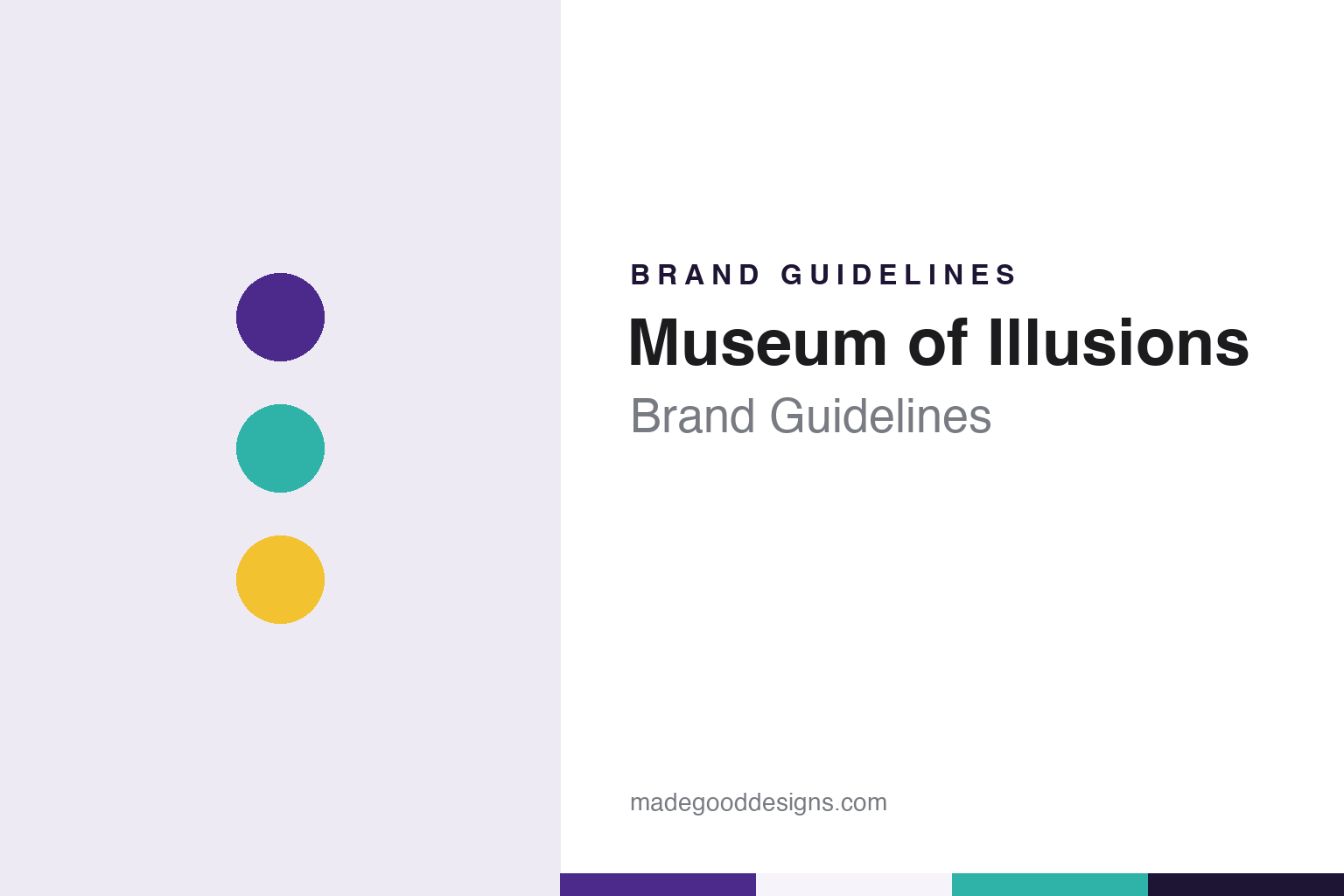
Museum of Illusions Brand Guidelines
A Zagreb idea that turned perception into a franchise.
Aa
Two constants: a violet, teal and yellow palette and a geometric grotesque register. Abstract homage — not a Museum of Illusions exhibit or mark; no logo or illusion is reproduced.
Muzej iluzija
Two friends, a television series and a room on Ilica.
The Museum of Illusions, in Croatian Muzej iluzija, opened in Zagreb in 2015, on the city’s Ilica street, Bloomberg Adria reported in May 2023. Its founders are Roko Živković and Tomislav Pamuković. Živković told Bloomberg Adria that the idea came from the National Geographic series Brain Games, at a time when he wanted a way out of long days in marketing agencies, and that two years passed between the idea and the opening; while the first museum was being built, the pair ordered exhibits from around the world. The San Diego Union-Tribune described them in 2025 as two friends who had sent brain games back and forth to each other for fun.
The company behind the brand is Metamorfoza, which runs the network from Zagreb. Živković said the first museum was busy from its first day and that visitors began writing to ask for one in their own cities. Franchising followed, with Zadar first and then Vienna, Belgrade and New York, according to Bloomberg Adria; English Wikipedia dates the first franchises, in Zadar and Ljubljana, to 2016. A master franchisee took the concept to the Middle East, including Oman, Dubai and Qatar, the same report said, and Živković recalled a period when roughly one museum opened every month, run by a team of seven.
Bloomberg Adria also reported a domestic quirk. In Croatia the Museum of Illusions does not appear in the register of museums kept by the Museum Documentation Centre, because it does not meet the national requirements for the title, and the word “museum” itself is not protected there.
Colour
Vortex tunnels, mirror rooms and an Ames room.
The museums are built from a shared set of exhibits with local additions. The San Diego Union-Tribune described the San Diego museum, opened in May 2025 as the chain’s 61st location, as a 10,000-square-foot space in the Gaslamp Quarter with 80 exhibits. Among them were 3D holograms, infinity rooms, a vortex tunnel that creates a spinning sensation, a cloning table that multiplies one person, an upside-down room and an Ames room, a distorted space that makes people look smaller or taller than they are. Pieces made for San Diego included a surf-themed reverse room and a walk-on facade of Old Town San Diego’s Colorado House, the paper said.
Photography is part of the design. Živković told Bloomberg Adria that most rooms were made to be photographed and that hashtags were added to speed up sharing, and the general manager in San Diego called the model “a self-marketing scheme,” the Union-Tribune reported.
The company calls its concept “edutainment,” a blend of education and entertainment, on its own website. Slaven Kordić of the investor Invera Equity Partners told tportal in January 2024 that schools had taken up the science content of the museums, and that from Monday to Thursday the American museums were full of school groups, with couples and families at weekends.
The museums vary in size. Kordić told tportal that the Las Vegas museum, opened in September 2023, covered 1,500 square metres and served as the chain’s flagship, while the American museums ranged from 700 to 1,500 square metres. The Zagreb original stayed on Ilica; Bloomberg Adria reported in 2023 that its whole display had been renewed that year.
Typography
How immersive venues present themselves.
Immersive art and experience venues sell a visit rather than an object. When Superblue announced its Miami opening programme in October 2020, The Art Newspaper reported that the company would earn its revenue through ticket sales rather than through sales of artworks. In December 2024 the same paper recalled that it had counted more than 100 large spaces for immersive digital art around the world, a group it called “immersive institutions.”
The companies present themselves through their rooms. Projection-filled halls, where images run across walls, floors and ceilings, sit beside mirrored rooms and colour-saturated light works. Frameless in London opened in October 2022 with four themed galleries of digitised paintings, one of them edged with mirrors, ianVisits reported; Superblue in Miami opened in May 2021 with a mirrored maze by Es Devlin and a light work by James Turrell, according to The Art Newspaper.
Naming is usually plain. Venues tend to carry the company name and the city, as in Superblue Miami, and shows and rooms take descriptive titles: the four permanent galleries at Frameless are called Beyond Reality, Colour in Motion, The World Around Us and The Art of Abstraction, The Art Newspaper reported in 2024. Both companies also list a café and private-event hire on their own websites, alongside their tickets.
Corporate pages are where founders, studios and owners appear. Artists and studios are credited by name, such as teamLab, DRIFT or Random International at Superblue, and partnerships with museums and production studios are announced in public: Frameless Creative’s touring work with London’s National Portrait Gallery, made with the studio Cinesite, was reported by The Art Newspaper in 2024 and 2025. This guide sets out what dated sources say about each company, and marks what rests on the company’s own word.
Aa
A geometric grotesque, as straight-edged as an Ames room. (Specimen set in Space Grotesk, a sans STAND-IN; NOT the Museum of Illusions logo.)
From franchise to owned museums
Two investors in five years.
Ownership changed in 2021. tportal reported in January 2024 that the private equity firm Invera Equity Partners took a 65 per cent stake in Metamorfoza in July 2021, and Bloomberg Adria reported that the deal included a capital increase and that the founders moved into advisory roles while keeping some museums, among them Zagreb’s. Under Invera the chain stopped growing by franchise alone and began opening museums owned by Metamorfoza, tportal reported. Bloomberg Adria dated the first of these to Charlotte, North Carolina, at the end of 2022 and the second to Minneapolis in April 2023, and counted 43 locations in 25 countries in May 2023, 40 of them franchised. By then, the same report said, Metamorfoza employed more than 50 people and was opening an office in Atlanta, while keeping its headquarters in Croatia; Teo Širola, who headed franchising, told Bloomberg Adria that with the company-owned museums Metamorfoza now ran every part of the operation itself. tportal reported 13 openings in 2023, six of them owned by the company and all in the United States. By May 2025 the San Diego Union-Tribune counted 22 locations in the United States and a presence in 26 countries.
In January 2026 Brightwood Capital Advisors, an American investment firm, acquired majority stakes in Metamorfoza, the company says; Lider reported in September 2026 that Brightwood had become the owner that year. In the same interview Metamorfoza’s chief development officer, Luka Novak, said the chain operated 71 locations and that a company-owned museum near Oxford Street and Covent Garden in London had opened earlier in 2026; English Wikipedia dates the London opening to May 2026.
For a design guide, the Museum of Illusions shows how a brand can be built from a repeatable kit of rooms that each invite a photograph. Compare Museum of Ice Cream, another venue designed around the camera, and Wonderspaces, which gathers interactive works under one roof. For this guide we use a deep violet, a teal and a yellow with a sans, an unofficial interpretation; no product or logo is reproduced.
Explore & save
Keep Museum of Illusions’s identity on hand — save it to a board in the Made Good inspiration library.
Museum of Illusions identity set
Pin the Museum of Illusions violet, teal and yellow palette and the geometric grotesque register to your own board.