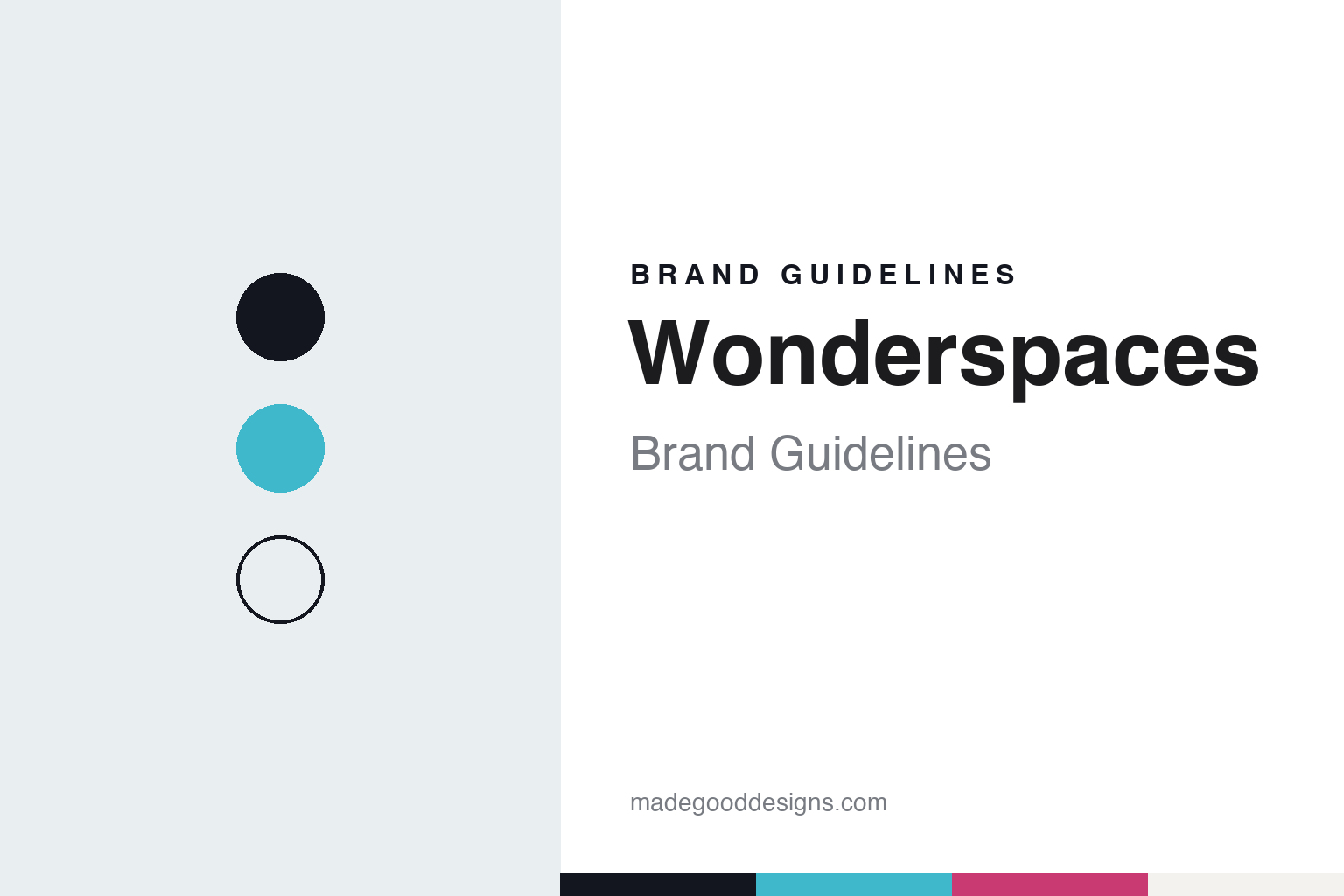
Wonderspaces Brand Guidelines
A 2016 art-show company that put interactive galleries inside shopping malls.
Aa
Two constants: a gallery-night, cyan and magenta palette and a rounded geometric sans register. Abstract homage — not a Wonderspaces product or mark; no artwork, logo or sign is reproduced.
Pop-ups first
Two co-founders, San Diego and a mall in Scottsdale.
Wonderspaces is an American company that stages changing shows of interactive art in galleries, two of them inside shopping malls. The Texas magazine PaperCity reported in January 2021 that Jason Shin and Patrick Charles co-founded Wonderspaces, Inc. in 2016. PhillyVoice described the company in January 2020 as based in California and said it had launched in 2016 and, after pop-up shows in San Diego, opened its first permanent gallery in Scottsdale, Arizona. The Phoenix public radio station KJZZ called it a Los Angeles-based company in May 2019. Both KJZZ and PhillyVoice named Shin as the company’s president.
The San Diego shows ran in temporary spaces. The company’s first long-term home, KJZZ reported, was at Scottsdale Fashion Square in Arizona: a gallery of about 16,000 square feet just behind the mall’s food court, in part of what had been a movie theatre. Its first exhibit there, called “Point of View,” opened in April 2019 with around a dozen pieces, among them virtual-reality works, 3D-printed sculptures lit by strobes and a piece that lets visitors “paint” by moving in front of a screen.
KJZZ reported the plan as a show model rather than a fixed collection: exhibitions of three to four months, three times a year, with works moving on to other Wonderspaces venues afterwards. The name is used plainly and paired with a place, as in Wonderspaces Arizona, the title of the company’s current Scottsdale website, and Wonderspaces Austin, the name used in local press for its Texas gallery.
Colour
Works by named artists, rotated.
Wonderspaces does not present itself as the author of the art it shows. Its galleries are made of works by outside artists and studios, and the press that reviewed them credits each piece by name. The most widely described is “Submergence” by Squidsoup, a UK-based group that PaperCity said in 2021 consisted of five members; it is a room of 8,064 individually programmed lights that change in time with music, which visitors walk through or lie beneath. PhillyVoice described the same work in 2020 as more than 8,000 lights changing colour with the music.
Other works named in those reports include “Body Paint” by Memo Akten, a motion-sensing piece that splashes digital paint across a projection screen as people move in front of it; “Thank You Bags” by Reed van Brunschot, two hand-painted plastic shopping bags enlarged to giant size and kept inflated by fans, which the artist told PaperCity was about the excess of consumer capitalism and the waste it leaves; and “On a Human Scale” by Matthew Matthew, a piano wired to videos of New Yorkers each singing a note, so that whoever plays the keys conducts a choir of strangers. PhillyVoice added “Black Balloons” by Tadao Cern and “The Last Word” by Illegal Art, a wall of thousands of tightly rolled notes on which visitors can write or read.
The company’s relationship with artists was part of its pitch. An assistant general manager at the Austin gallery told PaperCity in 2021 that Wonderspaces pays artists to show their work, where many galleries would charge them a fee. The same article reported that the Austin gallery opened with 12 pieces and planned to swap two or three of them every few months.
The rotation continues on the company’s own pages. In November 2026 the Wonderspaces Arizona website listed 13 installations and said the line-up changes regularly and draws on more than 100 artists from around the world. Its descriptions include a galaxy of 8,064 points of light, a life-drawing class in which three robots sketch the sitter, a sculpture of 2,300 suspended wooden balls that resolves into a portrait from about 40 feet away, and the giant “Thank You” bags.
Typography
Venues and their presentation.
Immersive art and experience venues sell a visit rather than an object. When Superblue announced its Miami opening programme in October 2020, The Art Newspaper reported that the company would earn its revenue through ticket sales rather than through sales of artworks. In December 2024 the same paper recalled that it had counted more than 100 large spaces for immersive digital art around the world, a group it called “immersive institutions.”
The companies present themselves through their rooms. Projection-filled halls, where images run across walls, floors and ceilings, sit beside mirrored rooms and colour-saturated light works. Frameless in London opened in October 2022 with four themed galleries of digitised paintings, one of them edged with mirrors, ianVisits reported; Superblue in Miami opened in May 2021 with a mirrored maze by Es Devlin and a light work by James Turrell, according to The Art Newspaper.
Naming is usually plain. Venues tend to carry the company name and the city, as in Superblue Miami, and shows and rooms take descriptive titles: the four permanent galleries at Frameless are called Beyond Reality, Colour in Motion, The World Around Us and The Art of Abstraction, The Art Newspaper reported in 2024. Both companies also list a café and private-event hire on their own websites, alongside their tickets.
Corporate pages are where founders, studios and owners appear. Artists and studios are credited by name, such as teamLab, DRIFT or Random International at Superblue, and partnerships with museums and production studios are announced in public: Frameless Creative’s touring work with London’s National Portrait Gallery, made with the studio Cinesite, was reported by The Art Newspaper in 2024 and 2025. This guide sets out what dated sources say about each company, and marks what rests on the company’s own word.
Aa
A rounded geometric sans for a plain, place-led name. (Specimen set in Outfit, a sans STAND-IN; NOT the Wonderspaces logo.)
Wonderspaces
Philadelphia, Austin and a smaller footprint.
The company grew from one mall to three cities in little more than a year. PhillyVoice reported that Wonderspaces would open on 24 January 2020 at Fashion District Philadelphia, a 24,000-square-foot gallery inside the mall with access from the street, 14 artworks and a bar serving food and cocktails. The paper called it the company’s largest location. PhillyVoice quoted Shin calling it “our first permanent location in a major metropolitan area.”
Texas followed. Community Impact reported that Wonderspaces Austin opened in June 2020; PaperCity said the gallery occupied a 28,000-square-foot warehouse in north Austin, near the Heritage Hills neighbourhood, rather than a mall unit, and showed 12 works when it reviewed the space in January 2021.
The footprint has since shrunk. In April 2026 Community Impact reported that Wonderspaces Austin had closed permanently in late 2025, according to the gallery’s Instagram account, after more than five years. The same report said that the Philadelphia gallery was closed for “operational changes,” according to social media, and that the Scottsdale gallery remained. In November 2026 the company’s main web address led straight to the Wonderspaces Arizona site, which sold timed tickets for Scottsdale Fashion Square and described the gallery as fully indoors and open year-round.
For a design guide, Wonderspaces shows how a venue brand can stay deliberately quiet: a plain name tied to a city, a mall address and a programme in which the credited artists, not the operator, supply the colour and spectacle. Compare Superblue, another company built around showing other artists’ immersive works, and Meow Wolf, a collective that makes its own. For this guide we use a deep gallery night, a point-of-light cyan and a magenta with a rounded sans, an unofficial interpretation; no product or logo is reproduced.
Explore & save
Keep Wonderspaces’s identity on hand — save it to a board in the Made Good inspiration library.
Wonderspaces identity set
Pin the Wonderspaces gallery-night, cyan and magenta palette and the rounded geometric sans register to your own board.