Topdeck Brand Guidelines
From London double-deckers to small group trips.
Aa
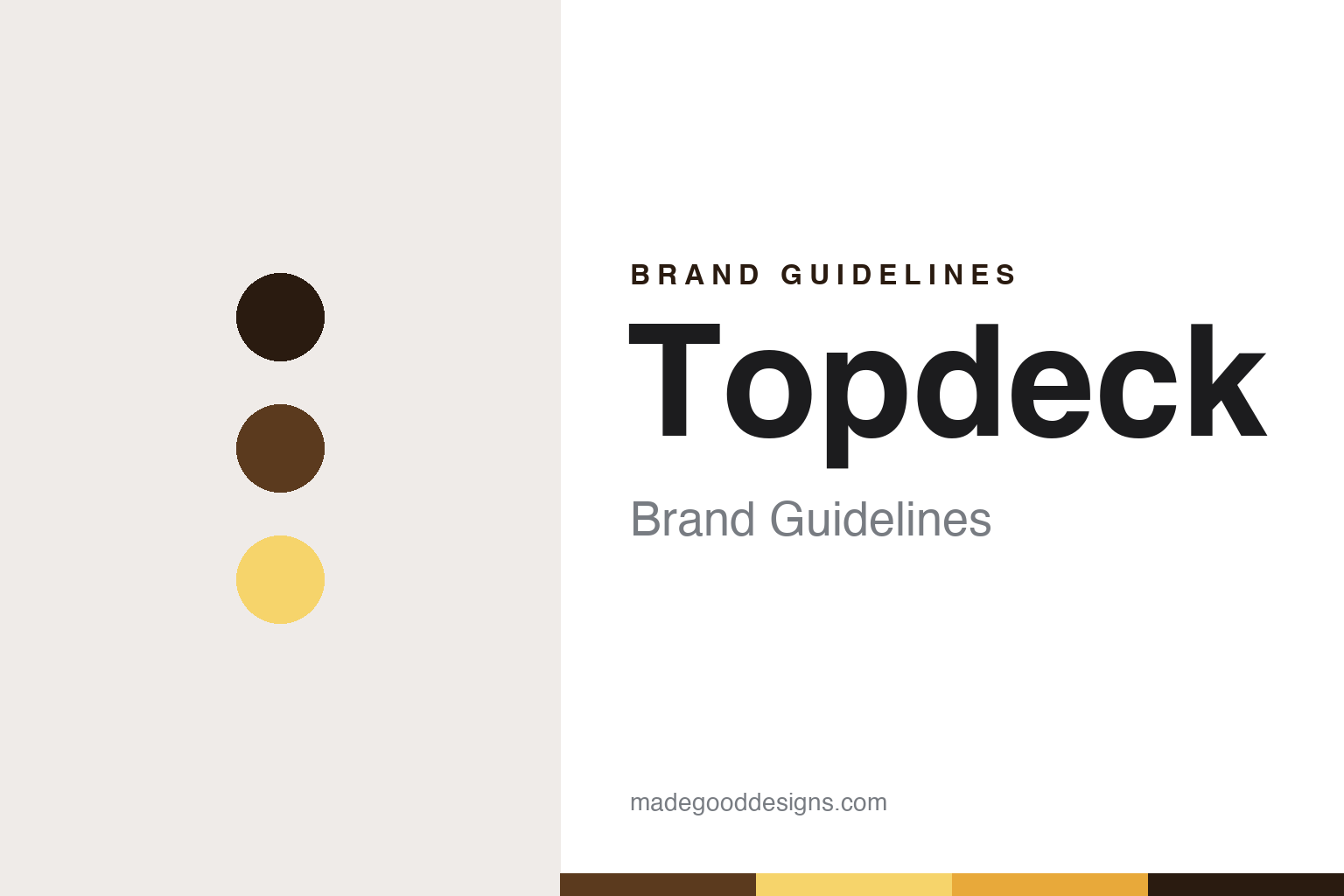
Two constants: a Topdeck yellow and brown palette and a Rounded grotesque register. Abstract homage — not a Topdeck product or mark; no bus, logo or nameplate is reproduced.
Argas Persicus
A double-decker bus and a road to Morocco.
Topdeck began in London in 1973. English Wikipedia says the company was formally named Argas Persicus Ltd and traded as Top Deck Travel, later shortened to Topdeck. The registered name refers to the turkey tick, Argas persicus, because the founders had met at veterinary school. The company’s own origin story says Topdeck was born when Skroo Turner and his friends bought a double-decker bus in London and drove it across Europe to Morocco, and that the trip went so well they ran it again, and again. English Wikipedia gives that first trip as one to Spain and Morocco.
Travel Weekly, the Australian trade title, reported in August 2014 that Graham Turner, by then chief executive of Flight Centre, was one of the original founders of Topdeck Travel in 1973. English Wikipedia says the founders went on to set up Flight Centre, the Australian travel retailer, so the bus company and the travel agency chain share their beginnings.
The buses were the brand. English Wikipedia says the company used Bristol K5 and Lodekka double-deckers converted to a camper-van layout, with passengers sleeping on board. From 1974 into the 1990s these “deckers” toured Europe and went further afield, to the Middle East and overland between London and Kathmandu. In the early 1980s the company moved into the United States, where it called its Lodekkas “Decker Homes,” and from 1980 it ran trips from Sydney to London, using a converted Sydney double-decker for the final stretch, the encyclopaedia says.
Colour
From deckers to coaches and hotels.
Coaches arrived in the mid-1980s, English Wikipedia says, at first mainly for winter ski holidays. The old Lodekkas, some of them more than 40 years old, began to retire in large numbers in the early 1990s, and many went abroad to new owners. Former Topdeck buses can still be seen in France, Italy, the Netherlands and New Zealand, the encyclopaedia says, and one former Southern Vectis bus is on display at the Isle of Wight Bus & Coach Museum. The emphasis moved to camping and hard-top trips staying at European campsites, and later to hotel-based trips.
Ownership changed several times in the 1990s. In 2003, English Wikipedia says, the company was bought by a consortium that included Australian Pacific Touring and Connections Adventures. It introduced a large hotel programme in 2005 and smaller group trips under an “Explorer” banner in 2007, and on 1 April 2010 Connections Adventures became Topdeck Australia. The encyclopaedia also says Topdeck joined a venture with Buffalo Tours to run trips in Vietnam, Laos, Cambodia and Thailand, and that Topdeck and Contiki are among the few survivors of a period in which several similar companies, such as Transit, Autotours and Sundowners, left the business.
In August 2014 the founder’s company came back into the picture. Travel Weekly reported on 27 August 2014 that Topdeck was forming a joint venture with Flight Centre, after two of its shareholders decided to sell their shares, on a model like Flight Centre’s existing joint venture with Back-Roads Touring. Managing director James Nathan stayed at the head of the business, and Topdeck would continue to operate as an independent entity with headquarters in Brisbane and in Chiswick, London, the title reported.
Typography
Design and documentation.
Escorted and adventure tour operators sell a trip rather than a single product: a fixed route, a group of strangers travelling together and a guide who stays with them. Some build that around coaches and hotels on long touring circuits; others around small groups on trails, local buses and homestays. The operators in this guide sit at different points along that range, and their brands are built to signal which kind of trip a traveller is booking.
Group size and the guide are central to how these companies describe themselves. Intrepid Travel says its groups are usually 12 to 14 people with a local leader, while G Adventures sorts its departures into named travel styles, from Classic to Local Living and trips for travellers aged 18 to 39. These style names do the work that a range name does for a manufacturer: they let a catalogue of hundreds of itineraries be read at a glance.
Brochure and website naming in this sector tends to be plain and descriptive. Trips are usually titled by region, route or length, and the brand voice lives in the surrounding copy and in the names of collections, partnerships and community programmes. Some operators also run foundations or work with non-profit partners whose names appear beside the trips; Intrepid has The Intrepid Foundation, and G Adventures works with the Planeterra Foundation.
The corporate pages tell a second story, about founders and owners. Intrepid Travel began in Melbourne in 1989 and G Adventures in Toronto in 1990; both have since passed through outside investors, and Intrepid through a joint venture and a series of acquisitions. This guide sets out who founded each brand, who owns it now and when that changed, as dated sources report it, and keeps each company’s own claims clearly marked as its own.
Aa
A rounded grotesque for a brand built on buses and road trips. (Specimen set in Space Grotesk, a sans STAND-IN; NOT the Topdeck logo.)
Topdeck
Small group trips packed with more.
The brand has been rebuilt twice in recent years. In January 2020, Travel Weekly reported, Topdeck launched a brand proposition called “Feel Real,” built on research in Australia, New Zealand, the United States and the United Kingdom among its target audience of 18- to 39-year-olds. It came with a new website, a digital campaign, refreshed messaging and new trips to Sri Lanka, Georgia, and Ecuador and the Galápagos. Its global general manager told the title that group travel “has an image problem” the company aimed to overcome.
The larger change came in September 2025. Mumbrella reported on 25 September 2025 that Topdeck had retired its 50-seat coaches and relaunched with a small-group model for travellers aged 18 to 32. Travel Bulletin reported the next day that groups were now capped at 18, with trips of seven to 47 days and travel by train, mini-coach and local transport, and that the age bracket had dropped from 18–39 to 18–32. Earlier in 2025, the magazine reported, a Flight Centre Travel Group announcement to the ASX had described Topdeck as an “underperforming asset,” which its general manager put down to a decline in large-coach youth touring across the market.
The relaunch came with a new look. Travel Bulletin said Topdeck rolled out a yellow and brown colourway, a refreshed website and the strapline “Small group trips packed with more,” which now heads the company’s website. The site describes groups of up to 18 people travelling with a Trip Leader, on trips across Europe, Asia, New Zealand, and the Middle East and North Africa, and its origin story still begins with the double-decker bus of 1973.
For a design guide, Topdeck shows how a youth tour brand can keep its founding story while changing almost everything else about the product. Compare Contiki, the other long-running youth tour operator, and Intrepid Travel, another small-group company. For this guide we use a sunny yellow and a deep bus brown with a rounded grotesque sans, an unofficial interpretation; no product or logo is reproduced.
Explore & save
Keep Topdeck’s identity on hand — save it to a board in the Made Good inspiration library.
Topdeck identity set
Pin the Topdeck yellow and brown palette and the Rounded grotesque register to your own board.