Total Wine & More Brand Guidelines
The Delaware liquor store that took a rival’s name and went national.
Aa
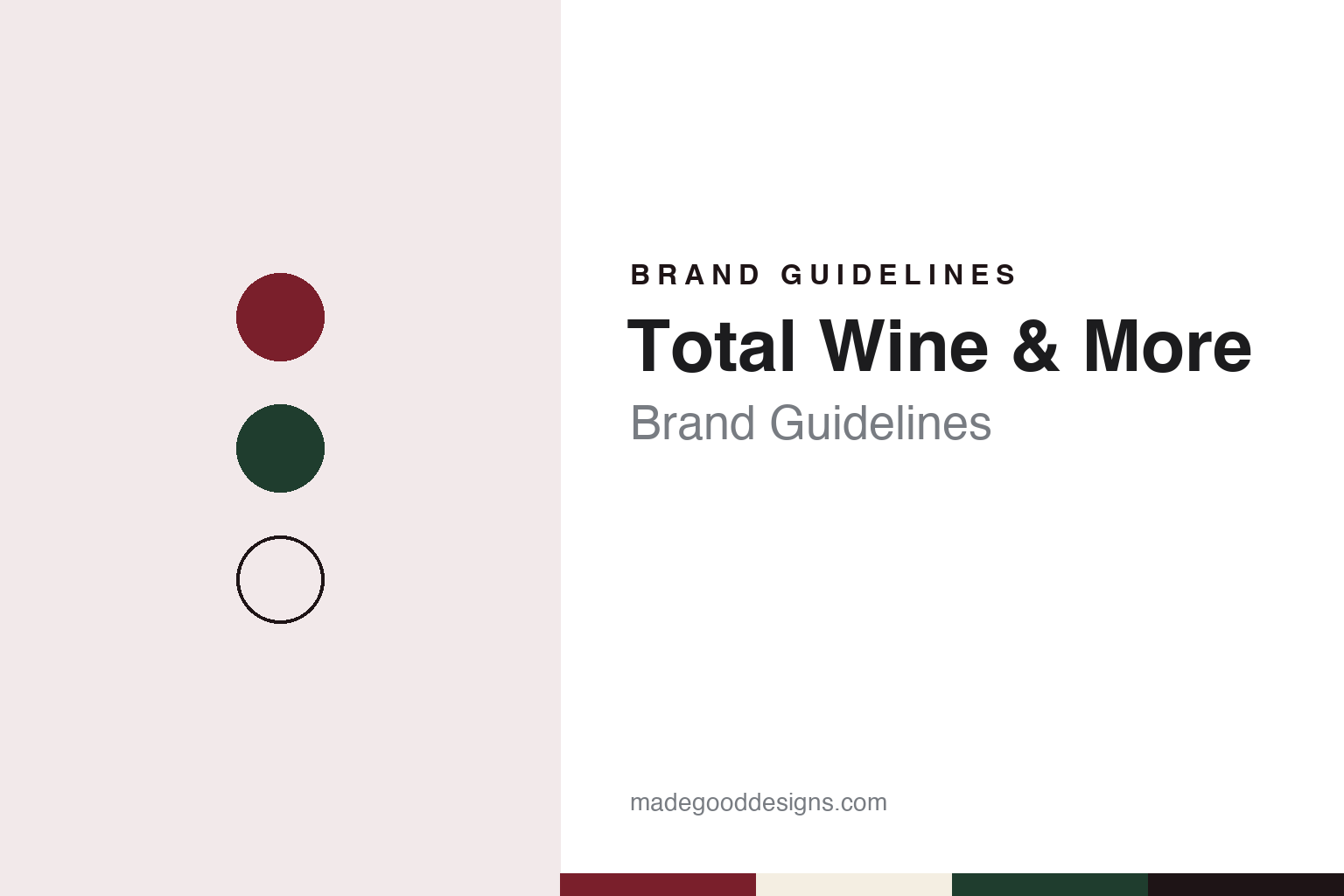
Two constants: a cellar red, bottle green and cream palette and a bookish serif register. Abstract homage — not a Total Wine & More product or mark; no logo, label or store sign is reproduced.
Liquor World
Two brothers, a Delaware store and a borrowed name.
Total Wine & More traces its present form to 1991, when the brothers David and Robert Trone opened a store called Liquor World. English Wikipedia places that first shop in Claymont, Delaware, and says a second followed in Milltown, in the same state. The family already knew drinks retail: English Wikipedia says Trone family members opened a store called Beer and Soda Warehouse in 1984, and in 1985 opened stores in the Pittsburgh area under the names Beer and Pop Warehouse and later Beer World, before legal difficulties in Pennsylvania led them to leave the state.
Liquor World grew through the 1990s along the East Coast, and its name changed after an acquisition. In 1998, according to English Wikipedia, the brothers bought Total Beverage, a chain in the Washington, D.C. area, and adopted and modified its name for the whole business. The trade magazine Market Watch, profiling the company in 2019, describes the same step: after acquiring the D.C.-area chain, the brothers changed the name to Total Wine & More and began expanding quickly. English Wikipedia gives the company’s headquarters as North Bethesda, Maryland, and says the stores are owned and operated by a company called Retail Services and Systems.
Expansion went south and then west. English Wikipedia dates the chain’s entry into Florida to 2005 and into California and Arizona to 2007. Market Watch reported that the company started 2019 with 193 stores in 23 states. By October 2023 English Wikipedia counts 259 stores in 28 states, with online sales in the 24 states that allow them, and in June 2025 the wine trade site Vinetur reported 277 stores across 29 states, with 14 new stores opened during 2024. Vinetur named Troy Rice as chief executive at that time; Market Watch had described both brothers as co-owners in 2019, with a senior leadership team running much of the daily work.
Colour
Big stores, printed guides and an app that reads labels.
The format is the large store with a deep range. English Wikipedia says each Total Wine store carries roughly 8,000 wines from around the world, about 3,000 spirits where state law permits, and around 2,500 beers, alongside accessories, gifts and cigars. It also says the company publishes separate guides to wine, beer and spirits for its customers and runs loyalty programmes that vary by location, and that in 2018 it employed about 7,000 people, including around 500 at its headquarters and some 800 wine specialists.
Digital tools became a larger part of the picture in the late 2010s. Market Watch reported in 2019 that the company had rebuilt its website and launched a new mobile app, which went live in 2017; the article describes label recognition, barcode scanning that brings up details of a wine, spirit or beer, and in-store wayfinding that helps shoppers find a bottle on the shelf. It adds that much of the website and app work was done by an in-house team. In June 2025 Vinetur reported that the app had been downloaded about seven million times.
Because alcohol retail is regulated state by state, the chain’s growth has often run through licensing boards and courts. English Wikipedia records that in August 2016 the company agreed with Connecticut to stop selling below the state’s minimum prices, and that in the same year Massachusetts regulators imposed multi-day licence suspensions over below-cost sales; the company challenged the suspensions in court and won. In New York, where it has a single store, English Wikipedia says the State Liquor Authority rejected an application for a store near White Plains in 2017, and in September 2019 a state court blocked a planned store in Hartsdale, a ruling the company appealed.
One case reached the United States Supreme Court. Tennessee Wine and Spirits Retailers Association v. Thomas (2019) arose after Total Wine applied for a licence to open a store in Knoxville. The Court ruled 7–2 that Tennessee’s two-year residency requirement for retail liquor licence applicants violated the Commerce Clause, upholding the Sixth Circuit. English Wikipedia notes that Kentucky, Indiana, Kansas and Louisiana later repealed similar residency rules.
Typography
Design and documentation.
Wine merchants and alcohol retailers sell a product that shoppers cannot always taste before they pay, so their identities lean on words, place and guidance more than on packaging of their own. A shop name, a fascia and a few lines of handwriting on a card next to a bottle carry much of the work. For a designer, the useful material is what these companies show in public: their shop fronts, shelf cards, tasting areas, catalogues and the corporate pages that explain who founded and who owns them.
The physical shop is the first layer. Some chains began in warehouse-style units where wine was stacked in cases, and later refits moved towards shelving and tasting areas, as Decanter reported of one British chain in 2019. Shelf talkers, the small cards that describe a wine’s style and origin, sit beside the bottles and can be written in a personal, conversational voice. Tasting counters and by-the-glass machines turn part of the shop into a place to try before buying.
Mail-order and online merchants work through a different set of objects: printed catalogues, mixed cases, club mailings and order pages. Their own-label wines, sold under invented names rather than the merchant’s own, are part of the range and are presented much like any producer’s bottle. A founder’s story, such as a first trip to a vineyard or a single van, can be retold in these materials.
Corporate pages fill in the rest: founding dates, changes of ownership, parent groups and, for state retailers, the legal basis on which they operate. This guide uses dated, independent sources for those facts and treats the company’s own descriptions as its own words. The palette and type on each page are an unofficial interpretation chosen for the guide, not a copy of any retailer’s signage, labels or logo.
Aa
A bookish serif for a retailer that prints its own guides. (Specimen set in Fraunces, a serif STAND-IN; NOT the Total Wine & More logo.)
Total Wine & More
A name taken from a chain it bought.
The name is the plainest piece of the brand’s history. “Total” comes from Total Beverage, the D.C.-area chain bought in 1998, which English Wikipedia says the brothers adopted and modified; the original Liquor World name gave way to it as the business grew. The “& More” sits over stores that, by English Wikipedia’s count, stock spirits, beer, cigars, gifts and accessories as well as wine.
Around that name, the company’s customer material is practical. English Wikipedia describes separate printed guides to wine, beer and spirits, and Market Watch describes an app built to recognise a bottle’s label, scan a barcode and guide a shopper through a large store. Store and state counts have been reported year by year in the trade press, from 193 stores in 2019 to 277 in 2025.
For a design guide, Total Wine & More shows how a regional liquor store grew into a national chain while carrying a name inherited from a smaller rival, and how a very large range is backed by printed guides, label recognition and in-store wayfinding. Compare BevMo!, the California chain with its own in-house wine scores, and LCBO, Ontario’s provincial retailer. For this guide we use cellar red, bottle green and cream with a serif, an unofficial interpretation; no product or logo is reproduced.
Explore & save
Keep Total Wine & More’s identity on hand — save it to a board in the Made Good inspiration library.
Total Wine & More identity set
Pin the Total Wine & More cellar red, bottle green and cream palette and the bookish serif register to your own board.