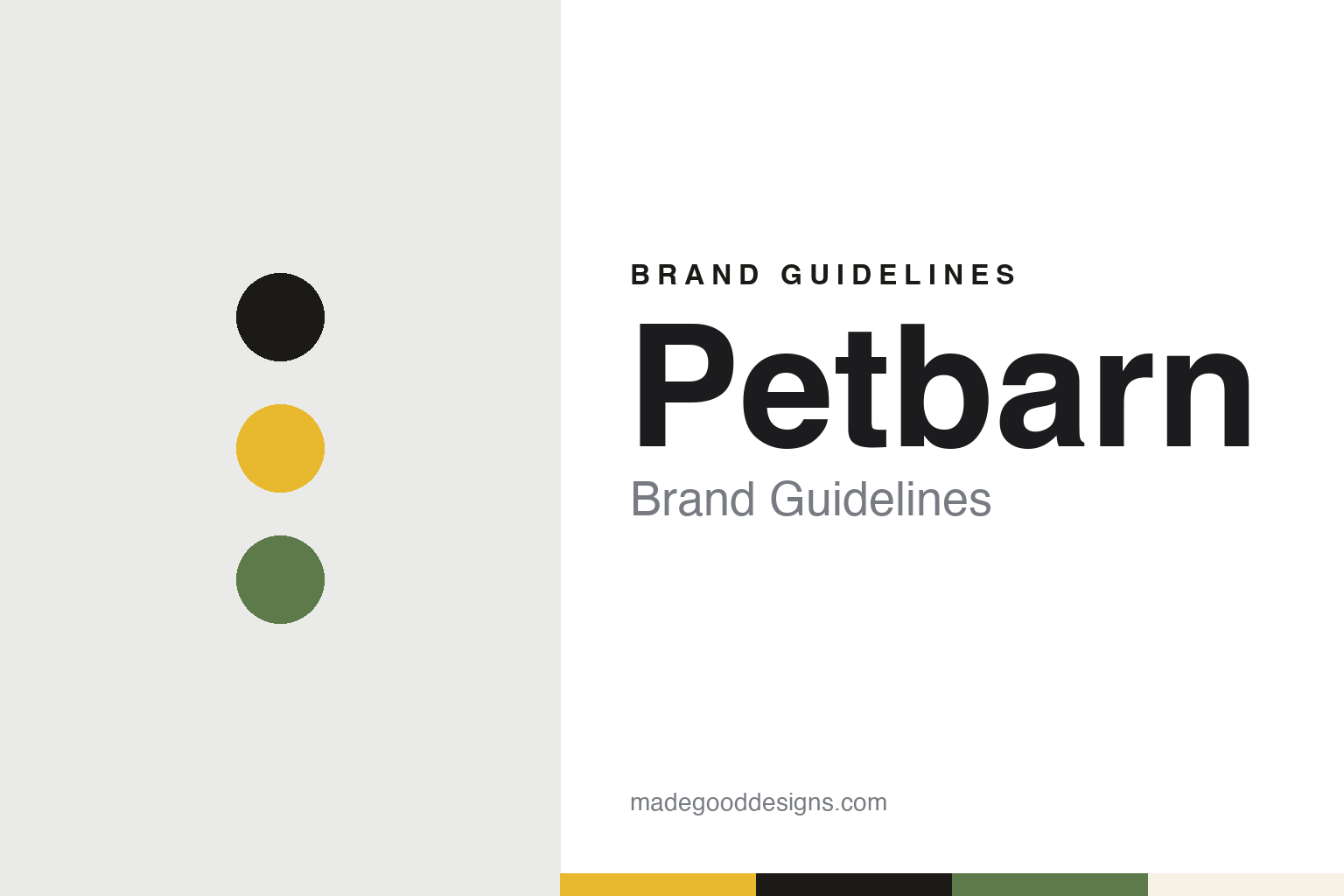
Petbarn Brand Guidelines
A yellow field, a family of black pet shapes and a chain that joined a vet group.
Aa
Two constants: a Petbarn yellow and black palette and a Rounded sans register. Abstract homage — not a Petbarn asset or mark; no logo, mascot or wordmark is reproduced.
A Sydney pet barn
A New South Wales chain, a rival’s store and a vet group.
Petbarn is a chain of pet-supply stores in Australia, and its paper trail starts in New South Wales. The Australian Business Register lists the Petbarn name against the company behind the chain from May 2000, with New South Wales as its main business location. The same record shows the company trading as Petbarn Limited between April 2004 and May 2009 before it returned to being a proprietary company, and it lists other business names held by the company, among them “The Pet Warehouse,” registered from October 2001.
That last name has a story behind it. Philip Bartholomew, a retailer who opened a store called The Pet Warehouse in Sydney in 2001, told SmartCompany in September 2015 that a Petbarn opened near his shop halfway through 2002. He said that, after he opened a second store in Kogarah, Petbarn asked him to run the company, and that in July 2004 he became its chief executive, folding his two stores into the Petbarn group to give it 11 in total. He left in 2006.
The larger change came a decade later. English Wikipedia says that in 2014 the veterinary group Greencross, founded in Townsville in 1994, acquired Mammoth Pet Holdings, the parent of Petbarn in Australia and of the Animates chain in New Zealand, citing a report in The Australian of 15 November 2013. The deal put a pet-supply chain and a network of vet clinics in one company; English Wikipedia illustrates the group with a photograph of a Petbarn and a Greencross Vets clinic side by side in Cannington, Western Australia.
Colour
A family of pets, drawn as black shapes on yellow.
Petbarn’s current look dates from 2019. Transform magazine reported that year that the retailer had worked with the brand consultancy Landor on a rebrand that left the logo mostly unchanged but added a family of pets as mascots: birds, mice, cats, dogs and lizards, each given a name and animated to copy the behaviour of its species. The magazine described a simple animation style of black, filled shapes against a yellow background, carried across brochures, posters, delivery boxes, tote bags and the stores themselves.
Landor’s own project notes, published by the identity blog Identity Designed, say the new brand launched in February 2019, that the agency worked with the Australian illustrator and animator Marco Palmieri on the animal family, and that Petbarn ran a campaign inviting customers to name each pet. Landor framed the work as a shift from utility to care, set against supermarkets that had begun to stock wide pet ranges.
The characters then became the centre of the advertising. B&T reported on 15 November 2022 that the agency Howatson+Company had built a platform called “Pets Love Petbarn” around them, with television spots directed by Max Barden of Sweetshop and voiced by comedians including Sam Simmons and Michelle Brasier, which gave the animals grown-up personalities. On 13 October 2026, B&T reported a further step: two of the characters, Petey and Barnadette, whose names are drawn from the word Petbarn, were recast as the voices of the brand. The launch began with Petey appearing to have deleted Petbarn’s whole Instagram feed by accident, and the magazine said customer emails now come from the pair, with outdoor posters, store media and social posts built from 3D modelling, 2D animation and visual effects.
Typography
Design and documentation.
Pet-supply retailers present themselves first through the store. Many trade from large out-of-town units described as superstores, where food, bedding, toys and aquarium or small-animal supplies run down long aisles under plain category signs. Several chains have added services under the same roof: grooming salons, vet clinics and training, each often with its own name that sits beside the main shop name on the fascia and in the aisles.
Naming follows the same pattern. Chains tend to keep one short shop name and add own-label ranges with names of their own, so a single store can carry the retailer’s brand, its food and accessory ranges and many outside makers side by side. In the UK, for example, Pets at Home dates its Wainwright’s food range to 2007, and trade reports of Jollyes have named its K9, Lifestage and Raw and Simple ranges. When a chain unifies these names, as Pets at Home did in 2023, the change is usually reported in the design and retail press.
Loyalty clubs and online shops are the other public face. Retailers publish membership schemes for regular buyers, such as Pets at Home’s VIP club, launched in 2012 according to the company, alongside websites with click-and-collect, delivery and repeat-order options. Shelf prices, promotions and member offers are presented in the stores and online, and change often, so a design guide describes how they are shown rather than what they are.
Behind the shop fronts sit corporate and investor pages. These usually give a founding story, the current owner and any stock-market listing, and many chains in this category have passed between private-equity owners before or after a listing. This guide sets out what dated sources say about each company’s founders, owners and listings, and treats the companies’ own descriptions as their claims.
Aa
A rounded sans in the spirit of the friendly retail lettering. (Specimen set in Nunito, a sans STAND-IN; NOT the Petbarn logo.)
Petbarn
Owned by a private equity group, sold through stores and screens.
Greencross, and Petbarn with it, has changed hands more than once. English Wikipedia says that in February 2019 TPG Capital announced it would buy Greencross and take it off the Australian Securities Exchange, and that in February 2022 TPG sold a 45 per cent stake to AustralianSuper and the Healthcare of Ontario Pension Plan. Inside Retail reported on 17 July 2026 that the supermarket group Coles had ended discussions with TPG over a possible acquisition of what is now called the Greencross Pet Wellness Company, which the paper described as the owner of Petbarn and City Vets. As of that report, Greencross had 240 locations in its retail portfolio and more than 200 veterinary clinics, according to Inside Retail, which noted that Coles had recently wound up its own pet retailer, Swaggle.
Petbarn also sells space to the brands on its shelves. Mediaweek reported on 18 February 2025 that Petbarn had launched a retail media network called PetAds with reo, a unit of the outdoor media company oOh!media, which would run campaigns for suppliers across Petbarn’s website and app, reach members of its Friends for Life loyalty programme, and install and manage an in-store screen network across the chain. Reo was to handle onsite, off-site and in-store media and supply a dedicated sales team, and advertisers could extend campaigns to oOh!media’s outdoor sites near Petbarn stores, the magazine said.
For a design guide, Petbarn shows how a retailer can keep its logo and change its whole character by adding a cast of animals with names and habits. Compare Petstock, the Victorian chain that grew alongside it, and Animates, the New Zealand chain that came into the same group through the Mammoth deal. For this guide we use a warm yellow, a soft black and a paddock green with a rounded sans, an unofficial interpretation; no product or logo is reproduced.
Explore & save
Keep Petbarn’s identity on hand — save it to a board in the Made Good inspiration library.
Petbarn identity set
Pin the Petbarn yellow and black palette and the Rounded sans register to your own board.