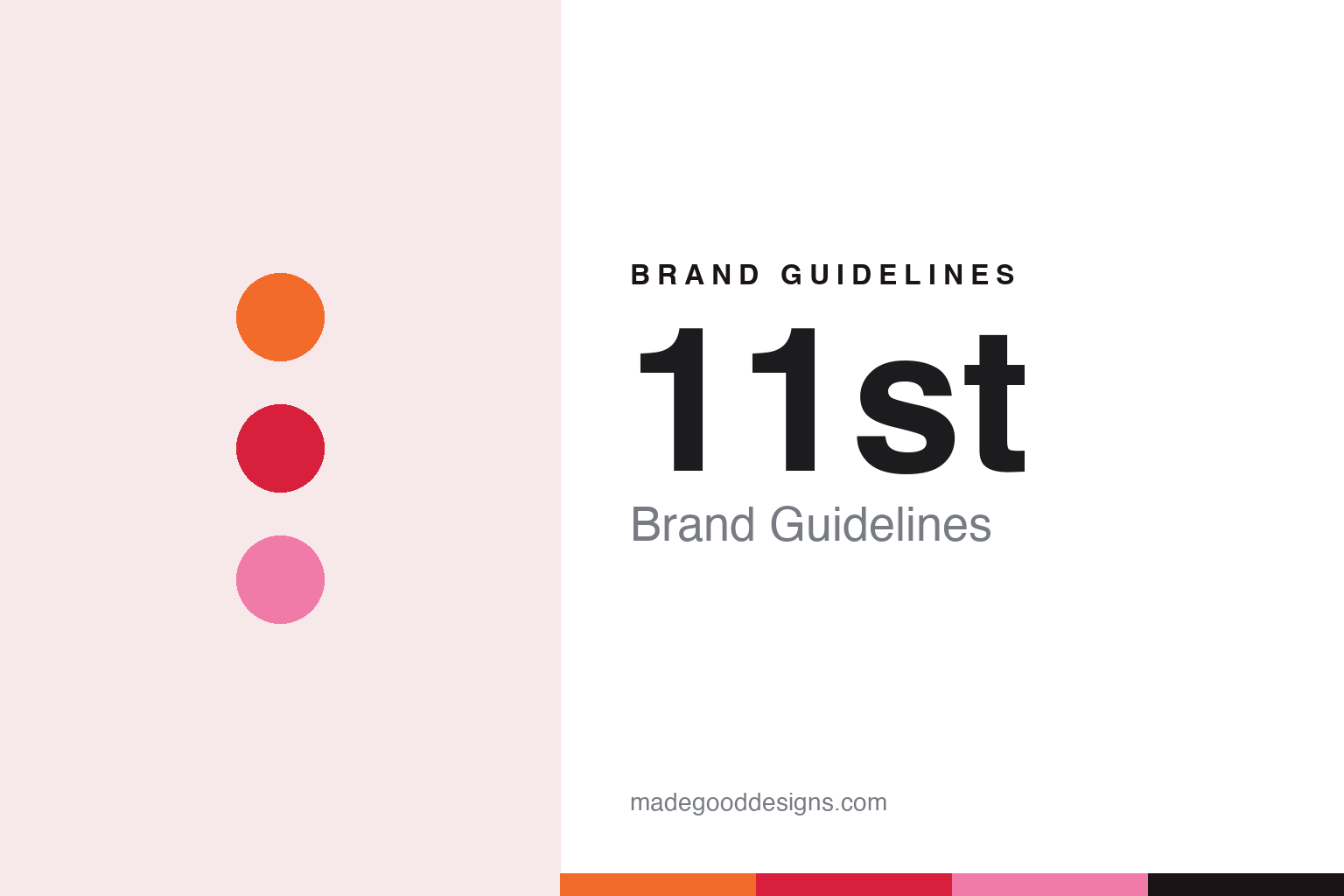
11st Brand Guidelines
The SK open market that turned a red 11 into a gradient.
Aa
Two constants: an orange, red and pink palette and a Korean gothic sans register. Abstract homage — not an 11st asset; no logo, app screen or mark is reproduced.
Commerce Planet
An SK open market launched in 2008.
11st, written 11번가 in Korean, is a South Korean online open market: a platform on which independent sellers list goods for shoppers. Korean Wikipedia says it began trading in February 2008. It grew up inside the telecoms side of the SK group. According to Korean Wikipedia, it was first run by a subsidiary, Commerce Planet, which was absorbed into SK Planet in February 2016, and on 1 September 2018 the 11st business was split off from SK Planet as a separate company, 11st Co. English-language press has written the name as 11st and as 11Street, and the company’s design system uses the form 11STREET.
Five years after launch, in April 2013, 11st unveiled a new brand identity and an English-language slogan at a ceremony for about 700 staff at its head office in Sindaebang-dong, Seoul, inews24 reported; the company said the identity would be applied across its strategy, marketing, sales and services. From 2017 it used five floors of Seoul Square, the former Daewoo Group headquarters in front of Seoul Station. In 2024, at the end of that lease, it moved its head office to the U Planet Tower in Gwangmyeong, Gyeonggi Province, the Asia Business Daily reported.
By 2021 11st was 80.28 percent owned by SK Telecom, Korea JoongAng Daily reported. By January 2024 its largest shareholder was SK Square, another SK company, The Korea Times reported.
Colour
From a red mark to a gradient 11.
11st’s mark is built on the numeral 11. Until 2022 the logo was a single red colour. On 6 September 2022 the company introduced a new logo in which orange, red and pink run into one another as a gradient, the Munhwa Ilbo reported. The company said the three colours stood for the customer, shopping and the experience, joined into one form, and that the gradient would be applied to the app icon, to banners inside the service and to the “buy” button.
In May 2024 11st opened a public website for its 11STREET Design System, which the company says it has organised and refined since 2016, the design magazine Design Compass reported. The brand section sets out principles, logo rules with clear-space and kerning measurements, and downloadable logo files for print and for screen, along with 11STREET Gothic, a company typeface offered in light, regular and bold weights. The foundation section covers accessibility, colour, grid, iconography, spacing and typography: a four-column grid, an 8-point spacing base and thin, round-ended icons on a 24-point base, with primary, secondary and per-service colours listed.
In the product itself the system uses Noto Sans CJK KR and Apple SD Gothic Neo, with body text anchored at 14 points, and type on iOS and the mobile web is set one point larger than on Android, according to the same report. Design Compass described the design-system logo as a rectangular-pillar 11 combined with a changing circle, square and triangle and finished with a full stop, and noted looping animations in which the circles and squares move with a slight, jelly-like give.
Typography
Screens, boxes and bookshops.
South Korea’s online marketplaces present themselves first through their apps. When eBay Korea reworked Gmarket in 2021, The Korea Times reported, the change ran from the logo and a company-made typeface to icons, loading animations and a simpler home screen built around a larger search bar. In 2022 11st carried its new gradient logo onto its app icon, its in-app banners and its “buy” button, the Munhwa Ilbo reported.
Several platforms now publish their design rules. 11st opened a public design-system website in 2024, with logo rules, a house typeface and guidance on colour, grids and icons, according to the design magazine Design Compass, while Gmarket made its Gmarket Sans typeface free for anyone to use. Naming tends to be plain and descriptive. “Open market” is the usual Korean term for a platform on which independent sellers list goods, and membership schemes and sale days carry their own names, such as Gmarket’s Smile Club.
The bookshop chains in this group work across screens and shop floors alike, so their identities reach from websites and apps to delivery boxes, flagship bookshops, reading lounges and campaign graphics. Each guide describes those materials only as the companies themselves publish them, or as dated press reports describe them, and names platforms and stores in the form the companies use in English.
Ownership is part of the story across the sector. Gmarket passed from Interpark to eBay, then to Shinsegae, and into a joint venture with Alibaba; 11st moved between SK companies and outside investors before becoming a subsidiary of SK Planet at the end of 2025. Each guide sets out founders, owners and stock-market listings as dated facts from corporate pages, official registers and independent press, and marks clearly what rests only on a company’s own word.
Aa
A Korean gothic sans, close in spirit to a house gothic. (Specimen set in Gothic A1, a sans STAND-IN; NOT the 11st logo and NOT 11STREET Gothic.)
11st
Amazon, investors and SK Planet.
On 31 August 2021 Amazon opened the Amazon Global Store on 11st, giving Korean shoppers access to goods from Amazon’s US store in more than 30 categories, from digital products and kitchen utensils to books and toys, Korea JoongAng Daily reported. The paper wrote that Korea was the first country in which Amazon had teamed up with a local online retailer. For that service 11st acted as an intermediary: it did not stock Amazon goods in Korea but arranged their delivery once orders were placed.
Ownership then became the larger story. In 2018 a financial-investor consortium, Nile Holdings, made up of the National Pension Service, MG Community Credit Cooperatives and H&Q Korea, invested in 11st on a commitment that the company would be listed on the stock market by September 2023, The Korea Times reported in January 2024. The listing did not happen; SK Square chose not to exercise its option to buy back the investors’ stakes, and the consortium used its drag-along rights to start a sale of the whole company. The paper added that SK Square’s own attempts to sell 11st over the previous year had all failed.
On 29 October 2025 SK Square’s board decided to sell its entire stake in 11st to its sister company SK Planet, with the financial investors selling alongside, the Asia Business Daily reported. The two companies pointed to links between 11st’s shopping, its 11pay payment service and SK Planet’s OK Cashback points scheme. The transfer was completed at the end of 2025, when SK Planet took 100 percent of 11st, giving a chain of ownership from SK Square to SK Planet to 11st, the broadcaster MTN reported in September 2026. In February 2026 the Asia Business Daily named Park Hyun-soo as chief executive and reported that the company was building up 11st Plus, its free membership programme.
For a design guide, 11st shows how a numeral can carry a brand, and how a published design system turns a logo into rules for grids, icons and type. Compare Gmarket, another Seoul open market that grew up inside a larger company, and Coupang. For this guide we use an ember orange, a signal red and a soft pink with a sans, an unofficial interpretation; no product or logo is reproduced.
Explore & save
Keep 11st’s identity on hand — save it to a board in the Made Good inspiration library.
11st identity set
Pin the 11st orange, red and pink palette and the Korean gothic sans register to your own board.