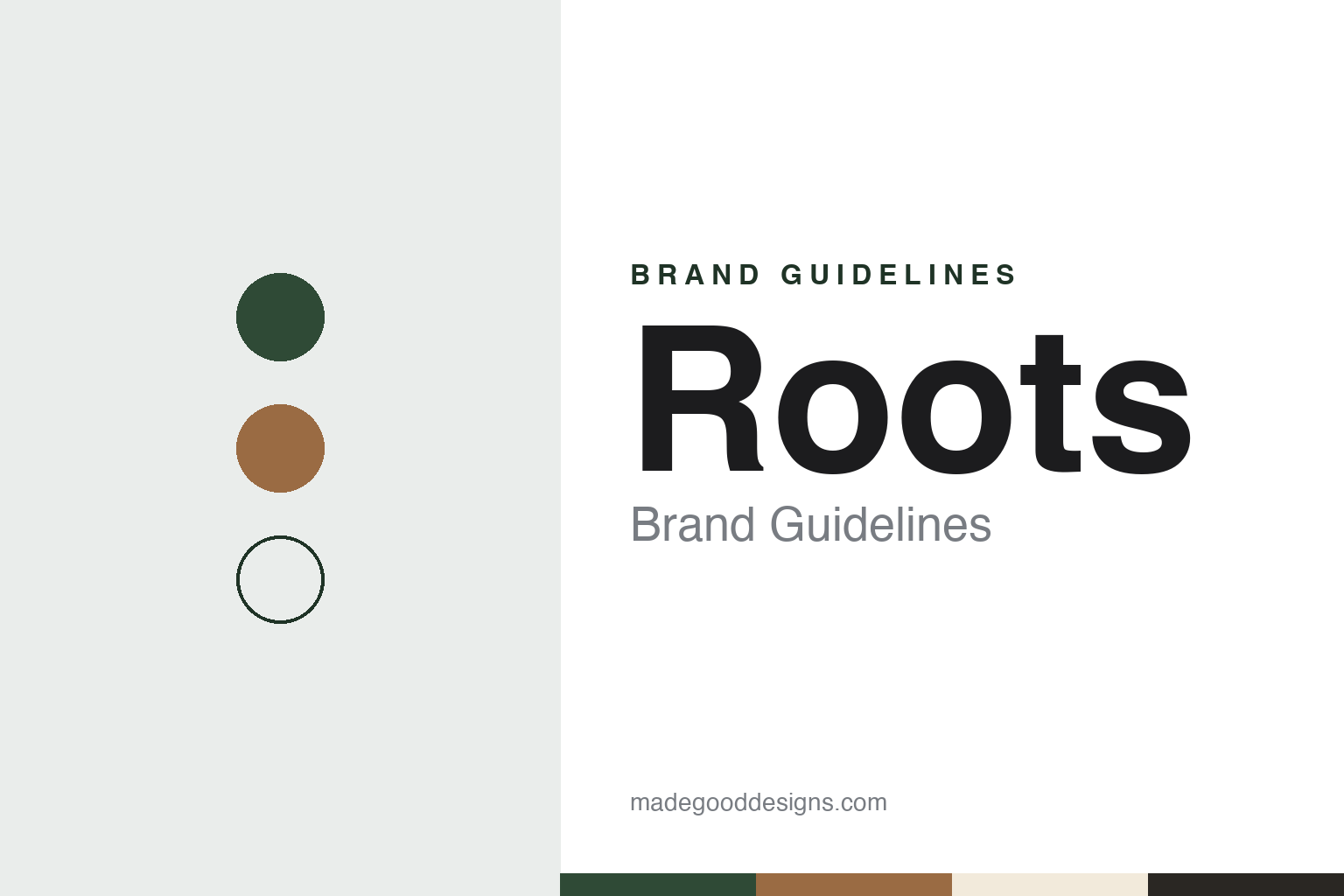
Roots Brand Guidelines
A Toronto label that began with a shoe and grew into sweats, leather and a beaver.
Aa
Two constants: a green, tan and cream palette and a soft heavy serif register. Abstract homage — not a Roots product or mark; no logo, beaver or label is reproduced.
A shoe on Yonge Street
Two friends from summer camp and a negative-heel shoe.
Roots began in Toronto in 1973. Its founders, Michael Budman and Don Green, first met at Camp Tamakwa in Ontario’s Algonquin Park in the 1960s, The Globe and Mail reported in June 2022. English Wikipedia says the company began as a footwear business selling a negative-heel shoe, a design in which the heel sits lower than the toe, and that the first pairs were made for them by the Boa Shoe Company, a family firm.
The first Roots store opened in August 1973 on Yonge Street near Rosedale station in Toronto, English Wikipedia says, and within months the partners had bought a small company and opened their own leather factory. By the end of that year there were Roots stores in Toronto, Vancouver and Montreal, as well as several in the United States. The factory grew quickly: English Wikipedia says that by the autumn of 1975 it was making more than two thousand pairs of shoes a day, up from thirty.
From shoes the company moved into casual clothing, handbags and leather jackets. By 1977, English Wikipedia says, it had 65 outlets across North America and Europe and was wholesaling bags, belts, footwear and leather jackets to department stores in Canada and the United States. A tailored menswear line, Roots Design, followed in 1979. After a round of closures in the United States and Europe at the end of 1980, the company turned its attention back to Canada and began making T-shirts and sweatshirts on a small scale.
English Wikipedia says the design centre and the leather factory are still in Toronto, while the locations of other factories that make Roots goods are not disclosed.
Colour
Beaver Canoe, a beaver and a red cap.
Much of the Roots look grew out of the founders’ camp years. When Omer Stringer, a co-founder of Camp Tamakwa and a canoe guide, began building canoes under the name Beaver Canoe, Budman and Green financed the business, The Globe and Mail reported in 2022; in 1982 Roots launched a line of sweatshirts and other camping-inspired clothes carrying Beaver Canoe’s diamond-shaped logo with conifers. The line was dropped as tastes changed in the 1990s, returned briefly through a partnership with Target Canada in 2013, and was relaunched by Roots in June 2022, with sweats, T-shirts and accessories, the paper reported. Since 2017 a Beaver Canoe pet range has also been sold at PetSmart Canada through a partnership with Canada Pooch, the Toronto maker that also produces Roots-branded pet accessories.
The company’s own emblem is a beaver, Canada’s national animal, standing on branches above the name. English Wikipedia says the beaver logo was drawn in the 1970s by the graphic artists Heather Cooper and Robert Burns, and came into use in 1985 with the launch of Roots Beaver Athletics; the name beneath it is set in a Cooper typeface, after the American type designer Oswald Cooper. By the early 1990s, English Wikipedia says, the logo had appeared on more than a million garments.
Sport gave the brand another stage. Roots supplied quilted boots to the Canadian team at the 1976 Winter Games in Innsbruck and jackets to Jamaica’s bobsleigh team in 1988, English Wikipedia says. Its formal Olympic role began at the 1998 Winter Games in Nagano, where the red “poor boy” cap worn backwards by Canadian athletes became the outfit’s most popular item, English Wikipedia says. Roots outfitted Canadian Olympic and Paralympic teams from 2000 to 2004 and dressed the United States team in 2002, 2004 and 2006, before the Canadian contract passed to the Hudson’s Bay Company in 2005.
In 2001 the company also lent its name to a short-lived discount airline, Roots Air, which began flying in March 2001 and stopped in May the same year, when its flights were transferred to Air Canada, according to English Wikipedia.
Typography
Banners, own labels and corporate pages.
Canadian retail identities are often built in layers: a parent group, a set of store banners, and the own-label ranges that sit on their shelves. Loblaw Companies is a clear example. English Wikipedia describes it as running corporate and franchise supermarkets under 22 regional and market-segment banners, from the full-service Loblaws to the discount No Frills and Maxi, each with its own sign, store format and tone of voice.
Own labels carry much of the visual identity. Loblaw’s No Name range arrived in 1978 in plain yellow packaging, and its President’s Choice line followed in the mid-1980s with photography-led packs, according to the International Directory of Company Histories. Loblaw’s apparel label, Joe Fresh, began in 2006, English Wikipedia says. Loyalty schemes and flyers do similar work: Loblaw’s PC Optimum points programme runs across its grocery and pharmacy banners, and when No Frills built a 2020 campaign around shopper types, Canadian Grocer reported, one of them was a deal hunter who searches the weekly digital flyer before she shops.
Quebec adds a language layer. Some national chains trade under French names there: Shoppers Drug Mart has used the Pharmaprix banner in the province since its first Quebec store in 1972, Loblaw’s own history says, and Loblaw entered the Quebec grocery market in 1998 by buying the Quebec-based chain Provigo, whose name it kept.
Corporate pages tell the rest of the story. Groups such as Loblaw publish timelines of founders and acquisitions, investor pages and lists of banners, and these are useful for dates and ownership; this guide presents them as the company’s own account, alongside encyclopaedias, trade press and regulators. The brands that follow range from century-old grocers to fashion chains, and each is described by what the sources show about its names, formats and labels.
Aa
A soft, heavy serif in the spirit of a 1920s display face. (Specimen set in Fraunces, a serif STAND-IN; NOT the Roots logo or its typeface.)
Roots
From founders to private equity, the stock market and a new owner.
English Wikipedia says the founders ran the business themselves until 2014, when they hired an outside president. In December 2015 the private equity firm Searchlight Capital Partners took a majority stake, The Globe and Mail reported in March 2026, and Roots completed an initial public offering on the Toronto Stock Exchange in October 2017. Budman and Green kept roughly 13 per cent of the shares, the paper said.
Roots had also tried to grow abroad. English Wikipedia says it opened two stores in Japan in 1993 and expanded in Taiwan and China in the 2000s; in April 2020 it closed its stores in Boston, Washington and Chicago, and its American subsidiary was liquidated, with sales to American customers continuing online. The Globe and Mail reported that the company abandoned its United States store expansion in 2020 and has since kept a small presence there. As of March 2026 Roots had roughly 100 stores in Canada, two in the United States and about 100 more operated by a partner in Asia, the paper said, and it was known for loungewear such as sweatpants and “cabin socks,” alongside leather goods.
On 3 March 2026 the board announced a strategic review that could include a sale, The Globe and Mail reported. As of August 2026, Roots had agreed to be taken private by Marquee Brands, a brand-management company based in the United States, Retail Insight Network reported on 21 August 2026. Under the agreement, a Canadian operating partner, JM&A Design and Development, was to acquire all of the shares and oversee design, manufacturing, distribution and the stores in Canada and the United States, while Marquee would look after the brand worldwide; the publication added that Roots would remain headquartered in Toronto. The deal was set up as a plan of arrangement needing shareholder, court and competition approval.
For a design guide, Roots shows how a label can build an identity from camp imagery, a single animal and a warm, rounded typeface. Compare Canada Goose, another Toronto clothing maker, and lululemon, a Canadian apparel brand with its own single emblem. For this guide we use a camp green, a saddle tan and a cabin cream with a soft heavy serif, an unofficial interpretation; no product or logo is reproduced.
Explore & save
Keep Roots’s identity on hand — save it to a board in the Made Good inspiration library.
Roots identity set
Pin the Roots green, tan and cream palette and the soft heavy serif register to your own board.