BackWerk Brand Guidelines
A Düsseldorf self-service bakery, franchised and run from Essen.
Aa
Two constants: a crust brown, flour white and oven amber palette and a bakery grotesque register. Abstract homage — not a BackWerk product or mark; no logo, shopfront or packaging is reproduced.
Tray and tongs
A self-service bakery in Düsseldorf, 2001.
BackWerk began in Düsseldorf in February 2001, not in Essen, where it is run today. German Wikipedia says the first shop was opened by the master baker and food technologist Robert Kirmaier and Marion Kirmaier, and that the first five shops were in Düsseldorf, Cologne and Duisburg. The idea was simple: customers take a tray and tongs, pick rolls, pastries and snacks from open counters themselves, and pay at the till. The company’s own pages still describe the format as a self-service bakery, and in 2026 it is marking its 25th year.
The founders did not keep it for long. In 2002, German Wikipedia says, the business was taken over by Hans-Christian Limmer and Dirk Schneider, and from 2003 it was rebuilt as a franchise system rather than a chain of company-run branches. Growth followed quickly: the chain moved beyond North Rhine-Westphalia into Bavaria in 2003, added about 30 locations in 2004 and about 40 in 2005, according to the same article. In 2006 it took over a rival, Die Backfabrik, with 13 shops in North Rhine-Westphalia, and in 2008 it bought the self-service bakery chain Baker’s Family, with more than 30 shops, from the bakery group Lieken.
By the end of 2007 there were about 150 BackWerk shops, German Wikipedia says, including the first outside Germany, in Graz, Austria. The Netherlands and Slovenia followed in 2009 and Switzerland in 2010. Almost every shop is run by a franchise partner: the trade magazine food-service reported in May 2018 that BackWerk had about 220 franchise partners running 350 locations in Germany, Austria, Switzerland, the Netherlands and Slovenia.
Colour
Open counters, then cafés, then express.
BackWerk’s look has moved from the discount bakery counter towards a café. The clearest record is its 350th shop, opened in the first week of May 2018 in the pedestrian zone of Bochum and described by food-service on 4 May 2018 as a flagship. The magazine reported a shop of about 380 square metres on two floors, built as a gallery with a glass front almost six metres high and a glass roof, more than 100 seats inside and out, and, for the first time in the chain, a visible production area where guests could watch snacks being baked and filled. The same store introduced a juice and smoothie bar and a new range of hot snacks, and the magazine said the store design was meant to carry the company’s new strategy.
The Vienna network shows how the format travels. On 13 March 2018 food-service reported that BackWerk had opened a shop of about 150 square metres with 40 seats in the BahnhofCity at Wien Westbahnhof, bringing its Vienna locations to 17, all run with franchise partners. Switzerland went the other way: Blick reported on 22 February 2019 that the chain’s oldest Swiss shop, opened in 2010 at the station in Schaffhausen, was closing, leaving a single Swiss shop in Winterthur at that date.
The newest format drops the tongs altogether. On 14 April 2026 the WAZ reported that BackWerk had opened its first “Express-Store” in Germany in Duisburg Hauptbahnhof, run by Valora with a franchise partner. Everything there is sold pre-packed from a chilled and a heated counter, mainly filled rolls, baguettes and hot snacks such as pizza slices, and staff scan the packs at the till; baking and filling still happen in a production area that customers can watch through a window. Chip reported in May 2026 that the change speeds up shopping for travellers but produces more packaging than the open-counter format.
Typography
How the category presents itself.
Europe’s bakery, sandwich, coffee and pizza chains present themselves first through the shop: the fascia over the door, the counter, the bags and cups, and the names of the products on the menu board. Chains in France, Spain, Belgium, Germany and Finland publish their menus by named ranges, such as sandwiches, salads, pastries and coffee, and their websites usually add a store finder, a loyalty app and a section for prospective franchisees.
Many of these brands sit inside larger groups, and ownership is often the clearest way to read their history. The Barcelona sandwich chain Pans & Company passed from the Catalan food group Agrolimen to the Portuguese restaurant group Ibersol in October 2016, according to Ibersol. In 2014, the agricultural trade paper Agra reported that the industrial baker Neuhauser owned two quick-service chains, Pomme de Pain in France and Crobag in Germany, as the grain group Soufflet took control of it. Pomme de Pain later went back to independence when its managers bought it from InVivo in July 2023, Réussir reported.
Shop networks are published by the companies and counted by the trade press, and the counts change. Franchising can carry a brand abroad, sometimes through a master franchise for a whole country, as Pomme de Pain did in Morocco and Tunisia, according to French Wikipedia; airport and railway-station sites can form a separate channel, such as the travel division through which Ibersol runs Café Pans counters in Spanish airports. A chain’s count of restaurants is therefore always a figure for a given date.
Identity changes are usually reported in the trade press when a refit is unveiled: a new logo, a new typeface, new uniforms and a pilot shop in a symbolic location. This guide sets out what can be checked about each brand, who founded it, who owns it and how its shops and packaging have changed, and attributes claims to the company where they rest on its own word.
Aa
A bold, plain grotesque for shop signs and counter cards. (Specimen set in Archivo, a sans STAND-IN; NOT the BackWerk logo.)
BackWerk
From private equity to a Swiss kiosk group.
Ownership has changed three times since the founders. At the start of 2014, German Wikipedia says, the Swedish investment firm EQT took a majority stake in the BackWerk group. In 2017 the business was sold to Valora, the Swiss operator of kiosks, convenience stores and bakery formats such as Ditsch and Brezelkönig; German Wikipedia dates the announcement to 18 September 2017 and completion, after competition clearance, to 27 October 2017, and food-service confirmed in May 2018 that BackWerk had belonged to Valora since 2017. Valora itself changed hands in turn: the company says the Mexican group FEMSA completed its takeover offer for Valora on 7 October 2022, and that Valora’s shares were delisted from the SIX Swiss Exchange on 17 April 2023 after the remaining shares were cancelled.
Today BackWerk is a brand of Valora Food Service Deutschland GmbH in Essen, the company’s website says. It describes more than 350 locations in Germany, the Netherlands, Austria and Switzerland, in city centres, at stations and motorways, and as smaller counters inside petrol stations and large shops. The range it lists runs from freshly filled rolls and sweet and savoury baked goods to hot snacks and hot and cold drinks, with vegetarian and vegan options and, in many stores, juices and smoothies. The WAZ also gave the chain’s size as 350 shops in April 2026.
For a design guide, BackWerk shows how a bakery brand can be built around a counter rather than a baker: the tray, the tongs and the open shelves were the identity long before the café seating and the express packs. Compare Greggs, another high-street bakery chain, and Kotipizza, a franchise chain from Finland. For this guide we use crust brown, flour white and an oven amber with a sans, an unofficial interpretation; no product or logo is reproduced.
Explore & save
Keep BackWerk’s identity on hand — save it to a board in the Made Good inspiration library.
BackWerk identity set
Pin the BackWerk crust brown, flour white and oven amber palette and the bakery grotesque register to your own board.
Source & notes
Frequently Asked Questions
What font can I use to match the BackWerk look?
This guide describes BackWerk’s type as “A bold, plain grotesque for shop signs and counter cards”. Its type specimen is set in Archivo from Google Fonts as a stand-in; Archivo is not BackWerk’s own lettering.
What colours are in the BackWerk palette?
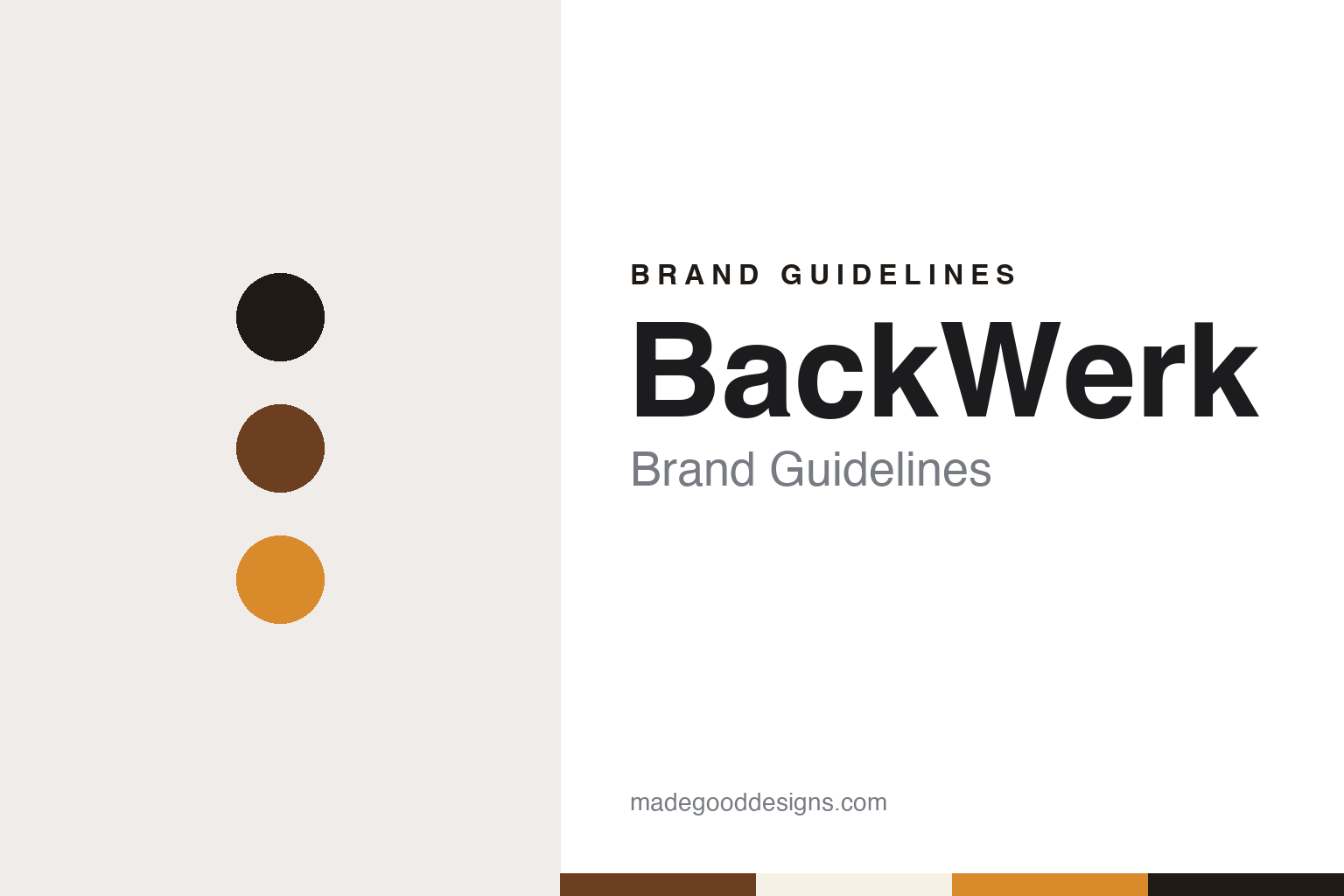
This guide’s BackWerk palette is Crust brown #6B3F1F, Ink #1F1A16, Flour white #F6F1E7, Oven amber #D98A2B and Paper #FBF8F2. The tones are the guide’s own unofficial interpretation, not official BackWerk hex codes.
When was BackWerk founded?
BackWerk was founded in February 2001, in Düsseldorf, Germany. BackWerk is known for Self-service bakery counters, filled rolls, hot snacks.
Who founded BackWerk?
BackWerk was founded by Robert and Marion Kirmaier in February 2001.