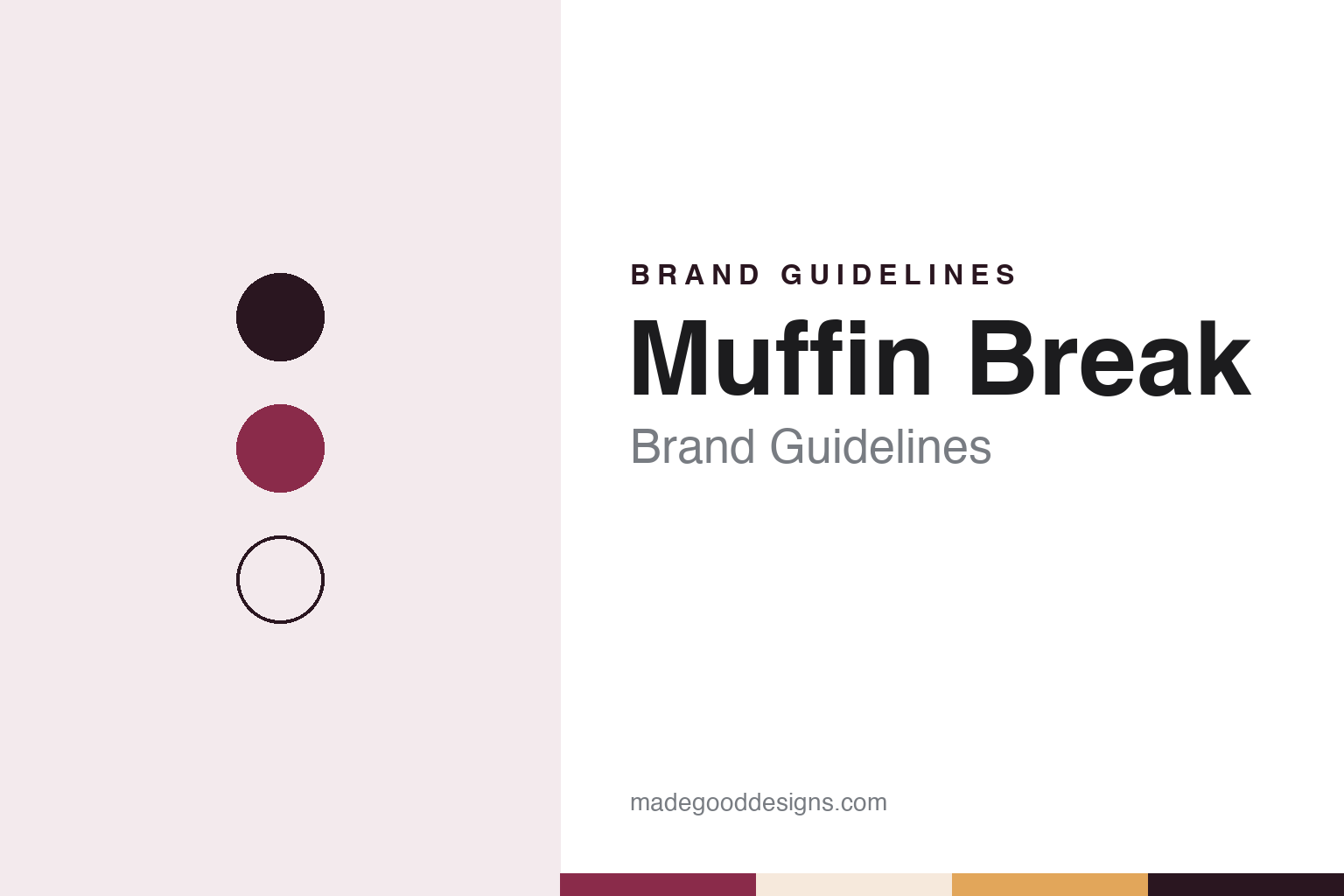
Muffin Break Brand Guidelines
The 1989 Coolangatta bakery café behind the ribbon logo.
Aa
Two constants: a berry, crumb and toasted-top palette and a rounded sans register. Abstract homage — not a Muffin Break product or mark; no muffin, logo or mascot is reproduced.
Coolangatta, 1989
An oven and an espresso machine on the Gold Coast.
Muffin Break’s Australian story starts in Coolangatta, on Queensland’s Gold Coast, in 1989. Its owner, Foodco Group, says that Bob and Wendy Nelson opened the first store there with an oven and an espresso machine, aiming to sell espresso coffee and food baked by hand. English Wikipedia, citing the company’s UK website, says the Muffin Break concept itself began in Canada in the 1970s and that Foodco acquired it and reworked it, with the first of the new-style stores opening in Coolangatta in 1989.
Foodco says the Fitzgerald family first invested in the business in 1991, and that the chain was built store by store in Australian shopping centres. Foodco describes Serge Infanti, one of its earliest franchise partners, as its long-serving chief executive; Australian Food News named him as Foodco’s managing director in 2010, and Franchise Business did so again in 2015. In 2022, Foodco says, Richard Goodman was appointed chief executive of Foodco in Australia and New Zealand.
The group has run more than one café brand. In April 2010 Australian Food News described Foodco as the owner of Muffin Break, Dreamy Donut and Jamaica Blue, and reported that it had bought its New Zealand counterpart, adding 36 New Zealand franchises to some 250 Australian outlets. Muffin Break and Jamaica Blue remain the group’s two café chains.
Colour
Shopping centres, three countries and a playcentre.
Muffin Break spread from Australia within a few years. English Wikipedia, citing The New Zealand Herald, says the first New Zealand store opened in Auckland in 1994. The chain reached the United Kingdom in 2001; Hospitality & Catering News reported in August 2018 that it had grown to more than 60 café-bakeries there since opening its UK business, and was then opening a café in the Trinity Walk shopping centre in Wakefield. English Wikipedia lists Australia, New Zealand and the United Kingdom as the chain’s markets and describes Jamaica Blue as its sister brand within Foodco.
Shopping centres have been the chain’s main home. In 2015 Foodco’s managing director told Franchise Business that Muffin Break had traded in shopping centres for more than 25 years, and the group runs both cafés and smaller kiosks. The chain has also tried other settings. In December 2015 Franchise Business reported a partnership with Croc’s Playcentres, an Australian indoor-play franchise, under which every new Croc’s site would include a Muffin Break café and existing Croc’s franchisees could convert their cafés; Foodco also took a financial interest in the Croc’s franchising business, and two Foodco executives joined the Croc’s board. Croc’s, founded in 2008, had 12 centres across Victoria, Tasmania, Western Australia and South Australia at the time. The two had trialled the idea at a Croc’s centre in Reservoir, Melbourne, which opened in April 2014.
The menu has moved beyond its name. In December 2025, Foodco’s general manager for customer and marketing told Franchise Business that the chain had added filled-centre muffins in flavours such as churros, lemon meringue and raspberry cheesecake, reworked its wraps, and replaced baguettes with Turkish melts and sandwiches. The report placed these changes in a longer line of menu additions, from gluten-free products to a newer dairy-free frappe range. The same report gave the Australian network as 137 stores, across shopping centres, railway stations and airports.
Typography
Category context.
Australian and New Zealand food chains usually present themselves through a small set of repeated parts: a shopfront and sign that can be read from across a car park, a menu built around a few named products, and a story about the suburb where the first shop opened. Roast and charcoal chicken, burgers, pies, muffins, juice, pizza and patisserie each have their own version of that formula, but the structure is shared.
Many of these brands are franchised, and their own pages say so plainly. A typical corporate site explains that each restaurant or café is run by a local franchisee, lists stores by suburb and state, and keeps a separate page for prospective franchise partners. Store formats are named rather than described: drive-thru, shopping centre, strip store, express counter. Store counts appear in trade press with a date attached, and they move as shops open and close.
Ownership is often layered. Several chains sit inside larger groups or private equity portfolios, so one parent may hold more than one brand in the same category; Craveable Brands, for example, owns Red Rooster, Oporto and Chicken Treat. Founders tend to stay in the brand story long after a sale, and company pages keep the founding year, the first shop and the first signature product in view.
Expansion abroad is a recurring chapter, from New Zealand to Asia, the Middle East, Britain and the United States, and the record is uneven, with some markets opened and later left. For designers, these brands are useful studies in how a local takeaway turns its name, colours and a handful of signature items into a system that franchisees can repeat from one suburb to the next.
Aa
A rounded, friendly sans for a shopping-centre bakery café. (Specimen set in Nunito, a sans STAND-IN; NOT the Muffin Break logo.)
Muffin Break
A ribbon, a mascot and a campaign.
Muffin Break’s identity is described most fully in reports on its 2025 refresh. Speaking to Franchise Business in December 2025, Foodco’s general manager for customer and marketing described the ribbon device logo as a key brand asset that customers recognise, which the company chose to keep; it was simplified and given a more contemporary colour. Around it the chain adopted a cleaner colourway, a more playful tone of voice and a new approach to food photography.
The refresh also brought back Muffin Man, the chain’s mascot, which had not been used for some years; Franchise Executives reported in December 2025 that it returned first as a plush toy in a mini-muffin promotion. A new marketing theme, “Cafe Diem”, launched in August 2025 as an invitation to seize the day with a coffee and something to eat, carried by three short films online, social-media advertising, in-store material and digital panels in shopping centres. Foodco told Franchise Business that the films had brought a shift in the ages of its customers and more trade at lunchtime, the part of the day the campaign set out to promote.
Foodco presented these changes as an evolution of the existing brand rather than a new identity. Its marketing head told Franchise Business that consumer research had found customers valued the chain’s familiarity and nostalgia, and that the aim was to balance comfort classics with newer menu items and to communicate a wider range than muffins and coffee. Franchise Executives reported that the campaign was used in store and in shopping-centre advertising as well as online.
For a design guide, Muffin Break shows how a long-running bakery café can freshen its colour, voice and photography while keeping a familiar logo device and mascot. Compare it with Gloria Jean’s, another shopping-centre coffee chain with Australian roots, and Pie Face. For this guide we use a berry red, a warm crumb cream and a toasted gold with a rounded sans, an unofficial interpretation; no product or logo is reproduced.
Explore & save
Keep Muffin Break’s identity on hand — save it to a board in the Made Good inspiration library.
Muffin Break identity set
Pin the Muffin Break berry, crumb and toasted-top palette and the rounded sans register to your own board.
Source & notes
Frequently Asked Questions
What font can I use to match the Muffin Break look?
This guide describes Muffin Break’s type as “A rounded, friendly sans for a shopping-centre bakery café”. Its type specimen is set in Nunito from Google Fonts as a stand-in; Nunito is not Muffin Break’s own lettering.
What colours are in the Muffin Break palette?
This guide’s Muffin Break palette is Berry ribbon #8A2B4A, Espresso plum #2A1620, Muffin crumb #F6E9DC, Toasted top #E2A65A and Paper cup #FBF7F2. The tones are the guide’s own unofficial interpretation, not official Muffin Break hex codes.
Who founded Muffin Break?
Muffin Break was founded by Bob and Wendy Nelson (per Foodco).


