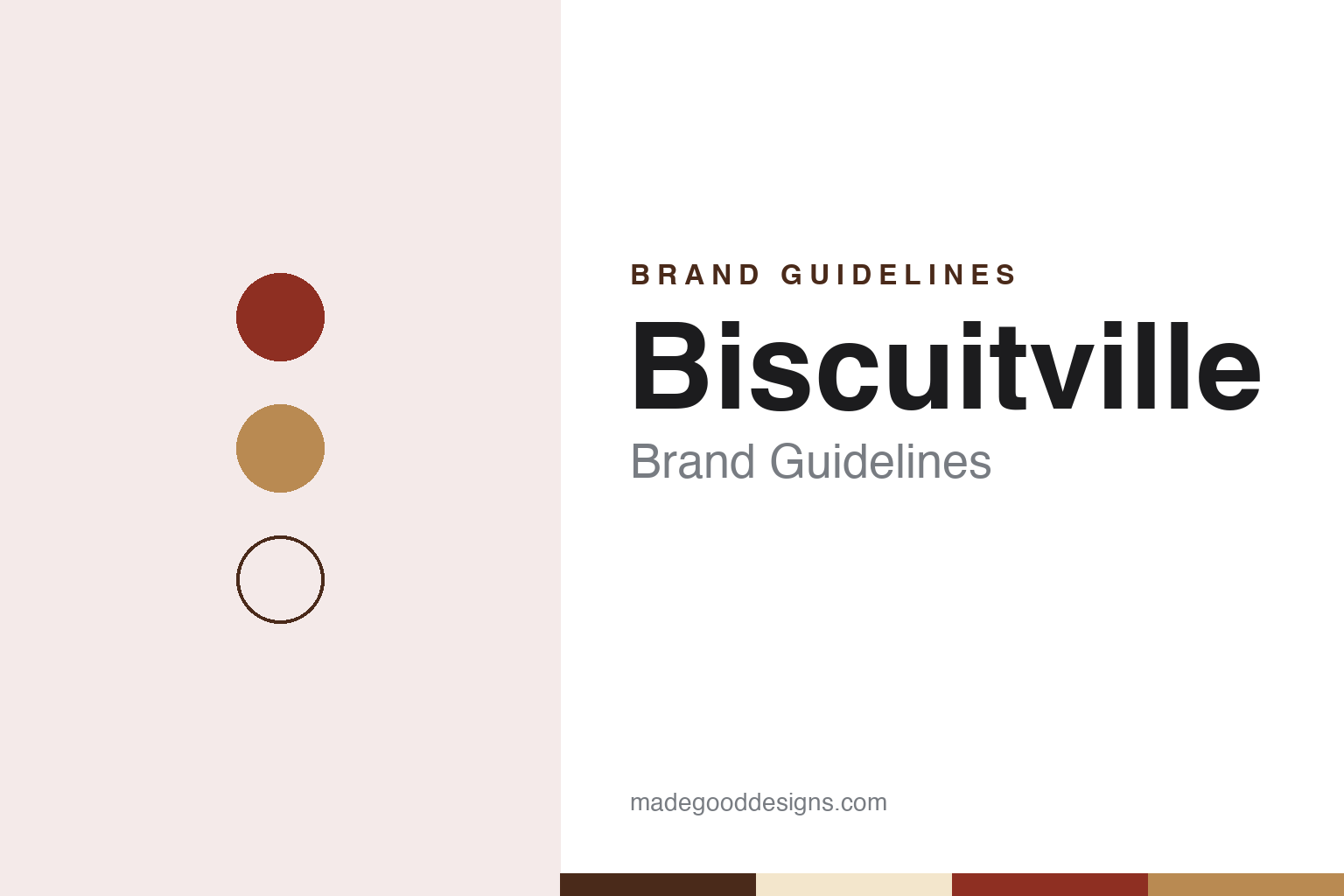
Biscuitville Brand Guidelines
A 1966 Burlington pizza shop that found its trade in morning biscuits.
Aa
Two constants: a brick red, toasted brown and buttermilk palette and a slab serif register. Abstract homage — not a Biscuitville product or mark; no menu board, logo or packaging is reproduced.
Pizzaville
Two bread and milk stores in Burlington.
Biscuitville began in Burlington, North Carolina, in 1966. That year Maurice Jennings, a former flour salesman, started selling take-out pizzas from two bread and milk stores he owned in the town, according to a February 2016 “This Day in North Carolina History” post by the state’s Department of Natural and Cultural Resources. WXII 12 News in Greensboro, citing the company’s website in September 2020, gave the stores’ name as Mountainbrook Fresh Bread & Milk and described Jennings as a former flour broker. The pizza business traded as Pizzaville, and English Wikipedia says the family business eventually came to be known by that name.
The biscuit came in through the morning. Pizza did little trade at breakfast, so the stores began baking biscuits in the early hours to bring in extra customers and income, the state history post says; Nation’s Restaurant News reported in 2020 that Pizzaville offered biscuits in the mornings with a jelly bar, and that demand grew until a separate biscuit store made sense. Jennings credited his grandmother with the recipe, telling the story that she once asked whether he would rather inherit her farm or her biscuit recipe, the trade paper reported.
By the mid-1970s the chain had six stores across the Triad region of North Carolina and southern Virginia. In 1975 Jennings opened the first biscuit-only store, under the name Biscuitville, in Danville, Virginia, just over the state line. WXII 12 reported that the brand moved south into North Carolina three years later, and the state history post says all of the Pizzaville stores were eventually converted to Biscuitville.
On 7 February 1978 the company, then based in Graham, filed to register a trademark for the first time, the state post records. In 1979 it opened a home office and a distribution centre in Graham, in Alamance County, WXII 12 reported, and in 2007 it moved its headquarters to Greensboro, the step English Wikipedia also dates to that year.
Colour
Biscuits every 15 minutes, doors shut at 2 p.m.
Biscuitville’s menu is built around the biscuit. Nation’s Restaurant News described the chain in 2020 as serving scratch-made biscuits baked fresh every 15 minutes, and WXII 12 listed biscuit and muffin sandwiches, breakfast platters, muffins, pancakes and honey buns. English Wikipedia calls the company Biscuitville Fresh Southern and says it specialises in the traditional southern breakfast, made from scratch and with local ingredients.
The opening hours follow the menu. English Wikipedia says that since 1982 company policy has been for restaurants to close at 2 p.m., so the chain trades as a breakfast-and-lunch business rather than an all-day one.
Sourcing is a large part of the story the company tells about itself. According to the company’s website, as WXII 12 summarised it in 2020, its flour is milled by a fourth-generation family business in Henderson, North Carolina, its eggs come from farms in Monroe and its country ham is dry-cured in Wilkesboro; WXII 12 added that the company sources from local and family-owned businesses whenever possible. Those are the company’s own descriptions of its supply chain.
The 1978 trademark filing recorded by the state came three years after the first biscuit-only store opened in Danville. The chain’s logos, typefaces and colours are not described in the independent sources used here, so the palette and type in this guide are our own choices.
Typography
Shopfronts, menus and franchise networks.
Burger, custard and chicken chains usually present themselves through a small set of fixed things: the name over the door, the shape of the building, the colours on the sign and the packaging, and a short list of named menu items that travel from one restaurant to the next. In the United States many of these chains began as a single family stand. Freddy’s opened in Wichita, Kansas, in 2002 under its founders’ father’s name, and Runza began in Lincoln, Nebraska, in 1949 with a sandwich that gave the company its name.
The menus are often the clearest part of the identity. A chain may be organised around one dish, as Runza is around its beef-and-cabbage bread pocket, or around a pairing, as Freddy’s was when its full name joined frozen custard and steakburgers with an ampersand. Smash burgers, biscuits, fried chicken and flame-grilled chicken play the same role for other chains in this group, in the United States, Singapore and South Africa, and each company publishes its own list of signature items.
Ownership varies widely. Some chains in this guide remain family businesses and say so on their corporate pages; others have passed to private-equity firms or to listed restaurant groups that run several brands at once. Where a chain has changed hands, the dates and buyers here come from trade press and company announcements, and any deal not completed is described as pending.
The restaurant networks are reported in the companies’ own terms: franchised or company-run, regional or international, counted on a stated date. Some chains say they keep close to home by choice, while others publish franchise maps that reach other countries. This guide gives those counts with their dates and sources, and treats colours and typefaces as an unofficial interpretation unless a source documents them.
Aa
A warm slab serif for a biscuit counter. (Specimen set in Zilla Slab, a slab-serif STAND-IN; NOT the Biscuitville logo.)
Biscuitville
Still a Jennings family business.
Biscuitville has stayed in the family. In 1996, when the company had grown to more than 40 restaurants, Maurice Jennings turned the business over to his son, Maurice “Burney” Jennings Jr., Elon University reported in October 2010. Burney Jennings, an Elon business graduate, had worked in various roles at the company before becoming president and chief executive, and the university put the chain at several dozen restaurants with more than 1,000 employees at the time of his talk in its Legends of Business series that September. Speaking to students, he said that on visits to his restaurants he pays for his own food and drink, to signal that menu items are not given away to friends.
The state history post of February 2016 counted more than 50 stores in North Carolina and Virginia and said the company was still owned by the Jennings family, with Burney Jennings as chief executive since 1996. In September 2020 Nation’s Restaurant News described Biscuitville as a 64-unit, Greensboro-based, family-owned company, with Burney Jennings as chief executive and Kathie Niven as president; in a statement quoted by WXII 12 that month, Niven counted the family-owned business as 54 years old, dating it from the 1966 stores rather than the 1975 biscuit shop. As of February 2024, English Wikipedia says, there were 82 locations in North Carolina, South Carolina and Virginia.
The chain has remained regional. Its restaurants sit in three neighbouring states of the Southeast, its first biscuit-only store was in a Virginia border town, and its headquarters has moved only within central North Carolina, from Graham to Greensboro.
For a design guide, Biscuitville shows how a regional chain can build its identity around one baked good and one part of the day. Compare Bojangles, the Charlotte chicken-and-biscuits chain, and Cook Out, another North Carolina chain. For this guide we use brick red, toasted brown and buttermilk cream with a slab serif, an unofficial interpretation; no product or logo is reproduced.
Explore & save
Keep Biscuitville’s identity on hand — save it to a board in the Made Good inspiration library.
Biscuitville identity set
Pin the Biscuitville brick red, toasted brown and buttermilk palette and the slab serif register to your own board.
Source & notes
Frequently Asked Questions
What font can I use to match the Biscuitville look?
This guide describes Biscuitville’s type as “A warm slab serif for a biscuit counter”. Its type specimen is set in Zilla Slab from Google Fonts as a stand-in; Zilla Slab is not Biscuitville’s own lettering.
What colours are in the Biscuitville palette?
This guide’s Biscuitville palette is Brick red #8E2F22, Toasted brown #4A2A1A, Buttermilk cream #F3E6CC, Golden crust #B98A52 and Flour white #FAF7F1. The tones are the guide’s own unofficial interpretation, not official Biscuitville hex codes.
When was Biscuitville founded?
Biscuitville was founded in 1966 (as Pizzaville), in Burlington, North Carolina.
Who founded Biscuitville?
Biscuitville was founded by Maurice Jennings in 1966 (as Pizzaville).