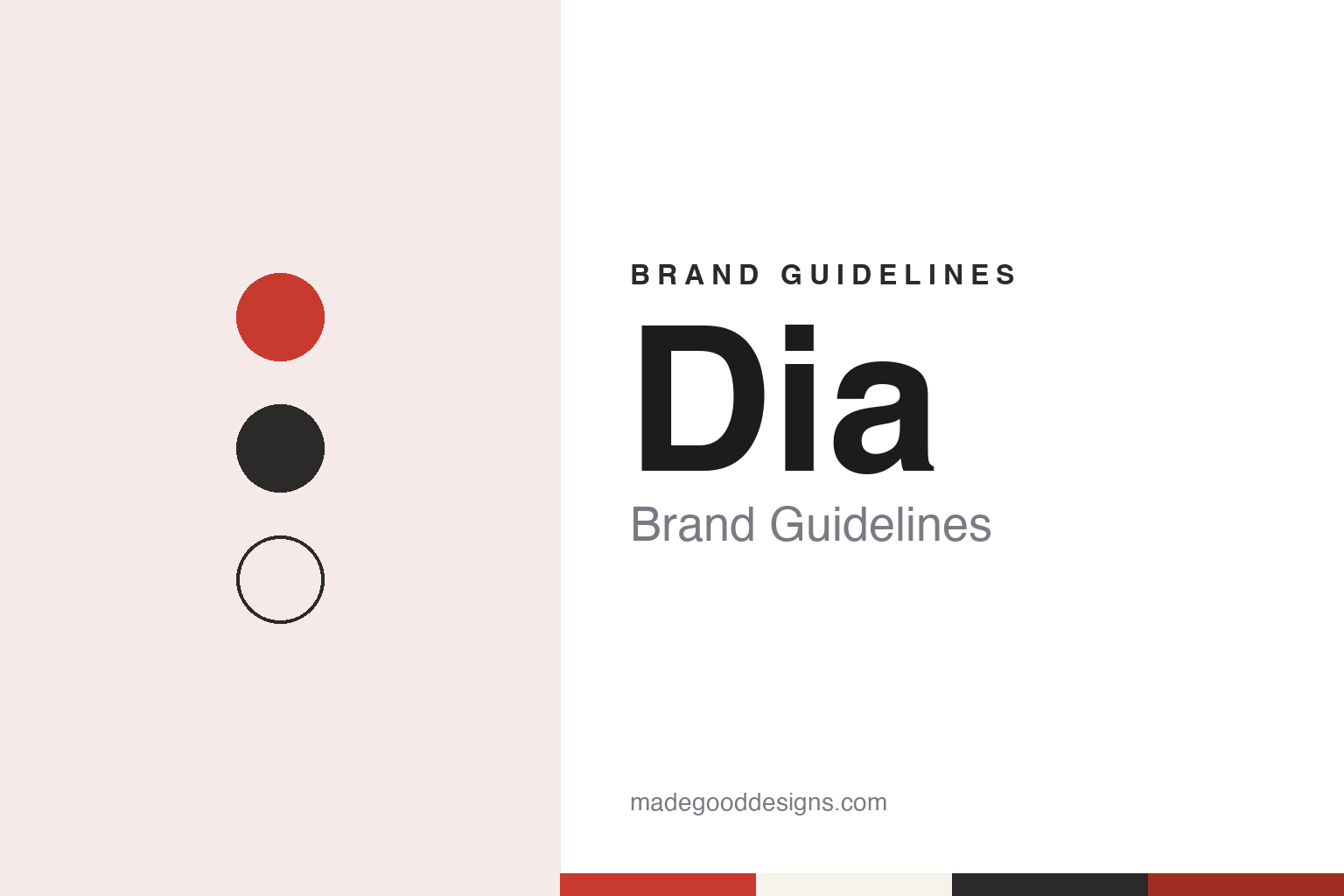
Dia Brand Guidelines
A 1979 Madrid discount store that grew into a franchised neighbourhood chain.
Aa
Two constants: a red, charcoal and warm white palette and a rounded sans register. Abstract homage — not a Dia product or mark; no logo, sign or pack is reproduced.
Saconia, 1979
A discount shop on a Madrid housing estate.
Dia began in Madrid in 1979. English and Spanish Wikipedia both date its first store to that year, on Calle Valderrodrigo in Saconia, a residential estate in the city. The name is an acronym of the company’s full title, Distribuidora Internacional de Alimentación, Spanish Wikipedia says, and the model from the start was the discount store: plain fittings and furniture, strict control of costs and a narrow range that mixed manufacturer brands with goods sold under the Dia name. Its advertising, English Wikipedia adds, rested on mass-media campaigns and regular leaflets of special offers.
Growth abroad came in the 1990s. English Wikipedia lists the purchase of the Portuguese chain Minipreço in 1993, then Dia stores in Greece in 1995, Argentina in 1997 and Turkey in 1999; Brazil followed in 2001 and China in 2003. Spanish Wikipedia adds that Dia arrived in Argentina as a company in 1996 and opened its first store there the following year, in the Buenos Aires district of Villa Devoto, with a first distribution centre at Vicente López in 1999.
In 2000 the French group Carrefour became Dia’s owner, both Wikipedias say. The French discount chain Ed, which Carrefour had acquired in 1999, was folded into the Dia group, and Spanish Wikipedia says the Ed name was eventually replaced by Dia in France. In 2007 Carrefour bought the Plus supermarkets in Spain to merge them into the Dia network, and in 2010 the Greek business was transferred out of the group.
Colour
Market, Maxi, Plaza and Clarel.
Dia has run a family of store banners rather than a single shop. Spanish Wikipedia describes Dia Market, a neighbourhood format of roughly 400 to 700 square metres; Maxi Dia, a larger store of up to about 1,000 square metres, usually on the edge of town with parking; Dia & Go, a convenience format with longer hours; and La Plaza de Dia, a traditional neighbourhood supermarket with a wider range of fresh food. Other names came and went, among them Cada Día for small towns and Citydia for franchised stores in China. In 2025, Spanish Wikipedia says, the Dia & Go name returned for shops at BP service stations.
Franchising has long been part of the model. Spanish Wikipedia says individuals can run a Dia store after making an investment, and that at the end of 2024 the company had 3,343 stores, of which 2,306 were franchises. Its range combines Dia own-label products with outside brands, and many Spanish stores, both company-run and franchised, have counters for fish, meat and sliced charcuterie.
Acquisitions built the Spanish network further. In 2013 Dia bought the Spanish and Portuguese stores of the German drugstore chain Schlecker, and at the end of that year it presented a new banner for most of them, Clarel, a chain for personal care, beauty and household goods. In 2014 it took over the regional supermarket chain El Árbol, and from 2015 it acquired stores from the Eroski cooperative; many of these became La Plaza de Dia, both Wikipedias say, and the El Árbol name was dropped in 2016.
Typography
Signs, own labels and store networks.
Europe’s supermarket, hypermarket and discount chains present themselves first through the shopfront. A store sign has to read from across a car park or down a busy street, so most chains keep a short name, a strong colour and a simple mark, and repeat them on carrier bags, leaflets, delivery vans and receipts. Some add an emblem: the Danish discounter Netto has used a Scottish terrier, which it calls the Scottie, since 1992.
Own-label packaging is the second carrier of identity. Chains name these ranges themselves, from the plain store name on everyday goods to separate labels for organic, premium or value lines, and the guides in this group name them only as the companies do. A range of thousands of products can carry one look, which makes the own label as visible as the sign above the door.
Store formats multiply a brand. One group may run small neighbourhood shops, larger edge-of-town stores, convenience outlets at service stations and hypermarkets, each with its own banner or a variation of the main one; Spain’s Dia, for example, has used names such as Dia Market, Maxi Dia and La Plaza de Dia. Networks also change across borders, as chains enter new countries, sell stores to rivals or leave markets altogether, and the store counts in these guides are given with the date of the source.
Ownership is often less visible than the sign. Many chains sit inside larger retail groups, some listed on stock exchanges, some controlled by investment firms and some owned by foundations or cooperatives of independent retailers. The corporate pages of these groups, along with official competition decisions and trade press, set out who founded each chain, who owns it now and which banners belong together, and those are the records this guide relies on.
Aa
A rounded sans for a neighbourhood shop sign. (Specimen set in Rubik, a sans STAND-IN; NOT the Dia logo.)
Dia
From Carrefour subsidiary to a Spanish neighbourhood chain.
Carrefour let Dia go in 2011. Spanish Wikipedia says the French group spun the business off by handing Dia shares to its own shareholders, and that Dia began trading on the Madrid stock exchange on 5 July 2011; it joined the IBEX 35 index on 2 January 2012 and left it on 24 December 2018. Three years after the split, Carrefour moved to buy back Dia’s French stores: the trade site RetailDetail reported the agreement in June 2014, noting that French approval was still needed, and English Wikipedia says the stores were later converted to Carrefour banners or closed.
The international map then shrank. Dia sold its Turkish business in 2013 and its Chinese business to Suning in 2018, English Wikipedia says. In May 2019 the investment firm LetterOne, already a shareholder, took control through a takeover offer and ended with 69.76 per cent of the shares; Spanish Wikipedia says its stake reached 77.7 per cent in August 2021. Under the new owner the company sold 224 larger supermarkets to Alcampo, a sale cleared by Spain’s competition regulator, the CNMC, in March 2023; sold Clarel to Colombia’s Grupo Trinity in April 2024; completed the sale of its Portuguese business, trading as Minipreço and Mais Perto, to Auchan on 30 April 2024; and sold its Brazilian business in June 2024.
Argentina was the last market abroad. At the end of 2024 Dia had 2,302 stores in Spain and 1,041 in Argentina, Spanish Wikipedia says. The company told ESM Magazine, in a report of 6 November 2026, that it operates more than 2,400 neighbourhood supermarkets in Spain, after its exits from Portugal and Brazil and the sale of its hypermarket formats and non-food business.
For a design guide, Dia shows how one short name can carry a whole family of formats, from small-town franchises to edge-of-town stores, through several owners. Compare Carrefour, its owner for eleven years, and Aldi, another discount chain built on a narrow range. For this guide we use a tomato red, a brick, a charcoal and a warm white with a rounded sans, an unofficial interpretation; no product or logo is reproduced.
Explore & save
Keep Dia’s identity on hand — save it to a board in the Made Good inspiration library.
Dia identity set
Pin the Dia red, charcoal and warm white palette and the rounded sans register to your own board.
Source & notes
Frequently Asked Questions
What font can I use to match the Dia look?
This guide describes Dia’s type as “A rounded sans for a neighbourhood shop sign”. Its type specimen is set in Rubik from Google Fonts as a stand-in; Rubik is not Dia’s own lettering.
What colours are in the Dia palette?
This guide’s Dia palette is Tomato red #C93A2E, Brick #9E2E22, Charcoal #2B2A28, Pale blush #F2DCD6 and Warm white #F6F2EC. The tones are the guide’s own unofficial interpretation, not official Dia hex codes.
When was Dia founded?
Dia was founded in 1979, in Madrid, Spain. This guide lists Carrefour (2000–2011); LetterOne (control since 2019) as its owner.
Who owns Dia?
Dia is owned by Carrefour (2000–2011); LetterOne (control since 2019).