ICA Brand Guidelines
Hakonbolaget 1917, retailer-owned stores and Rune Monö’s 1964 sign.
Aa
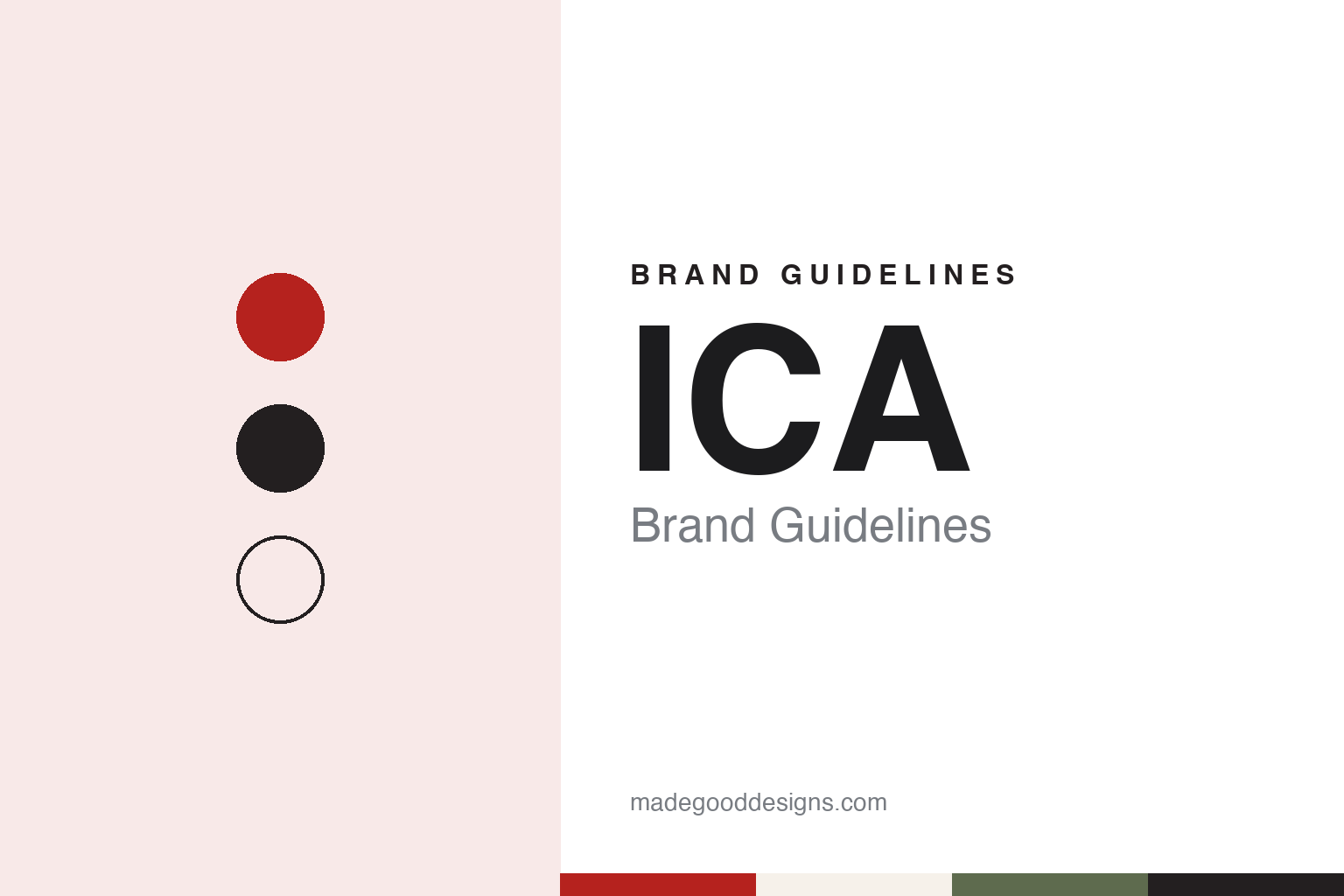
Two constants: a red, warm white and ink palette and a heavy rounded sans register. Abstract homage — not an ICA product or mark; no logo, sign or pack is reproduced.
Hakonbolaget
Grocers who owned their own wholesaler.
ICA traces its history to 1917, when Hakon Swenson started a wholesale business in Västerås, in central Sweden. It was registered as Hakon Swenson & Co but became known as the Hakonbolaget, and its idea was that independent grocers would themselves own the wholesaler that supplied them, Dagens PS reported in a February 2023 history of the group. About 250 retailers subscribed for shares at the start, and by the 1920s more than 1,500 retailers were part-owners, the paper wrote. Swedish Wikipedia says the first trading actually began in Gävle, through the purchase of a wholesale firm there, and that the model was a response to the joint buying of the consumer co-operatives, then a strong force in Swedish food retail.
The ICA name came from cooperation between four such regional, retailer-owned wholesalers. According to Swedish Wikipedia, their chief executives met on 8 April 1938 at Swenson’s house in Västerås, representing Hakonbolaget, Speceristernas Varuinköp, AB Eol and Nordsvenska Köpmannabolaget. The joint company held its founding meeting on 9 January 1939 and was registered on 15 March that year as Inköpscentralernas AB ICA, “the purchasing centres’ company.” Its founders had considered “Sica,” with the S standing for Swedish, but that name was already taken. Dagens PS and English Wikipedia both date the formation of the four-firm company to 1938.
The following years built out the wider group. Swedish Wikipedia says the retailers’ association, Ica Förbundet, was formed in 1940; ICA Industrier, owned in equal parts by the four wholesalers, and the publisher Ica Förlaget, with the magazine Ica-kuriren, followed in 1942; and in 1945 the book imprint Ica Bokförlag published the first edition of the baking book Sju sorters kakor.
Colour
Separately owned shops, one shared company.
ICA is not a chain of company-owned shops. Each store is owned and run by its own retailer, while ICA Sverige handles joint buying, logistics and shared marketing, Swedish Wikipedia says; the retailers act together through ICA-handlarnas Förbund, the members’ association that grew out of the 1940 Förbundet and became ICA’s main owner in 1972. The regional wholesalers and the joint ICA company were merged into a single company, Ica AB, only in 1990.
Ownership opened up around 2000. English Wikipedia says half of ICA was sold to the Dutch retailer Ahold in 2000, which raised its holding in 2004 but was barred by agreement from exercising majority control. The retailers’ holding company, founded in 2000 as Ica Förbundet Invest, was renamed Hakon Invest and listed on the Stockholm exchange on 8 December 2005, Swedish Wikipedia says. In March 2013 Hakon Invest bought Ahold’s 60 per cent, and on 24 May 2013 it took the name ICA Gruppen.
The listing lasted until 2022. On 10 November 2021 ICA-handlarnas Förbund and the pension company AMF made a recommended offer for all the shares, and by December they controlled just over 90 per cent, enough to begin compulsory redemption and delisting, Dagens PS reported on 21 December 2021. ICA Gruppen left Nasdaq Stockholm on 13 January 2022, English and Swedish Wikipedia say.
Beyond the shops, the group runs ICA Banken, started in 2001, and the pharmacy chain Apotek Hjärtat, which it bought in November 2014, according to Swedish Wikipedia. Its ventures abroad have come and gone. In 2001 ICA and Dansk Supermarked set up Netto Marknad to bring the Danish Netto chain to Sweden, where the first store opened in May 2002; ICA sold most of its share in December 2006 and took over 21 stores. ICA entered the Baltic states in Latvia in 1997, made Rimi Baltic a wholly owned subsidiary in October 2006, and sold it to Salling Group in a deal completed in June 2025. ICA Norge was sold to Coop Norge, a sale completed in April 2015, Swedish Wikipedia says.
Typography
How European grocers present themselves.
Europe’s supermarket, hypermarket and discount chains present themselves first through the shopfront. A store sign has to read from across a car park or down a busy street, so most chains keep a short name, a strong colour and a simple mark, and repeat them on carrier bags, leaflets, delivery vans and receipts. Some add an emblem: the Danish discounter Netto has used a Scottish terrier, which it calls the Scottie, since 1992.
Own-label packaging is the second carrier of identity. Chains name these ranges themselves, from the plain store name on everyday goods to separate labels for organic, premium or value lines, and the guides in this group name them only as the companies do. A range of thousands of products can carry one look, which makes the own label as visible as the sign above the door.
Store formats multiply a brand. One group may run small neighbourhood shops, larger edge-of-town stores, convenience outlets at service stations and hypermarkets, each with its own banner or a variation of the main one; Spain’s Dia, for example, has used names such as Dia Market, Maxi Dia and La Plaza de Dia. Networks also change across borders, as chains enter new countries, sell stores to rivals or leave markets altogether, and the store counts in these guides are given with the date of the source.
Ownership is often less visible than the sign. Many chains sit inside larger retail groups, some listed on stock exchanges, some controlled by investment firms and some owned by foundations or cooperatives of independent retailers. The corporate pages of these groups, along with official competition decisions and trade press, set out who founded each chain, who owns it now and which banners belong together, and those are the records this guide relies on.
Aa
A heavy rounded sans for a shop-sign register. (Specimen set in Rubik, a sans STAND-IN; NOT the ICA logo.)
ICA
Three letters on every roof from 1964.
For more than two decades the ICA name stayed in the background. Each wholesaler had its own logo, which retailers used to show which purchasing centre they belonged to, and a joint ICA symbol from the 1940s was used only now and then, and not by Hakonbolaget, Swedish Wikipedia says. That changed in 1964, when the retailers who were part-owners were offered the ICA name and logo for their own shops; the shops were re-signed that year with some ceremony, Dagens PS reported, under a logotype drawn by the industrial designer Rune Monö. Swedish Wikipedia dates the logotype itself to 1963 and says it was approved before the 1964 roll-out. ICA Gruppen’s own site credits Monö with the mark and calls its launch the start of ICA’s modern history.
Store profiles do much of the visual work. In Sweden the shops trade as ICA Nära, small neighbourhood stores; ICA Supermarket, mid-sized food stores; ICA Kvantum, larger stores often on main roads; and Maxi ICA Stormarknad, the hypermarkets, which the company writes with Maxi first. Swedish Wikipedia counted 1,262 ICA stores in Sweden in December 2025. It lists the group’s own labels as including ICA, ICA Basic, I love eco and ICA Selection, and says one of the earliest own-label goods was Luxus coffee, on sale around 1920.
Advertising has been part of the identity since the 1940s, when painted posters were used, Swedish Wikipedia says. It lists home-economics films in the 1950s and 1960s, the characters Icander and Monica from 1973 to 1990, and, since December 2001, a television series set in a fictional ICA store, with its staff and customers as recurring characters.
For a design guide, ICA shows how one shared wordmark can tie separately owned shops into a single brand. Compare Rimi, the Baltic chain ICA owned until 2025, and Netto, which ICA helped bring to Sweden. For this guide we use a strong red, a warm white and an ink with a heavy sans, an unofficial interpretation; no product or logo is reproduced.
Explore & save
Keep ICA’s identity on hand — save it to a board in the Made Good inspiration library.
ICA identity set
Pin the ICA red, warm white and ink palette and the heavy rounded sans register to your own board.
Source & notes
Frequently Asked Questions
What font can I use to match the ICA look?
This guide describes ICA’s type as “A heavy rounded sans for a shop-sign register”. Its type specimen is set in Rubik from Google Fonts as a stand-in; Rubik is not ICA’s own lettering.
What colours are in the ICA palette?
This guide’s ICA palette is Shopfront red #B5221E, Ink #231F20, Warm white #F6F1EA, Moss #5E6B4E and Paper #FAF8F4. The tones are the guide’s own unofficial interpretation, not official ICA hex codes.
When was ICA founded?
ICA was founded in 1917 (Hakonbolaget); ICA company 1938–39, in Västerås, Sweden.
Who founded ICA?
ICA was founded by Hakon Swenson in 1917 (Hakonbolaget); ICA company 1938–39.
Who owns ICA?
ICA is owned by ICA-handlarnas Förbund and AMF. This guide dates ICA to 1917 (Hakonbolaget); ICA company 1938–39, in Västerås, Sweden.