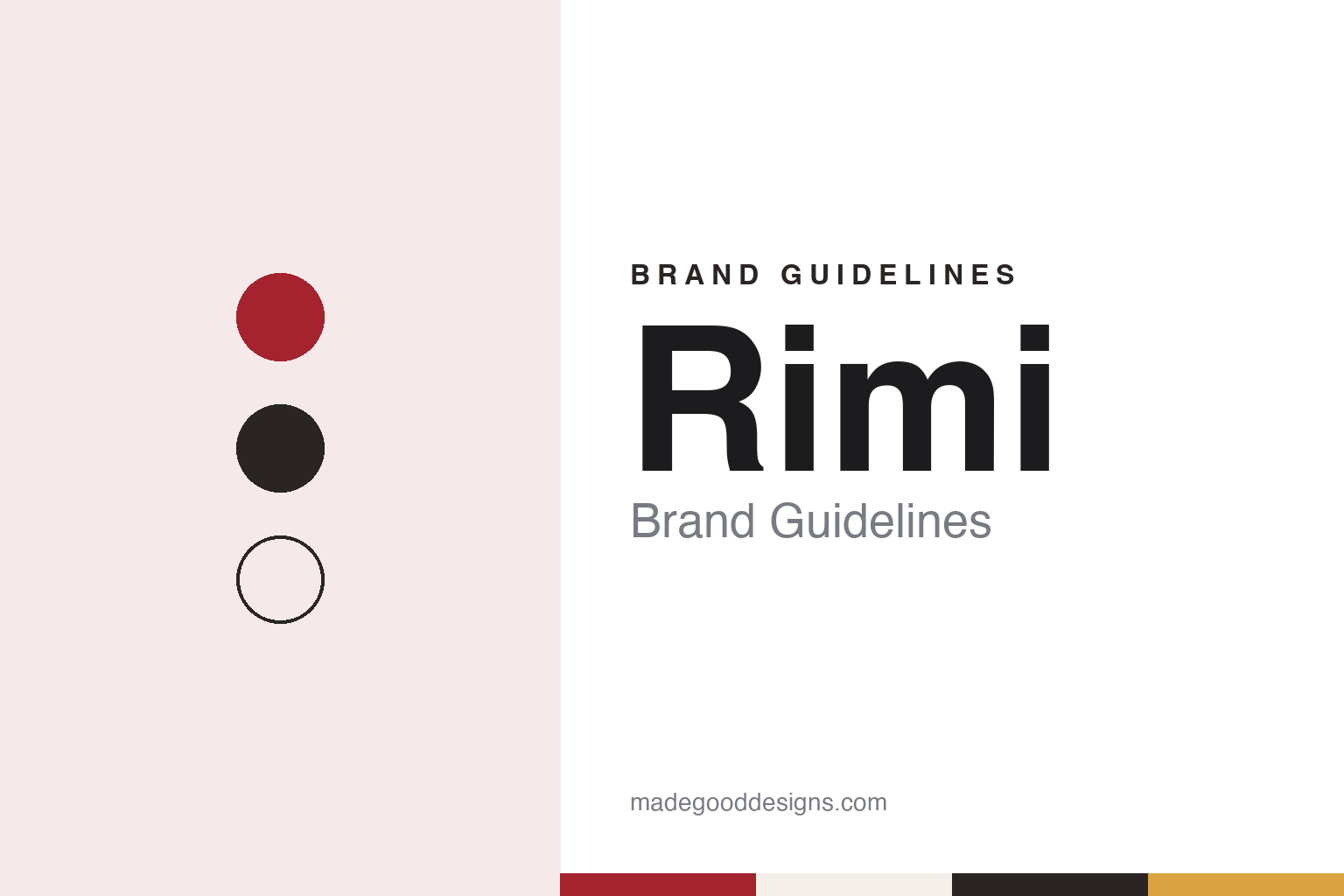
Rimi Brand Guidelines
A Norwegian discount name that became a Baltic family of store signs.
Aa
Two constants: a red, charcoal and warm white palette and a rounded grocery sans register. Abstract homage — not a Rimi product or mark; no logo, sign or pack is reproduced.
From RIMI 500
A Norwegian discount name that crossed to the Baltics.
The Rimi name is Norwegian. Norwegian Wikipedia says Stein Erik Hagen started the chain in 1977 as RIMI 500, when he reworked a Matkroken VIVO grocery in the Oslo and Akershus area. Each early store carried a range of about 500 products, and the number in the name reflected that count. Larger stores with a range of about 1,000 items followed as RIMI 1000, the first of them opening at Hadeland in 1986. In 1988 Hagen’s group bought the SPAR 800 chain and merged it with its own stores as RIMI 800, and every store received a new graphic profile that combined the logos of the two chains, the same source says. In 1990 the number was dropped, and the stores became simply RIMI.
In 1992 Hagen sold 30 percent of the chain to the Swedish grocery group ICA, and later sold it a further stake, according to Norwegian Wikipedia. ICA used the Rimi name on discount food stores in Norway and, English Wikipedia says, for a time in Sweden, while the Finnish group Kesko used it in Finland; those stores have since moved to other formats. The Norwegian chain itself went to Coop Norge together with ICA Norge, a sale the Norwegian competition authority approved in March 2015, and the last Norwegian Rimi stores closed in 2016, reopening as Coop Extra or Coop Prix stores.
The Baltic business began as an offshoot of the Norwegian chain. English Wikipedia says the Latvian company SIA Rimi Baltija was founded in 1996, and that its first store opened in the Dole shopping centre in Riga on 20 February 1997. In 1999 it bought the Ekovalda grocery chain in Lithuania, whose stores at first kept their local name, and from 2000 the Baltic stores began moving under a single, pan-Baltic Rimi identity.
Colour
A joint venture, then a single owner.
The present company took shape in 2004, when Kesko and ICA agreed to merge their Baltic operations in a 50/50 joint venture. Rimi Baltic began operating on 1 January 2005, English Wikipedia says. Kesko brought K-Citymarket hypermarkets in Estonia and Latvia, the Säästumarket discount stores in Estonia and the Supernetto discount outlets in Latvia; ICA brought its Rimi supermarkets and compact hypermarkets in all three countries. The Citymarkets were converted to Rimi hypermarkets during 2005. At the end of 2006 Kesko sold its half to ICA, and Rimi Baltic became wholly owned by ICA from 1 January 2007.
Latvian Wikipedia adds a design note. At the end of 2009 Rimi began moving its stores across the Baltic region to a new supermarket concept, with a layout planned around how people shop, a more visible sign system, greener technology and a new graphic identity. English Wikipedia says the interior design of Rimi’s compact hypermarkets can also be seen in some smaller ICA Maxi stores in Sweden, such as ICA Maxi Västra Hamnen in Malmö and ICA Maxi Enköping.
The chain runs four store formats, which the company names Rimi Hyper, Rimi Super, Rimi Mini and Rimi Express, and it says it has had an online store in all three Baltic countries since 2020. Its own-label range carries the Rimi name. The company describes tiers it calls Selection by Rimi, Rimi Smart and Rimi Basic, the last sold in simpler packaging, and sub-brands including Rimi Planet and Rimi Grill.
Not every plan went through. In December 2016 ICA Gruppen agreed to buy the Lithuanian company Palink, which ran the IKI grocery chain. Lithuania’s Competition Council approved the deal in October 2017 on condition that 17 Rimi and IKI stores in four cities be sold to third parties, did not accept the proposed buyers in March 2018, and in April 2018 announced that the sale of IKI to Rimi had been terminated, English and Latvian Wikipedia say.
Typography
How Europe’s grocers present themselves.
Europe’s supermarket, hypermarket and discount chains present themselves first through the shopfront. A store sign has to read from across a car park or down a busy street, so most chains keep a short name, a strong colour and a simple mark, and repeat them on carrier bags, leaflets, delivery vans and receipts. Some add an emblem: the Danish discounter Netto has used a Scottish terrier, which it calls the Scottie, since 1992.
Own-label packaging is the second carrier of identity. Chains name these ranges themselves, from the plain store name on everyday goods to separate labels for organic, premium or value lines, and the guides in this group name them only as the companies do. A range of thousands of products can carry one look, which makes the own label as visible as the sign above the door.
Store formats multiply a brand. One group may run small neighbourhood shops, larger edge-of-town stores, convenience outlets at service stations and hypermarkets, each with its own banner or a variation of the main one; Spain’s Dia, for example, has used names such as Dia Market, Maxi Dia and La Plaza de Dia. Networks also change across borders, as chains enter new countries, sell stores to rivals or leave markets altogether, and the store counts in these guides are given with the date of the source.
Ownership is often less visible than the sign. Many chains sit inside larger retail groups, some listed on stock exchanges, some controlled by investment firms and some owned by foundations or cooperatives of independent retailers. The corporate pages of these groups, along with official competition decisions and trade press, set out who founded each chain, who owns it now and which banners belong together, and those are the records this guide relies on.
Aa
A rounded, friendly grocery sans. (Specimen set in Rubik, a sans STAND-IN; NOT the Rimi logo.)
Rimi Baltic
Danish ownership since June 2025.
In 2025 ICA Gruppen sold the business. FOOD, the food-retail news service of the Norwegian School of Economics (NHH), reported on 18 March 2025 that ICA was selling Rimi Baltic, its wholly owned grocery operation in Estonia, Latvia and Lithuania, to the Danish Salling Group. The agreement covered 314 stores, an e-commerce platform, warehouses and distribution centres, and more than 11,000 employees, and ICA said it would now focus on the Swedish market. On 15 May 2025 FOOD reported that the European Commission had approved the acquisition. Rimi Baltic announced on 2 June 2025 that the transaction had been concluded, and its website now names Salling Group as its owner.
The company is based in Riga. Latvian Wikipedia says it works through a company in each country, Rimi Latvia, Rimi Lietuva and Rimi Eesti Food, with a distribution centre in each of the three. For 2025 the same source lists 39 Rimi Hyper, 37 Rimi Super, 58 Rimi Mini and 6 Rimi Express stores in 36 places in Latvia. In Estonia, Rimi operated 83 stores at the end of 2025, across its hypermarket, supermarket, mini and express formats, ERR News reported in June 2026.
For a design guide, Rimi shows how a name first built on a product count in Norway became a four-format family of store names across three other countries. Compare Maxima, its Lithuanian-owned Baltic neighbour, and Netto, the discount chain of Rimi’s new owner, Salling Group. For this guide we use a shopfront red, a charcoal and a warm white with a sans, an unofficial interpretation; no product or logo is reproduced.
Explore & save
Keep Rimi’s identity on hand — save it to a board in the Made Good inspiration library.
Rimi identity set
Pin the Rimi red, charcoal and warm white palette and the rounded grocery sans register to your own board.
Source & notes
Frequently Asked Questions
What font can I use to match the Rimi look?
This guide describes Rimi’s type as “A rounded, friendly grocery sans”. Its type specimen is set in Rubik from Google Fonts as a stand-in; Rubik is not Rimi’s own lettering.
What colours are in the Rimi palette?
This guide’s Rimi palette is Shopfront red #A4232E, Charcoal #2A2523, Warm white #F4EFE8, Mustard #D9A441 and Paper #FAF8F4. The tones are the guide’s own unofficial interpretation, not official Rimi hex codes.
Who owns Rimi?
Rimi is owned by Salling Group (Denmark) (since June 2025).


