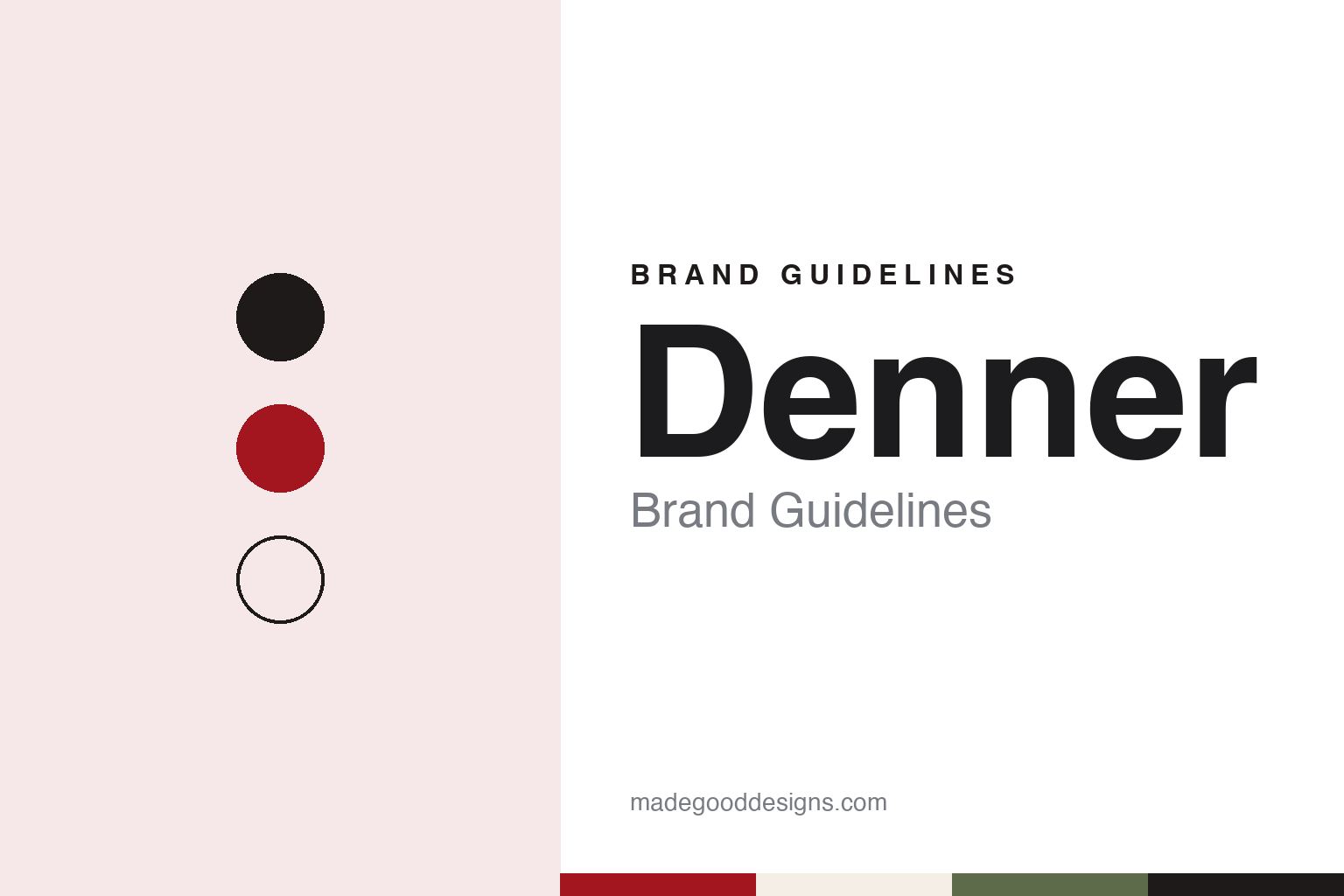
Denner Brand Guidelines
An 1860 grocery near Zürich, Swiss hard discount and a Migros owner.
Aa
Two constants: a Denner red, cream and cellar black palette and a Plain discount sans register. Abstract homage — not a Denner product or mark; no logo, sign or pack is reproduced.
Reiff-Schwarz
A haberdashery and grocery shop by Lake Zürich.
Denner is older than the discount trade it now belongs to. German Wikipedia says Heinrich Reiff-Schwarz, from Greifensee, founded a haberdashery and grocery business, “Reiff-Schwarz, Mercerie und Spezereihandel,” in 1860 in Zollikon, just outside Zürich, with branches around the upper end of Lake Zürich, in the Zürcher Oberland and in the canton of Glarus. The Historisches Lexikon der Schweiz, in an entry by Thomas Gmür last edited in May 2009, places the 1860 shop in Zürich. Denner’s own history page also starts in 1860.
The name came later. In 1881 Reiff’s son-in-law Cäsar Denner, from Biel, became a partner, and both the Historisches Lexikon and the company say the Denner name goes back to him. German Wikipedia traces the firm through several names: in 1888 the business split, one half becoming Denner-Reiff & Cie. Consumgesellschaft; in 1896 it became Cesar Denner & Co. Consumgesellschaft; and from 1914 Cäsar’s son Hans Denner ran it as Denner & Co. Consumgesellschaft. In 1935 it became a company limited by shares, moved its head office to the Grubenstrasse in Zürich and took the name Consum AG. Denner & Co., the encyclopedia says, under pressure from Migros, which had appeared in 1925, and from the slump of the late 1920s.
The modern company was shaped by Karl Schweri. German Wikipedia says the trading company Import- und Grosshandels AG (IGA), in which he held a stake, took over the Denner business with other grocers in 1947; Denner’s own timeline puts the purchase in 1946. Schweri was pushed out of the firm in 1947, and in 1951 he returned as majority shareholder, the Historisches Lexikon says. From 1953, according to German Wikipedia, all 166 IGA shops traded under the single name Denner, and in 1969 IGA itself became Denner AG, with Schweri as sole owner.
Colour
Discount shops, cartel cases and Denner Satellit.
The turn to discount came in the late 1960s. Denner opened its first supermarket in Zürich-Schwamendingen in 1962, the company says, with 570 square metres of floor space. Resale price maintenance for food and household brands ended in Switzerland on 2 February 1967, after a long dispute between IGA and the branded-goods industry, German Wikipedia says, and on 24 October 1967 Denner opened a food discount shop in Zürich-Altstetten. The Historisches Lexikon der Schweiz calls it the first food discount shop in Switzerland. The same entry dates Denner’s move into western Switzerland to 1970 and the opening of its 100th discount shop, in Mendrisio, to 1973.
Much of the company’s public story in the following decades took place in court. German Wikipedia describes a beer-supply dispute that began with a boycott by the Swiss brewers’ association in 1969 and ended in Denner’s favour in 1993, and a long case over the tobacco industry’s minimum-price rules that began at the cantonal court in Fribourg in 1973. During that case Denner handed customers tobacco vouchers, and after a second case was decided in its favour at the Federal Supreme Court in 1996 it redeemed them as goods vouchers, the company says.
A second network grew beside the company’s own shops. In 1977 the first Denner Satellit opened in Endingen, in the canton of Aargau: legally and financially independent shops, mostly in rural areas, that sell part of the Denner range, German Wikipedia says, with 141 of them within ten years. The group also spread into other trades. It bought the toy chain Franz Carl Weber in 1984 and the Waro grocery chain in 1994, and ran optician shops from 1988 to 1996 and Pronto-Reisen, a travel business, until 1994, according to the Historisches Lexikon. By 1999, the same source says, Denner had about 1,240 employees, 307 discount shops and 201 Satellit shops. The company says it cut its range to about 1,000 lines in 1993 and opened its first “Denner Top Superdiscount” shop in 1997.
Typography
Design and documentation.
Europe’s supermarket, hypermarket and discount chains present themselves first through the shopfront. A store sign has to read from across a car park or down a busy street, so most chains keep a short name, a strong colour and a simple mark, and repeat them on carrier bags, leaflets, delivery vans and receipts. Some add an emblem: the Danish discounter Netto has used a Scottish terrier, which it calls the Scottie, since 1992.
Own-label packaging is the second carrier of identity. Chains name these ranges themselves, from the plain store name on everyday goods to separate labels for organic, premium or value lines, and the guides in this group name them only as the companies do. A range of thousands of products can carry one look, which makes the own label as visible as the sign above the door.
Store formats multiply a brand. One group may run small neighbourhood shops, larger edge-of-town stores, convenience outlets at service stations and hypermarkets, each with its own banner or a variation of the main one; Spain’s Dia, for example, has used names such as Dia Market, Maxi Dia and La Plaza de Dia. Networks also change across borders, as chains enter new countries, sell stores to rivals or leave markets altogether, and the store counts in these guides are given with the date of the source.
Ownership is often less visible than the sign. Many chains sit inside larger retail groups, some listed on stock exchanges, some controlled by investment firms and some owned by foundations or cooperatives of independent retailers. The corporate pages of these groups, along with official competition decisions and trade press, set out who founded each chain, who owns it now and which banners belong together, and those are the records this guide relies on.
Aa
A plain, compact sans — the register of a shelf label. (Specimen set in Archivo, a sans STAND-IN; NOT the Denner logo.)
Denner
A Migros company since 2007.
Ownership changed in the new century. The company says Schweri handed control of the group to his grandson Philippe Gaydoul at the end of 2000, under a holding company, Rast Holding. In November 2005 Denner took over the Pick Pay chain from the REWE Group’s Swiss arm, with about 145 shops and a logistics centre in Egerkingen, and retired the Pick Pay name in 2006, the company says; German Wikipedia adds that the competition commission cleared that purchase on 14 October 2005 without conditions. Between 2003 and 2004 the shops were refitted under the “New Denner” banner, according to both sources.
On 12 January 2007 Denner and the Migros-Genossenschafts-Bund announced that Migros would take 70 per cent of Denner’s share capital, with the Gaydoul family holding keeping 30 per cent. The Swiss competition commission, WEKO, approved the takeover on 3 September 2007 but attached conditions lasting seven years, the Swiss federal government announced on 4 September 2007. By the end of 2009 Migros owned all of Denner, according to the company and German Wikipedia. In 2014 Denner decided to rework the look and range of its shops; all company-owned shops had been rebuilt by the end of 2016, and the Satellit shops were renamed Denner Partner, German Wikipedia says.
The range mixes branded goods with an own label. German Wikipedia puts it at about 1,900 lines, roughly three-quarters of them brands and the rest sold under the Denner own label. Since 2016 the shops have carried products from the Swiss farm label IP-Suisse, and in October 2022 the agricultural weekly BauernZeitung reported that Denner had begun selling whole milk bearing the Bio Suisse bud label, supplied by the dairy group Emmi, while Denner itself was not a Bio Suisse licensee. The company launched an online wine shop in 2010. German Wikipedia, citing the company, gives 612 branches and 260 partner shops, 872 outlets in all, for 2025, and says a new distribution building in Mägenwil went into service on 2 February 2026.
For a design guide, Denner shows how a 19th-century grocer’s name can carry a hard-discount chain, a network of independent partner shops and a change of owner without being replaced. Compare Aldi and Lidl, two other discount names. For this guide we use a shelf-edge red, cellar black and carton cream with a plain sans, an unofficial interpretation; no product or logo is reproduced.
Explore & save
Keep Denner’s identity on hand — save it to a board in the Made Good inspiration library.
Denner identity set
Pin the Denner red, cream and cellar black palette and the Plain discount sans register to your own board.
Source & notes
Frequently Asked Questions
What font can I use to match the Denner look?
This guide describes Denner’s type as “A plain, compact sans — the register of a shelf label”. Its type specimen is set in Archivo from Google Fonts as a stand-in; Archivo is not Denner’s own lettering.
What colours are in the Denner palette?
This guide’s Denner palette is Shelf-edge red #A3161F, Cellar black #1E1A19, Carton cream #F4EEE6, Vineyard green #5E6B4A and Paper #FAF8F4. The tones are the guide’s own unofficial interpretation, not official Denner hex codes.
When was Denner founded?
Denner was founded in 1860 (as Reiff-Schwarz), in Zollikon, near Zürich.
Who founded Denner?
Denner was founded by Heinrich Reiff-Schwarz in 1860 (as Reiff-Schwarz).
Who owns Denner?
Denner is owned by Migros-Genossenschafts-Bund, 100% since end of 2009.