Smashburger Brand Guidelines
A Denver burger chain named after the way it cooks.
Aa
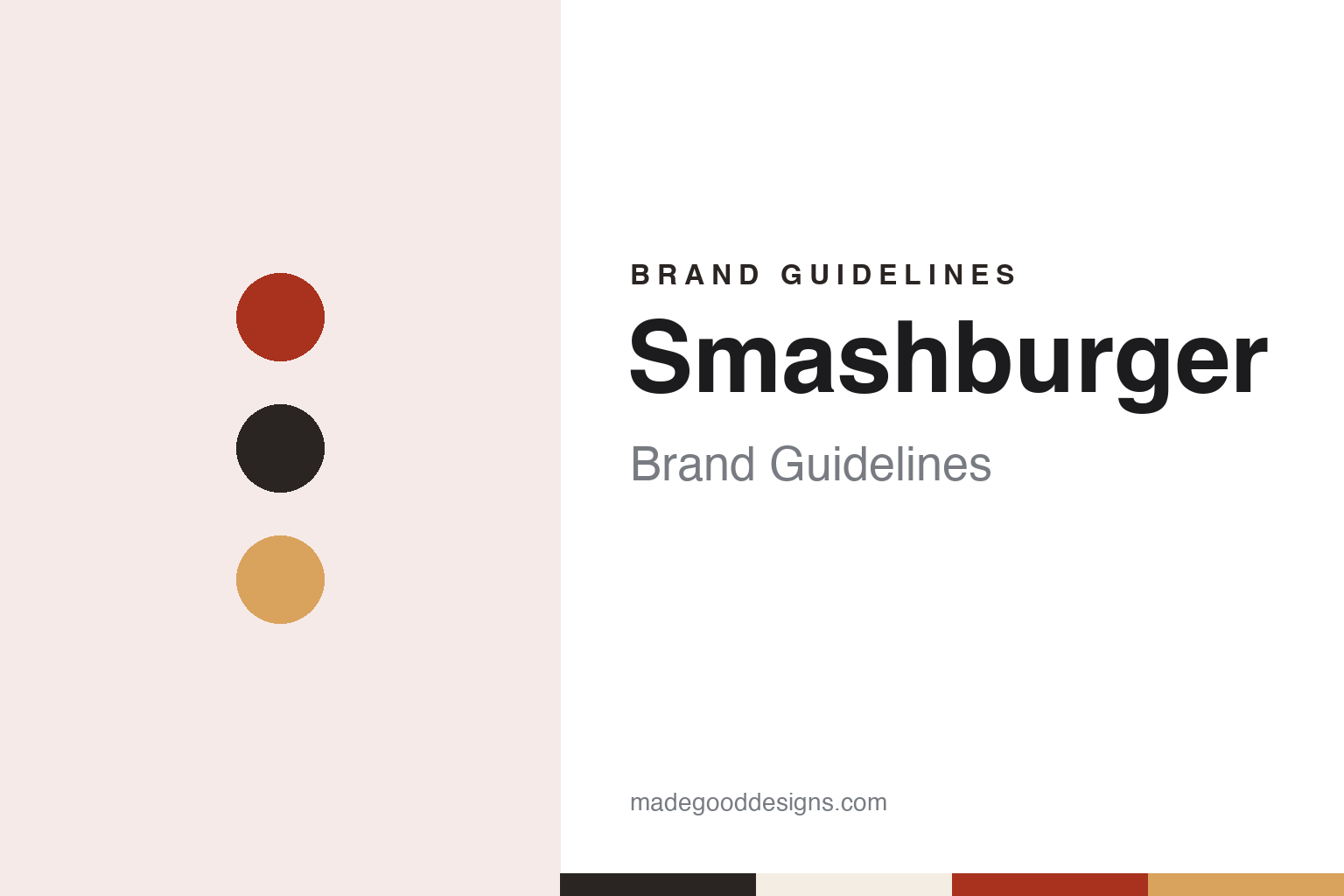
Two constants: a griddle red, charcoal and toasted bun palette and a heavy grotesque register. Abstract homage — not a Smashburger product or mark; no logo, menu or packaging is reproduced.
The kitchen engine
Two Quiznos figures and a griddle in Denver.
Smashburger was founded in Denver in 2007 by Tom Ryan and Rick Schaden. Restaurant Business reported in February 2018 that Schaden, the former owner of the Quiznos sandwich chain, funded the start-up through his private-equity firm, Consumer Capital Partners. In September 2025 the same publication described both men as key figures at Quiznos, and Ryan as a former McDonald’s executive who had helped create products including the McGriddle breakfast sandwiches. English Wikipedia adds that Ryan had earlier worked on Pizza Hut’s stuffed-crust pizza.
Before opening, English Wikipedia says, the founders bought a Denver restaurant, Icon Burger, to test cooking and management methods, and spent six months designing what they called a “kitchen engine”: modular surfaces around a central griddle, with a refrigerated space underneath for the portioned beef, so that a cook could work without walking away from the griddle. The layout was later standardised for every Smashburger. They chose flat-top grills over char-broilers and settled on Angus beef after blind tastings of many kinds of beef.
The first Smashburger opened in Denver in June 2007, English Wikipedia says, followed by Houston and then Minneapolis, cities where the founding team knew the property market.
The name describes the method. A ball of beef is pressed hard onto a hot griddle with a purpose-made tool so that it cooks thin, with a browned crust; Restaurant Business describes this as the concept the chain is built on. Smashburger was part of an early generation of fast-casual “better burger” chains, the publication wrote in 2025, and by its count operated nearly 300 locations by 2014.
Colour
Red rooms, steel baskets and a city burger.
English Wikipedia describes the restaurants as designed around a bright red colour scheme, with no fixed footprint, so that each site can be fitted to the space available. Interiors are modern, with indirect lighting and locally produced photo murals. Customers order at a central counter, and food is brought to the table in stainless-steel baskets, with metal cutlery rather than plastic. Seating mixes high and low tables, booths and, where there is room, an outdoor patio.
The menu has also leaned local. For a time the chain created a burger for each city it served, English Wikipedia says: roasted green chiles in Colorado, grilled chorizo in Miami, a cranberry chutney in Boston. From 2012 it paired its burgers with beers from regional craft breweries. The core menu covers burgers, chicken sandwiches, black bean burgers and salads, with sides such as “smash fries,” finished with rosemary and olive oil, and milkshakes.
The logo has changed several times. Restaurant Business reported in September 2025 that the mark had moved from a plain red “Smashburger” to a brown “Smash burger” partly crushed by a burger press, and then to a reddish-orange wordmark beside a patty topped with an S shaped like a press. Chief executive Jim Sullivan told the publication that the biggest task for bringing customers back into the restaurants was uniformity in the brand and its logo, and eventually updating the brand’s assets.
The same report described a “Summer of Smash” menu that brought back hot dogs and the Brisket Burger, a two-patty sandwich with smoked brisket and bacon served on a Parker House roll, as part of an effort to bring diners back to the dining room after years of heavy reliance on delivery apps.
Typography
Shopfronts, menus and franchise networks.
Burger, custard and chicken chains usually present themselves through a small set of fixed things: the name over the door, the shape of the building, the colours on the sign and the packaging, and a short list of named menu items that travel from one restaurant to the next. In the United States many of these chains began as a single family stand. Freddy’s opened in Wichita, Kansas, in 2002 under its founders’ father’s name, and Runza began in Lincoln, Nebraska, in 1949 with a sandwich that gave the company its name.
The menus are often the clearest part of the identity. A chain may be organised around one dish, as Runza is around its beef-and-cabbage bread pocket, or around a pairing, as Freddy’s was when its full name joined frozen custard and steakburgers with an ampersand. Smash burgers, biscuits, fried chicken and flame-grilled chicken play the same role for other chains in this group, in the United States, Singapore and South Africa, and each company publishes its own list of signature items.
Ownership varies widely. Some chains in this guide remain family businesses and say so on their corporate pages; others have passed to private-equity firms or to listed restaurant groups that run several brands at once. Where a chain has changed hands, the dates and buyers here come from trade press and company announcements, and any deal not completed is described as pending.
The restaurant networks are reported in the companies’ own terms: franchised or company-run, regional or international, counted on a stated date. Some chains say they keep close to home by choice, while others publish franchise maps that reach other countries. This guide gives those counts with their dates and sources, and treats colours and typefaces as an unofficial interpretation unless a source documents them.
Aa
A heavy grotesque, pressed flat like the patty. (Specimen set in Archivo Black, a sans STAND-IN; NOT the Smashburger logo.)
Smashburger
From Denver start-up to Jollibee unit.
Smashburger grew quickly and then changed hands in stages. The Philippine restaurant group Jollibee Foods Corporation bought a 40 percent stake in 2015, Restaurant Business reported; English Wikipedia dates that deal to October 2015. On 13 February 2018 Jollibee took another 45 percent, giving it a controlling 85 percent stake, and the chain then said it had 360 locations, down from 374 a year earlier. Jollibee had been looking for a brand to enter the North American market when it first invested, the publication wrote.
On 14 December 2018 Jollibee acquired the remaining 15 percent from Black Shamrock Partners, the private-equity firm formerly known as Consumer Concept Group & Affiliates, Nation’s Restaurant News reported, making Smashburger a wholly owned Jollibee business. Ryan stayed on as chief executive and also became chief product development advisor for JFC Global, while the Jollibee executive Jose Miñana became president; the trade paper counted more than 350 corporate and franchise stores in 38 states. English Wikipedia had put the network at 380 locations in 38 states and nine countries by mid-2017, and at more than 227 restaurants in 35 states, the District of Columbia and two Canadian provinces as of 2022.
The years since have brought a smaller network and several leadership changes. Restaurant Business reported in September 2025 that Smashburger operated 194 locations at the end of 2024, most of them company operated, and that Jim Sullivan, president since February 2025, had been named chief executive the previous month. Ryan, the cofounder, was by then an advisor with Jollibee. In April 2026 The Manila Times reported on Jollibee’s own disclosures about the burger chain, which remained part of the group.
For a design guide, Smashburger shows how a cooking method can become a brand name, and how often a chain’s logo can be redrawn across owners and managers. Compare Five Guys, another fast-casual burger chain, and Culver’s. For this guide we use griddle red, charcoal and a toasted bun tan with a heavy sans, an unofficial interpretation; no product or logo is reproduced.
Explore & save
Keep Smashburger’s identity on hand — save it to a board in the Made Good inspiration library.
Smashburger identity set
Pin the Smashburger griddle red, charcoal and toasted bun palette and the heavy grotesque register to your own board.
Source & notes
Frequently Asked Questions
What font can I use to match the Smashburger look?
This guide describes Smashburger’s type as “A heavy grotesque, pressed flat like the patty”. Its type specimen is set in Archivo Black from Google Fonts as a stand-in; Archivo Black is not Smashburger’s own lettering.
What colours are in the Smashburger palette?
This guide’s Smashburger palette is Griddle red #A8321E, Charcoal #2A2523, Toasted bun #D9A35E, Steel grey #8D9094 and Parchment #F4EDE3. The tones are the guide’s own unofficial interpretation, not official Smashburger hex codes.
When was Smashburger founded?
Smashburger was founded in 2007, in Denver, Colorado. Smashburger is known for Smashed burgers, smash fries, local city burgers.
Who founded Smashburger?
Smashburger was founded by Tom Ryan and Rick Schaden in 2007.