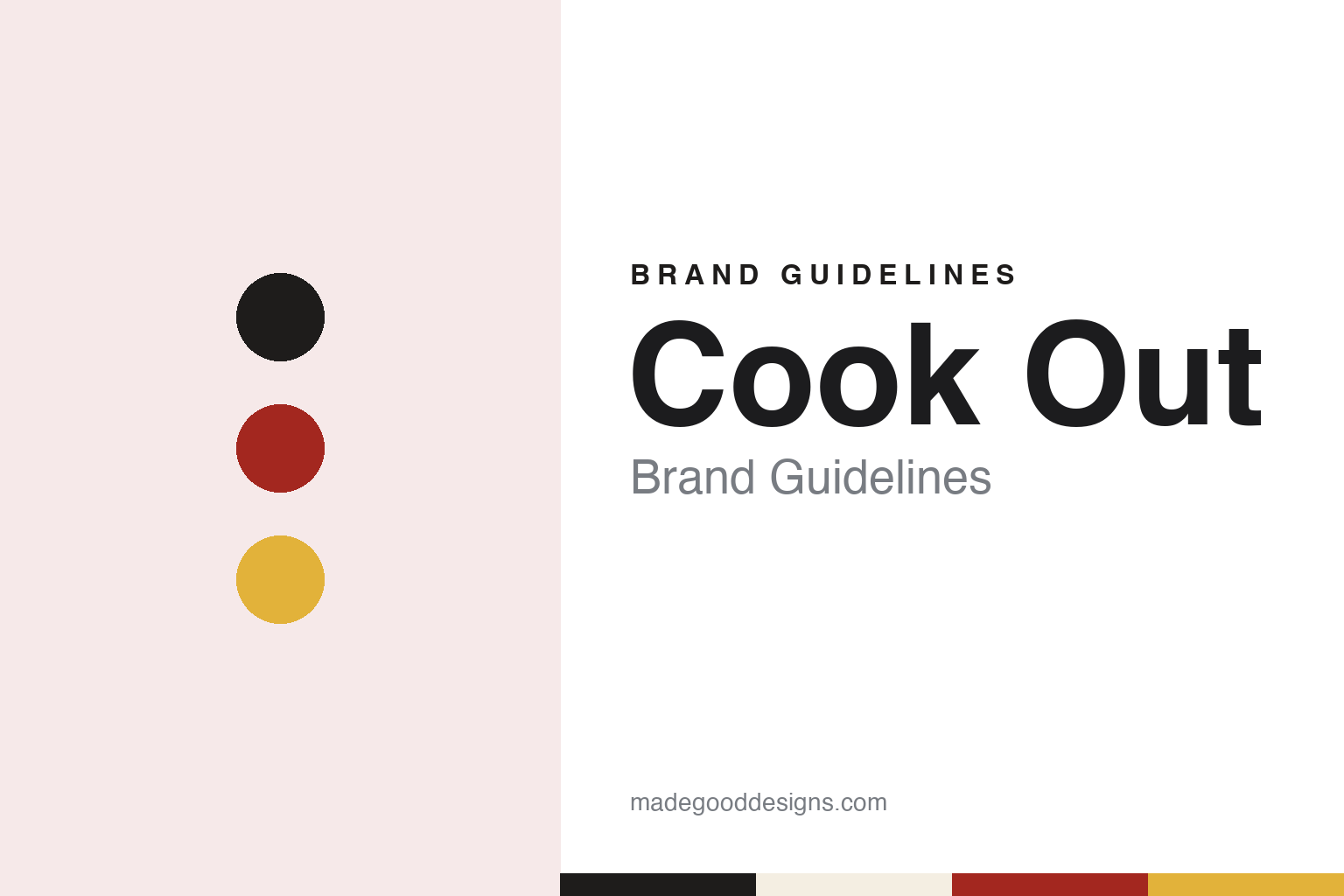
Cook Out Brand Guidelines
The Greensboro drive-thru with two lanes, a walk-up window and a tray.
Aa
Two constants: a charcoal, grill red and mustard palette and a heavy grotesque register. Abstract homage — not a Cook Out product or mark; no sign, logo or menu board is reproduced.
Randleman Road
A Greensboro drive-thru, opened in 1989.
Cook Out is a privately owned drive-thru chain from North Carolina. It was founded in 1989 in Greensboro by Morris Reaves, who remains its owner, the Greater Fayetteville Business Journal reported in August 2021; the paper added that the company does not offer franchises. Its first restaurant opened on Randleman Road in Greensboro, and the Greensboro magazine O.Henry marked 35 years since that opening in its July 2024 issue.
Reaves came to the business with fast-food experience. O.Henry wrote that he started as a short-order cook at Waffle House and became a Wendy’s franchisee at the age of 20 in the 1970s, after appealing directly to the Wendy’s founder Dave Thomas. The magazine says he worked out the Cook Out idea in his home state of Florida but chose Greensboro for the rollout in 1989.
English Wikipedia says the company is based in Thomasville, North Carolina, and that Jeremy Reaves, the founder’s son, is chief executive; O.Henry also names him as CEO. The Fayetteville paper described Cook Out as Thomasville-based and gave its size as nearly 300 locations in 100 cities, mainly in the Southeast, as of August 2021. By July 2024, O.Henry counted 117 locations in North Carolina alone and an expansion into ten Southern states.
For two decades the chain stayed at home. English Wikipedia says more than 50 locations opened in North Carolina before Cook Out left the state, and dates its first out-of-state store to Spartanburg, South Carolina, on 30 July 2010. Vice also gave 2010 as the year it crossed state lines, in a November 2018 feature by Eric Ginsburg, who wrote that the chain then had more than 200 restaurants, most of them still in North Carolina.
Colour
Two lanes, a window and a long board.
The standard Cook Out building is small and plain. In his 2018 Vice feature, Ginsburg described “a small, black box of a restaurant” with two drive-thru lanes and a walk-up window, no indoor seating, and tinted mirrors wrapped around the middle of the outside wall. English Wikipedia describes the same standard format and notes that some newer locations add an indoor dining room and counter service; O.Henry pointed to a Cook Out dining room in Kernersville in 2024.
The menu is long and is printed on an equally crowded board. Reports name grilled burgers and cheeseburgers, hot dogs, chicken sandwiches, quesadillas, hush puppies and North Carolina–style pork barbecue; Vice cited burger styles such as the Big Double and the Out West Style, made with barbecue sauce and bacon. The format customers order around is the Cook Out Tray: one main item with two sides and a drink, or, for a small extra charge, a milkshake in place of the drink, as English Wikipedia and Vice describe it. Vice added that the usual drink order in North Carolina was a large sweet tea or a Cheerwine float. Bham Now summed it up in January 2021 as the one-main, two-sides option.
Milkshakes are the other constant. Vice counted more than 40 flavours on the board in 2018, and O.Henry listed “something like 40” in 2024, among them cappuccino, hot fudge, blueberry cheesecake and a watermelon shake sold only in July and August. Both also mention Cheerwine, the North Carolina cherry soda: O.Henry says Cook Out pours it on tap even in states where the drink is not distributed, and Potomac Local noted the Cheerwine fountain when the Manassas Park, Virginia, restaurant opened on 4 November 2022, on the site of a former Hardee’s.
The company keeps a low public profile. O.Henry wrote in 2024 that neither the founder nor his son had given an interview and that the chain employed no spokesperson.
Typography
Design and documentation.
Burger, custard and chicken chains usually present themselves through a small set of fixed things: the name over the door, the shape of the building, the colours on the sign and the packaging, and a short list of named menu items that travel from one restaurant to the next. In the United States many of these chains began as a single family stand. Freddy’s opened in Wichita, Kansas, in 2002 under its founders’ father’s name, and Runza began in Lincoln, Nebraska, in 1949 with a sandwich that gave the company its name.
The menus are often the clearest part of the identity. A chain may be organised around one dish, as Runza is around its beef-and-cabbage bread pocket, or around a pairing, as Freddy’s was when its full name joined frozen custard and steakburgers with an ampersand. Smash burgers, biscuits, fried chicken and flame-grilled chicken play the same role for other chains in this group, in the United States, Singapore and South Africa, and each company publishes its own list of signature items.
Ownership varies widely. Some chains in this guide remain family businesses and say so on their corporate pages; others have passed to private-equity firms or to listed restaurant groups that run several brands at once. Where a chain has changed hands, the dates and buyers here come from trade press and company announcements, and any deal not completed is described as pending.
The restaurant networks are reported in the companies’ own terms: franchised or company-run, regional or international, counted on a stated date. Some chains say they keep close to home by choice, while others publish franchise maps that reach other countries. This guide gives those counts with their dates and sources, and treats colours and typefaces as an unofficial interpretation unless a source documents them.
Aa
A heavy grotesque for a plain, loud menu board. (Specimen set in Archivo Black, a sans STAND-IN; NOT the Cook Out logo.)
Cook Out
From the Carolinas to Florida.
Growth came through new markets across the South. WSFA reported the opening of a Montgomery, Alabama, restaurant in January 2019, and Bham Now reported a second Birmingham location in January 2021, after the first opened on Lakeshore Parkway in 2019. In August 2021 the Greater Fayetteville Business Journal reported that a Cook Out subsidiary had bought a former KFC site on Raeford Road in Fayetteville and, citing the Triangle Business Journal, that the chain had bought two former Applebee’s sites in the Triad.
Florida followed. English Wikipedia dates the chain’s first Florida restaurant to Pensacola on 9 July 2025. The Tampa Bay Beacons reported that a restaurant in Temple Terrace, on the former site of a Boston Market, soft-opened on 16 July 2026 as the first in the Tampa Bay area and the third in Florida, with a district manager recalling the earlier Tallahassee opening.
The name also travels through motorsport. English Wikipedia says Cook Out has sponsored the Southern 500 at Darlington Raceway since 2020, the NASCAR Cup Series race at Richmond Raceway since 2023 and the spring race at Martinsville Speedway since 2024, and that in January 2025 it took the title of the Clash at Bowman Gray Stadium in Winston-Salem.
For a design guide, Cook Out shows how a chain can build a recognisable identity from a building type, a crowded menu board and a tray format. Compare Wendy’s, where the founder began as a franchisee, and Bojangles, another Carolinas chain. For this guide we use charcoal, a grill red and a mustard yellow with a heavy sans, an unofficial interpretation; no product or logo is reproduced.
Explore & save
Keep Cook Out’s identity on hand — save it to a board in the Made Good inspiration library.
Cook Out identity set
Pin the Cook Out charcoal, grill red and mustard palette and the heavy grotesque register to your own board.
Source & notes
Frequently Asked Questions
What font can I use to match the Cook Out look?
This guide describes Cook Out’s type as “A heavy grotesque for a plain, loud menu board”. Its type specimen is set in Archivo Black from Google Fonts as a stand-in; Archivo Black is not Cook Out’s own lettering.
What colours are in the Cook Out palette?
This guide’s Cook Out palette is Charcoal box #1E1C1B, Grill red #A3271F, Mustard #E2B23A, Napkin cream #F4EEE2 and Ink #121110. The tones are the guide’s own unofficial interpretation, not official Cook Out hex codes.
When was Cook Out founded?
Cook Out was founded in 1989, in Greensboro, North Carolina.
Who founded Cook Out?
Cook Out was founded by Morris Reaves in 1989. Cook Out is known for Cook Out Tray, milkshakes, two drive-thru lanes.
Who owns Cook Out?
Cook Out today: Privately owned, based in Thomasville, North Carolina.


