4Fingers Brand Guidelines
Singapore’s 2009 crispy chicken chain from ION Orchard.
Aa
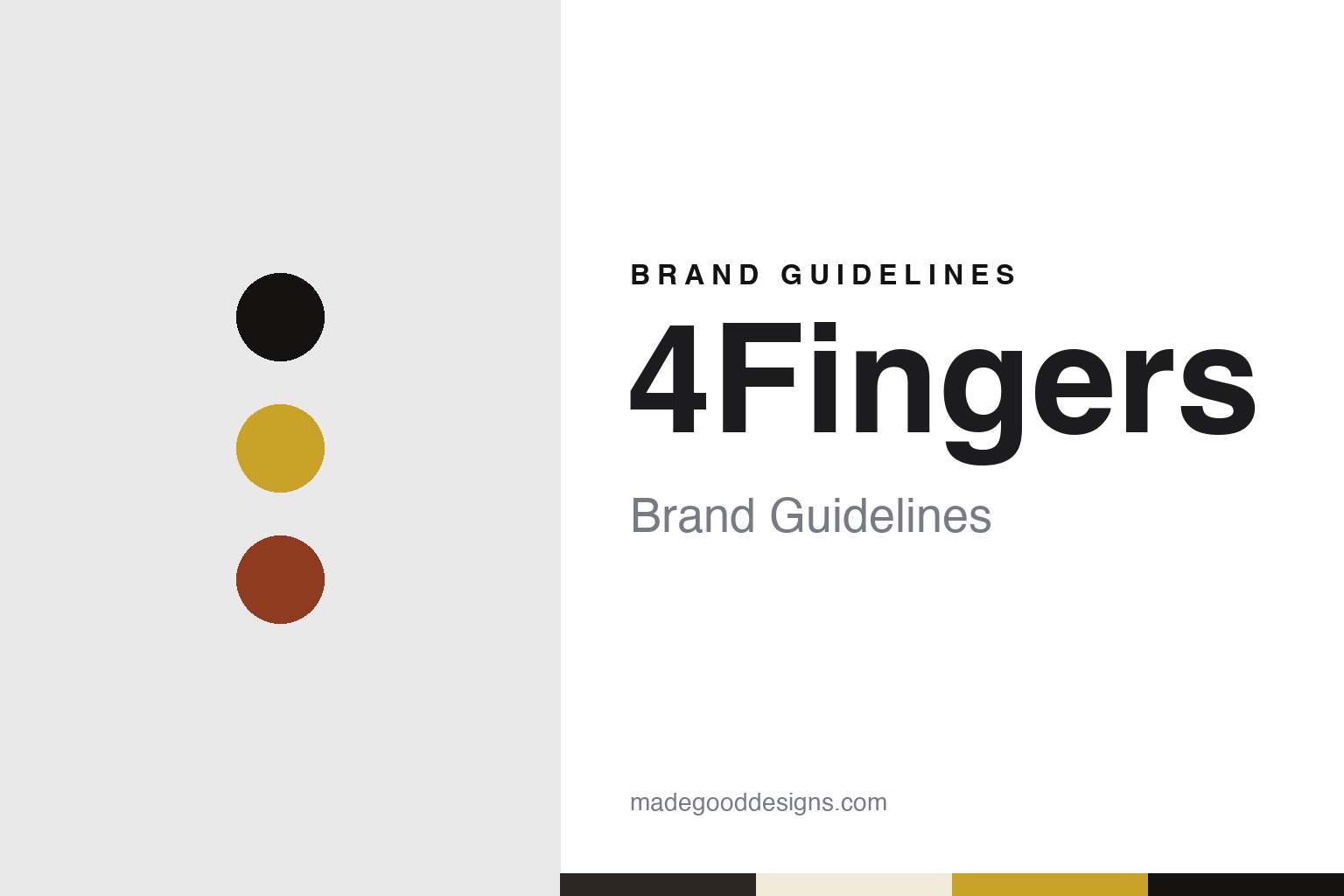
Two constants: a 4Fingers charcoal, mustard and soy amber palette and a Heavy grotesque register. Abstract homage — not a 4Fingers product or mark; no logo, menu board or packaging is reproduced.
ION Orchard, 2009
A single counter in a Singapore mall.
4Fingers, also written in capitals as 4FINGERS and known as 4Fingers Crispy Chicken, is a Singapore restaurant chain that sells Asian-style crispy fried chicken. English Wikipedia says it was founded in 2009 and is headquartered in Singapore. Its first restaurant was in ION Orchard, the mall on Orchard Road, where Vulcan Post reported in June 2017 that the brand had traded since 2009.
The founders are not named in the press accounts of the company. Inside Retail Asia wrote in June 2017 that 4Fingers was launched by four foodie friends who wanted to open their own store serving crispy Korean-style fried chicken. Vulcan Post said the inspiration came not from Seoul but from New York City’s Koreatown, where the founders adapted the recipe before bringing it to Singapore. The same article noted that, although the chain looks like one of the many Korean fried chicken shops in Singapore, it did not come from South Korea.
For its first years 4Fingers was a one-outlet business, and Vulcan Post described those years at ION Orchard as a time of long queues and a packed restaurant. Growth came later. Vulcan Post reported that the expansion began after Steen Puggaard, a Danish restaurant executive who had worked at McDonald’s and Burger King and had earlier been a director of the company, took over as chief executive in 2014.
English Wikipedia dates the first overseas store to 2015, in Kuala Lumpur. In July 2017 the New Straits Times reported that the chain had just opened its fourth Malaysian store, at Berjaya Times Square, and had grown from one outlet to 21 across Malaysia, Australia, Singapore and Indonesia in four years.
Colour
Wings, kimslaw and a soy-based sauce.
The menu is built around fried chicken pieces brushed with sauce. English Wikipedia lists free-range fried chicken, baked burger buns and kimslaw, a kimchi coleslaw, alongside Asian rice boxes, salads and crispy seafood dishes, and says the core products rest on signature sauces made from a base of fermented soy sauce. Inside Retail Asia wrote in 2017 that the kimslaw was fermented on site and that the burger buns were freshly baked.
The soy sauce has its own story. Vulcan Post reported in 2017 that it came from a family-owned business in Penang, a long-time partner of the chain, and that the chief executive had turned down approaches from large manufacturers who offered to make the sauce, saying they could not reproduce it.
The chain has always presented itself as a step up from fast food. “We are about casual dining, not fast food,” Steen Puggaard told Inside Retail Asia in 2017, adding that the company’s store designs, uniforms and even the music it played were meant to build the brand. Vulcan Post described the setting as casual dining in a vibrant, underground style, and noted the care put into the brand’s digital channels, from a staff-curated Spotify playlist to online games with travel prizes.
Australia showed how the format could change. Inside Retail Asia reported in June 2017 that the first Australian store was opening on Bourke Street in Melbourne’s CBD, followed by Westfield Chermside and Albert Street in Brisbane, and that the Australian outlets would stock artisanal beers, ciders and local wines. Vulcan Post added that the Australian menu was tweaked, portions were larger, and menu boards were replaced with pegboards, since the outlets there did not need halal certification.
Typography
Design and documentation.
Burger, custard and chicken chains usually present themselves through a small set of fixed things: the name over the door, the shape of the building, the colours on the sign and the packaging, and a short list of named menu items that travel from one restaurant to the next. In the United States many of these chains began as a single family stand. Freddy’s opened in Wichita, Kansas, in 2002 under its founders’ father’s name, and Runza began in Lincoln, Nebraska, in 1949 with a sandwich that gave the company its name.
The menus are often the clearest part of the identity. A chain may be organised around one dish, as Runza is around its beef-and-cabbage bread pocket, or around a pairing, as Freddy’s was when its full name joined frozen custard and steakburgers with an ampersand. Smash burgers, biscuits, fried chicken and flame-grilled chicken play the same role for other chains in this group, in the United States, Singapore and South Africa, and each company publishes its own list of signature items.
Ownership varies widely. Some chains in this guide remain family businesses and say so on their corporate pages; others have passed to private-equity firms or to listed restaurant groups that run several brands at once. Where a chain has changed hands, the dates and buyers here come from trade press and company announcements, and any deal not completed is described as pending.
The restaurant networks are reported in the companies’ own terms: franchised or company-run, regional or international, counted on a stated date. Some chains say they keep close to home by choice, while others publish franchise maps that reach other countries. This guide gives those counts with their dates and sources, and treats colours and typefaces as an unofficial interpretation unless a source documents them.
Aa
A heavy grotesque for a casual-dining chicken chain. (Specimen set in Archivo Black, a sans STAND-IN; NOT the 4Fingers logo.)
4Fingers Group
From one brand to a small group.
By 2018 the company was buying other restaurant brands. In September 2018 Inside Retail reported that 4Fingers had acquired a 50 per cent stake in Mad Mex Fresh Mexican Grill, the Australian Mexican chain, with Mad Mex’s founder Clovis Young staying on as chief executive and keeping the other half of the business. English Wikipedia dates the same deal to September 2019; the contemporary report is dated 2018. Vijay Sethu, described in that report as a director of 4Fingers, called Mad Mex “the second key brand in the 4Fingers Group.”
Three months later the group bought a Singapore business to give Mad Mex a local footprint. In December 2018 Inside Retail reported that 4Fingers had acquired 100 per cent of Mex Out, a Mexican concept with four outlets in Singapore.
The chain’s footprint has shifted over time. In June 2017 Inside Retail Asia counted 18 outlets across Singapore, Malaysia and Indonesia, before the Australian openings. As read in November 2026, English Wikipedia gives a total of 27 stores across Singapore, Malaysia, Indonesia, Thailand and Australia, with two outlets in Medan, Indonesia, and one at Central Ladprao in Bangkok.
The brand also runs separate country websites: the main 4fingers.com address forwards visitors to a Singapore or a Malaysia site depending on where they are. In Malaysia, where it opened in 2015, the chain is run as 4Fingers Crispy Chicken Malaysia.
For a design guide, 4Fingers shows how a single-mall chicken counter turned its interiors, uniforms, music and sauce story into a brand that travelled across Southeast Asia and to Australia. Compare KFC, the global fried chicken chain, and Bojangles, a regional chicken brand from the American South. For this guide we use charcoal brown, mustard gold and a soy amber with a heavy sans, an unofficial interpretation; no product or logo is reproduced.
Explore & save
Keep 4Fingers’s identity on hand — save it to a board in the Made Good inspiration library.
4Fingers identity set
Pin the 4Fingers charcoal, mustard and soy amber palette and the Heavy grotesque register to your own board.
Source & notes
Frequently Asked Questions
What font can I use to match the 4Fingers look?
This guide describes 4Fingers’ type as “A heavy grotesque for a casual-dining chicken chain”. Its type specimen is set in Archivo Black from Google Fonts as a stand-in; Archivo Black is not 4Fingers’ own lettering.
What colours are in the 4Fingers palette?
This guide’s 4Fingers palette is Charcoal brown #2B2622, Ink #141210, Rice paper #F1E9DA, Mustard gold #C9A227 and Soy amber #8E3B1F. The tones are the guide’s own unofficial interpretation, not official 4Fingers hex codes.
When was 4Fingers founded?
4Fingers was founded in 2009 (ION Orchard), in Singapore. 4Fingers is known for Crispy wings and drumettes, kimslaw, soy-based sauces.
Who founded 4Fingers?
4Fingers was founded in 2009 (ION Orchard) by Four friends, per Inside Retail (2017).