Lopia Brand Guidelines
A 1971 Fujisawa butcher’s shop that became a supermarket chain.
Aa
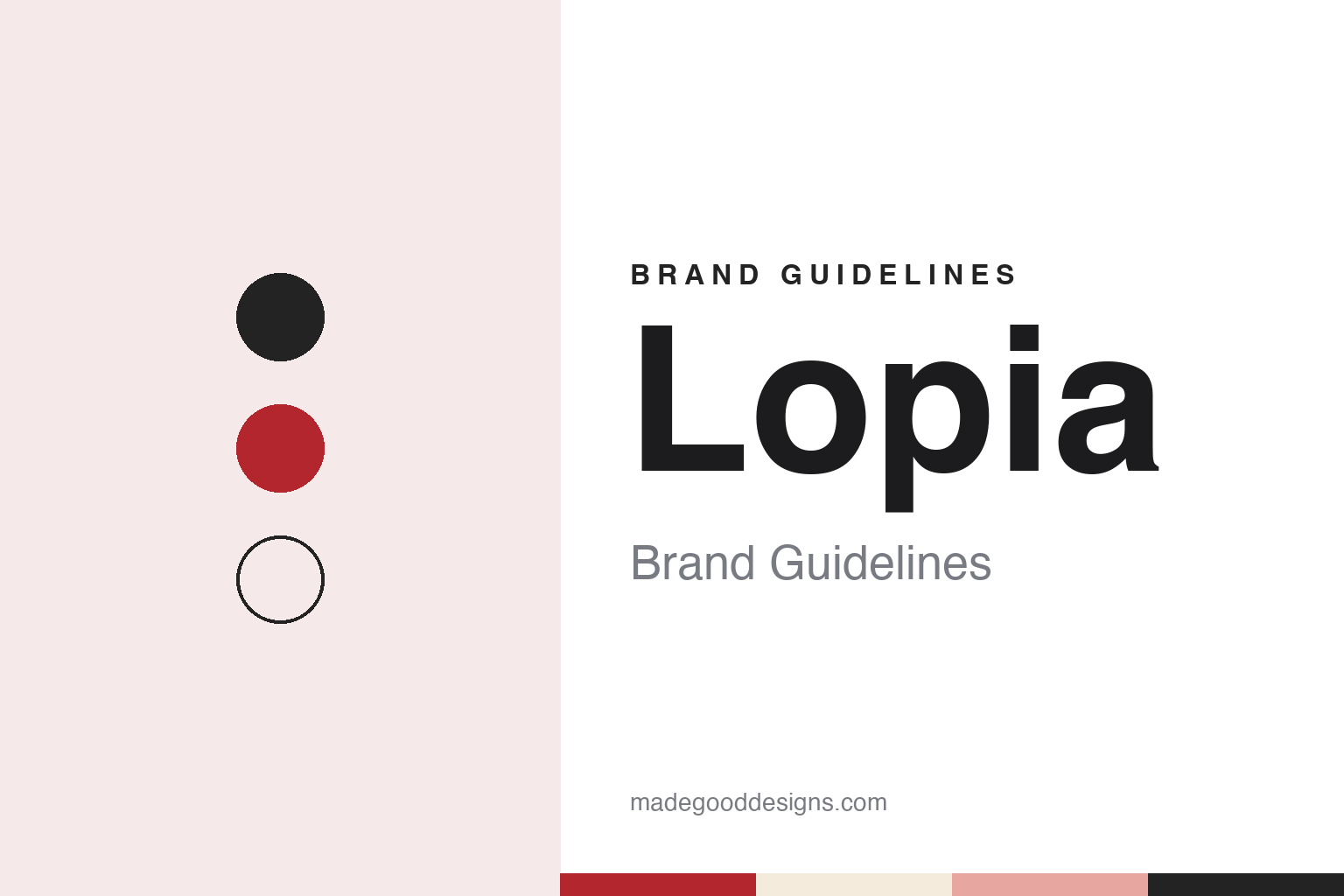
Two constants: a butcher red, cream and charcoal palette and a rounded sans register. Abstract homage — not a Lopia product or mark; no sign, logo or mascot is reproduced.
Niku no Takaraya
A meat shop in Fujisawa.
Lopia began as a butcher’s shop. According to Japanese Wikipedia, Hideo Takagi opened a meat shop called Niku no Takaraya in Fujisawa, Kanagawa Prefecture, in 1971; the company gives its founding date as 28 April 1971. The Thai newspaper Thairath, profiling the chain in February 2026, also traced it to a small butcher’s shop opened by Takagi in Fujisawa in 1971, aimed at families buying meat to cook at home.
The shop became a limited company in 1972 and began opening further branches in 1976, Japanese Wikipedia says. A delicatessen section followed in 1978, and in 1980 the business started making its own ham and sausages, which the company still lists among its activities alongside running supermarkets and specialist meat shops and importing food. It moved into supermarkets in 1994 with a store at Kohoku New Town in Yokohama, and in 1996 it became a joint-stock company under the name Yūtakaraya.
The present name arrived in 2011, when the company renamed itself Lopia; the first store under the new name was in Ayase, Kanagawa, according to Japanese Wikipedia. Both Japanese Wikipedia and Thairath explain the name as a contraction of “Low Price Utopia.” The older name has not disappeared: the company’s own store list still includes a supermarket and a specialist meat shop trading as Shinsen Ōuri Yūtakaraya.
Leadership has passed through three hands. In 2013 Yūsuke Takagi became the second representative director, and in 2019 the head office moved to Kawasaki, Japanese Wikipedia says. On 1 March 2026 Tsuneo Okubo, who had earlier served as president of Seiyu and other retailers, became the third representative director, and the company’s profile now names him as its representative.
Colour
From Kanagawa to the OIC Group.
Lopia spread out of Kanagawa during the 2010s. It reached Chiba in November 2012 with a store in the rebuilt west wing of Lalaport Tokyo-Bay in Funabashi; its first store in Tokyo opened in Hachioji in April 2017; and its first in the Kinki region opened inside a Shimachu Homes store in Neyagawa, Osaka Prefecture, in September 2020, according to Japanese Wikipedia. Many of its stores sit inside shopping centres or inside other large retailers, among them home centres and electronics stores. Gifu followed in 2022, then Fukuoka and Sendai in 2023.
In February 2024 Lopia announced that it would take over seven sites that Ito-Yokado was closing, including stores in Sapporo and Aomori, and in July 2024 it said the shopping centres at those sites would be called CiiNA CiiNA, Japanese Wikipedia says. Its first Hokkaido store opened in the CiiNA CiiNA centre at Tonden, Sapporo, in November 2024. In December 2024 Lopia agreed a business tie-up with Arclands, operator of the Musashi and Viva Home home centres; a franchise store run by Arclands opened in Niigata in May 2025.
The company belongs to the OIC Group. Lopia’s own company profile names OIC Group as the holding company, with other retailers such as Super Value and Akidai beside Lopia, and with group firms in fruit and vegetables, seafood, livestock, food manufacturing, trading and restaurants. Thairath described the group in February 2026 as covering the chain from farms and factories through import and export to retail stores. Lopia lists process centres in Shonan and Kansai, a fish process centre and a bread factory among its sites.
Store counts depend on the date and the source. Thairath gave 139 branches across Japan in February 2026. The company’s own profile listed 173 stores as of November 2026, in a list that also takes in its stores in Taiwan and Thailand.
Typography
Asian supermarket and convenience chains.
Supermarket and convenience chains across East and South-East Asia present themselves through a few fixed things: the name on the sign, the colours of the fascia and the carrier bag, the layout of the shop floor and the names of their own-label ranges. In Japan, Kobe Bussan’s Gyomu Super has built a recognisable store out of logistics, stacking fast-selling goods in the cardboard boxes they arrive in, a practice Japanese Wikipedia calls “hakochin”.
Names and signs do not always travel unchanged. FRIDAY DIGITAL reported in December 2024 that Gyomu Super stores are called “Gyomu Super” in Hong Kong but “GYOMU Japan” in Vietnam and Malaysia, where Japanese text cannot be shown on the sign. Chains in Korea, Indonesia, Thailand, Hong Kong, Malaysia and Singapore make similar choices about script, language and lettering, and this guide describes them as each company or a dated source shows them.
Ownership is often layered. Some chains are run directly by a listed retail group; others are franchised, licensed to local partners or held inside a larger conglomerate with interests far beyond food. Gyomu Super, for example, is almost entirely a franchise network: Japanese Wikipedia says that only three of its 1,007 stores were company-run at the end of October 2022. Where a chain has changed hands, this guide gives the buyer and the date from a dated source, and describes any deal not completed as pending.
Store counts, formats and own-label ranges are given in the companies’ own terms and with their dates, because networks change quickly. Founders, owners and retail groups are named as the companies’ corporate pages and the press record them. Colours and typefaces are treated as an unofficial interpretation unless a source documents them, and no sign, logo or package is reproduced.
Aa
A rounded sans — friendly, food-hall lettering. (Specimen set in M PLUS Rounded 1c, a sans STAND-IN; NOT the Lopia logo.)
Lopia
Taiwan, Thailand and a piglet.
Lopia’s first store outside Japan opened in January 2023 as the anchor store of Lalaport Taichung in Taiwan, Japanese Wikipedia says, and Thairath also dates the move into Taiwan to January 2023. Stores in Taoyuan, New Taipei, Taipei, Kaohsiung and Tainan followed. Taiwan’s TechNews counted 11 stores on the island at the start of May 2026, most of them inside department stores and large malls. In September 2026 a Kaohsiung store became the first to carry a section called LOPIA PREMIO, according to Japanese Wikipedia.
In February 2026 Lopia opened its first store in Thailand, at Central Chaengwattana in Nonthaburi, trading as LOPIA JAPAN, Thairath reported. The paper described typical Lopia stores as 2,000 to 3,000 square metres with more than 10,000 items, and said the chain sticks to food rather than household goods or clothing.
Inside the Japanese stores, departments carry names of their own: the vegetable section trades as Yaomonoya Azuma and the fish counter as Nihonbashi Uoman, part of a store-by-store approach that gives each department head wide discretion, Japanese Wikipedia says. The chain’s mascot is a piglet named Lopita-kun, whose face appears on its carrier bags and whose figure stands outside stores; the company’s app is called Lopita.
For a design guide, Lopia shows how a butcher’s shop can carry its trade into a whole supermarket identity, with named counters and a pig mascot. Compare Gyomu Super, another Japanese food retailer, and Don Quijote. For this guide we use a butcher red, a warm cream and a charcoal with a rounded sans, an unofficial interpretation; no product or logo is reproduced.
Explore & save
Keep Lopia’s identity on hand — save it to a board in the Made Good inspiration library.
Lopia identity set
Pin the Lopia butcher red, cream and charcoal palette and the rounded sans register to your own board.
Source & notes
Frequently Asked Questions
What font can I use to match the Lopia look?
This guide describes Lopia’s type as “A rounded sans — friendly, food-hall lettering”. Its type specimen is set in M PLUS Rounded 1c from Google Fonts as a stand-in; M PLUS Rounded 1c is not Lopia’s own lettering.
What colours are in the Lopia palette?
This guide’s Lopia palette is Butcher red #B3262E, Charcoal #232323, Warm cream #F4EBDD, Pork pink #E8A6A0 and Paper #FAF7F2. The tones are the guide’s own unofficial interpretation, not official Lopia hex codes.
When was Lopia founded?
Lopia was founded in 1971 (as a butcher’s shop), in Fujisawa, Kanagawa.
Who founded Lopia?
Lopia was founded by Hideo Takagi in 1971 (as a butcher’s shop).
Who owns Lopia?
Lopia today: Lopia Co., Ltd., Kawasaki; part of the OIC Group.