Floriade Australia Brand Guidelines
Canberra’s spring flower festival since 1988.
Aa
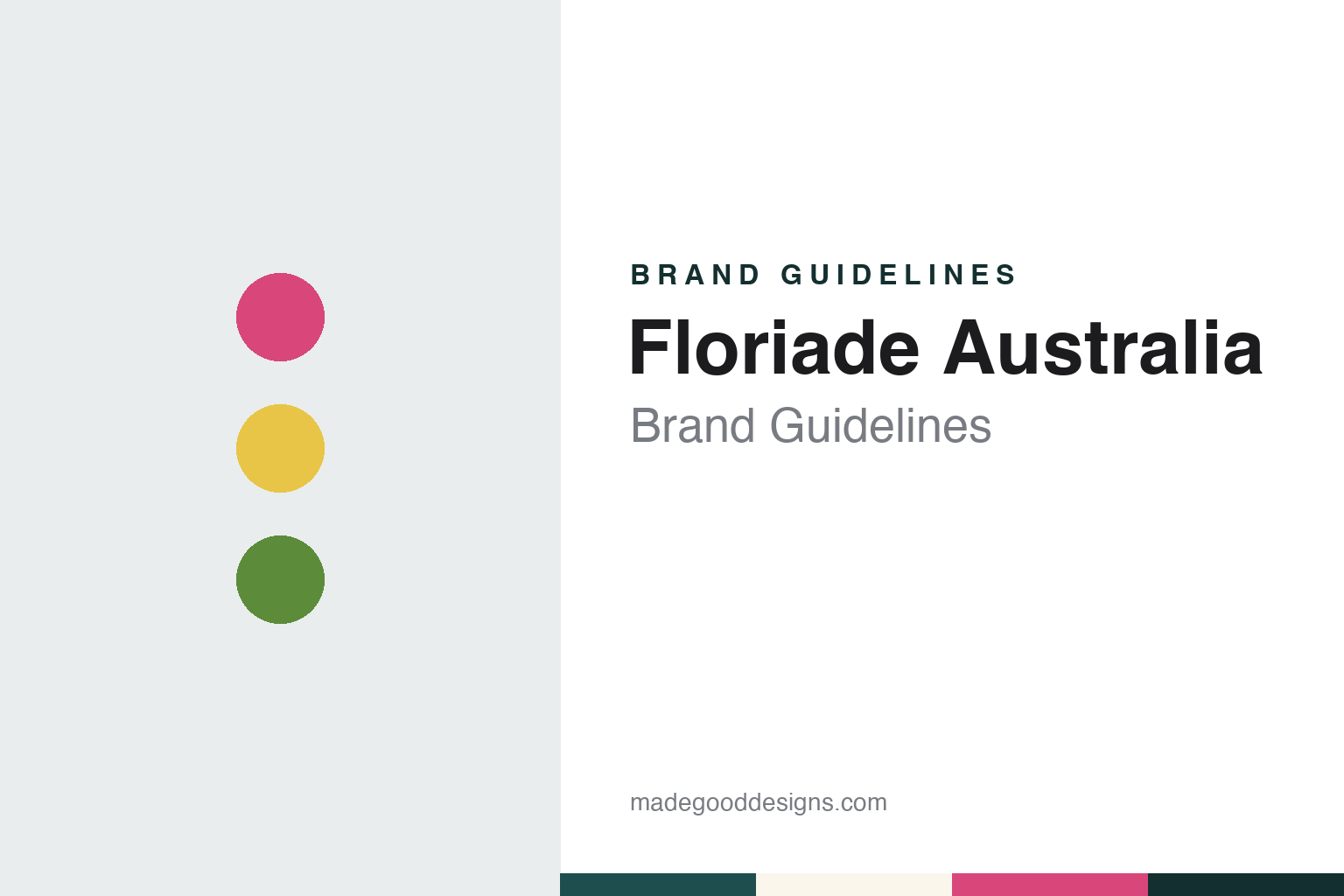
Two constants: a tulip pink, bulb yellow and lakeside teal palette and a garden-bed sans register. Abstract homage — not a Floriade garden design, logo or mark; nothing of the festival identity is reproduced.
A one-off for 1988
A birthday, a Bicentenary and a Dutch model.
Floriade is a spring flower festival held each year in Commonwealth Park, on the shore of Lake Burley Griffin in Canberra, running from mid-September to mid-October, English Wikipedia says. Its website, floriadeaustralia.com, presents it simply as Floriade: a free festival of more than a million blooms with music, food and wine, workshops and art displays.
It began as a one-off. Floriade was first held in 1988, as a celebration of Canberra’s 75th birthday and of the Bicentenary of European settlement in Australia, according to both Wikipedia and the festival’s own history page. The idea came from Christiaan Slotemaker de Bruine, a landscape architect with the Department of the Capital Territory, who began the design in 1986 and based it on the Keukenhof bulb gardens in the Netherlands, Wikipedia says.
He built it with Peter Sutton, a horticulturist and manager of the Commonwealth Gardens, and City Parks staff. Wikipedia says de Bruine also arranged the marketing, the sculptures, live music, the purchase of bulbs and the lifting of bulb quarantine quotas, and won sponsorship from the Embassy of the Netherlands and the Bicentennial Authority. The festival’s own page credits the pair together, and notes that importing such a range of bulbs into Australia was hard at the time. The first event’s design theme was “Multiculturalism of the Nation,” with Dutch and Aboriginal floral layouts.
The partnership continued for 1989 and 1990, and the event kept going with a new theme each year. A night programme, “Floriade by Night,” ran from 1989 to the late 1990s with lighting, food stalls and entertainment, Wikipedia says; night opening returned in 2008 as NightFest, a separate ticketed event. In 2020 and 2021 the central event in Commonwealth Park was not held. In 2020 the bulbs and annuals planned for the park were spread across about 130 sites around the city instead, as a trail of tulips through Canberra’s suburbs under the name “Floriade: Reimagined,” and the plants were again shared around the city in 2021.
Colour
Twelve garden designs, planted by hand.
The festival’s look is made in the ground. Ahead of the 2025 festival, the 38th, Region Canberra reported that more than a million tulip bulbs and annuals had been sorted and counted at the Yarralumla Nursery since April before being moved to Commonwealth Park for planting in designed beds. The head gardener, Tim Howard, told the paper his team had created 12 garden designs, built about 8,000 square metres of garden and planted about 970,000 flowers, and that each festival takes about 18 months of planning and preparation.
The beds are designed around a theme that changes every year. The 2025 theme was “Science and Nature,” with displays inspired by physics, chemistry, astronomy, biology and botany, Region Canberra reported. For 2026, Xinhua reported in a story carried by The Star on 12 September 2026, the 39th Floriade opened in Commonwealth Park under the theme “Feast of Flowers,” about the links between flowers, food, harvests and shared traditions, running until 11 October with more than a million blooms.
The festival also travels beyond the park. Region Canberra reported that for 2025 more than 300,000 bulbs and annuals went to over 100 schools, retirement villages, community centres and local groups as “Floriade Community,” and that Lanyon Homestead in Tuggeranong was a satellite site with guided tours and its own garden installation. The programme around the beds that year included NightFest from 2 to 5 October, a Dog’s Day Out on 12 October and the Great Big Bulb Dig on 13 October.
Attendance is reported each year. Region Canberra reported 470,000 visitors for 2024. Xinhua reported that official data counted 519,413 attendees in 2025, above the previous high of 507,550 set in 2019. Entry to the park is free, with gates open from 9.30 a.m. to 5.30 p.m. daily during the festival, according to both reports.
Typography
Shows, parades and festivals.
Flower shows, flower parades and garden festivals present themselves through a small set of recurring elements: a show name, often with the organiser’s initials or a place in front of it; a venue that stays the same for years; a fixed month or week; and a dated history of editions. The RHS Chelsea Flower Show, for example, is still formally the Great Spring Show, and has been staged in the grounds of the Royal Hospital Chelsea since May 1913.
Most of what visitors see is temporary. Show gardens are built for a few days and taken down again; floral marquees and pavilions hold the nursery and grower displays; parades carry floats along a set route. Each edition’s posters, programmes, maps and signage therefore carry much of the identity work, alongside the show name itself, and many organisers give each year a theme, as the RHS did with “Wonder” at Hampton Court in 2025.
Organisers vary widely. Some events are run by horticultural societies, some by public bodies or host municipalities, some by foundations or associations set up for the purpose, and some began as partnerships before changing hands, as the Hampton Court show did when the Royal Horticultural Society took it over in 1993. Names change too: in 2019 that show became a Garden Festival rather than a Flower Show.
This guide sets out what can be checked about each event — who organises it, where and when it is held, when it began and how its name has changed — and marks clearly what rests only on the organiser’s own word. The focus is on names, venues, editions and the way each event is presented.
Aa
A friendly geometric sans for a public spring festival. (Specimen set in DM Sans, a sans STAND-IN; NOT the Floriade logo or any festival lettering.)
Floriade Australia
A government event with a Latin name.
Floriade is a public event. Region Canberra described its preparation as the work of the ACT Government’s events team, and the festival website carries the Events ACT name. The festival’s own page also credits the apprentice programme championed by Peter Sutton with training many of its gardeners.
The name has its own history. When the first festival was announced in 1987, Wikipedia says, “floriade” was said to mean “to decorate with floral designs”; a later explanation links it to the Latin verb floreo, to bloom or be covered with flowers, and the festival’s website gives that Latin root. The name is shared with the Dutch horticultural expo Floriade Expo, a different event.
Beyond flowers, the festival commissions public art each year for its gardens, and some pieces stay after the season ends, Wikipedia says. For several years it has also held a decorated-gnome display: the first competition, in 2000, used 5,000 mass-produced gnomes, and the winning gnome is kept at the Canberra Museum and Gallery. Since 2005 the display, known as the Floriade Gnome Gnoll, has been managed by the Rotary Club of Canberra East.
For a design guide, Floriade shows how a yearly theme, a fixed park and a planting plan drawn in beds can carry a festival identity, with a city-wide spin-off each spring. Compare Keukenhof, the Dutch bulb park that inspired it, and the Melbourne International Flower and Garden Show. For this guide we use a tulip pink, a bulb yellow and a lakeside teal with a sans, an unofficial interpretation; no product or logo is reproduced.
Explore & save
Keep Floriade Australia’s identity on hand — save it to a board in the Made Good inspiration library.
Floriade Australia identity set
Pin the tulip pink, bulb yellow and lakeside teal palette and the garden-bed sans register to your own board.
Source & notes
Frequently Asked Questions
What font can I use to match the Floriade Australia look?
This guide describes Floriade Australia’s type as “A friendly geometric sans for a public spring festival”. Its type specimen is set in DM Sans from Google Fonts as a stand-in; DM Sans is not Floriade Australia’s own lettering.
What colours are in the Floriade Australia palette?
This guide’s Floriade Australia palette is Lakeside teal #1F4E4F, Tulip pink #D9467A, Bulb yellow #E8C547, Spring leaf #5C8C3A and Paper #FAF6EC. The tones are the guide’s own unofficial interpretation, not official Floriade Australia hex codes.