Open a drawer in a seventeenth-century collector’s cabinet and you might have found something like a Jan van Kessel: a butterfly with eyespots, a green grasshopper, a dragonfly, a beetle with striped wing cases, each a few centimetres long and each cast with its own small shadow. Jan van Kessel is the name behind some of the clearest small-scale natural history painting of his century, and his sheets work for designers because they solve a problem still common today, how to show many different things on one surface without confusion. This guide looks at what to see in his work, what is documented about his career and how to borrow the method.
Two of his insect sheets in the Metropolitan Museum of Art are flagged public domain and appear below. For more reusable images, browse the MGD museum inspiration collection.
Who was Jan van Kessel the Elder?
The Met records him as Flemish, 1626–1679. Standard biographies give his baptism in Antwerp on 5 April 1626 and his death there on 17 April 1679. He was the son of the painter Hieronymus van Kessel the Younger and Paschasia Brueghel, which made him a grandson of Jan Brueghel the Elder and a great-grandson of Pieter Bruegel the Elder, and a nephew of Jan Brueghel the Younger.
Accounts of his training name the history painter Simon de Vos and members of his own family. He joined the Antwerp Guild of Saint Luke in 1644, where he was recorded as a flower painter, and he married Maria van Apshoven in 1646. His dated works are reported to run from 1648 to 1676. He died in Antwerp in 1679.
One practical note for anyone searching collections: several painters named Jan van Kessel worked in the Netherlands at the time, including his own son, Jan van Kessel the Younger, and a landscape painter in Amsterdam. Always check dates and the museum’s attribution before assuming a work is by the Antwerp artist.
Key works and formats
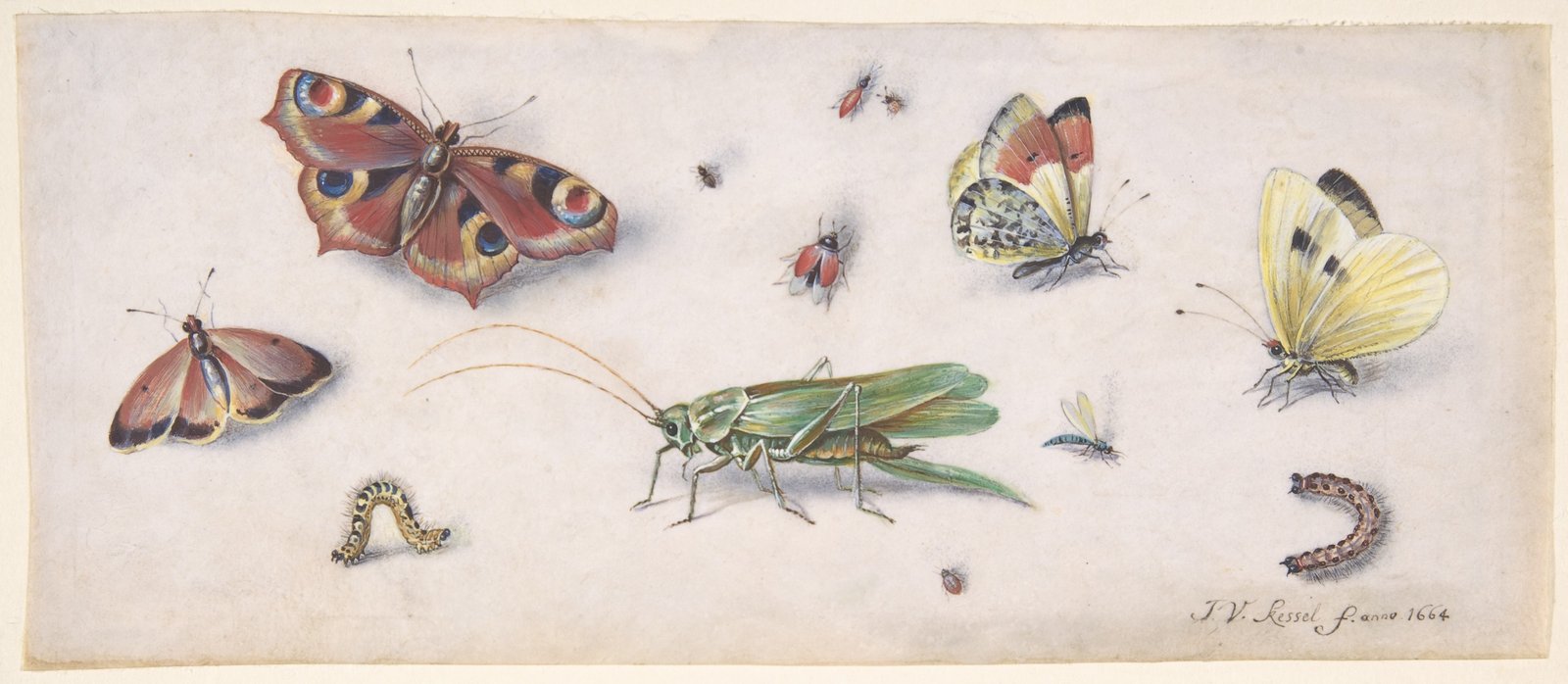
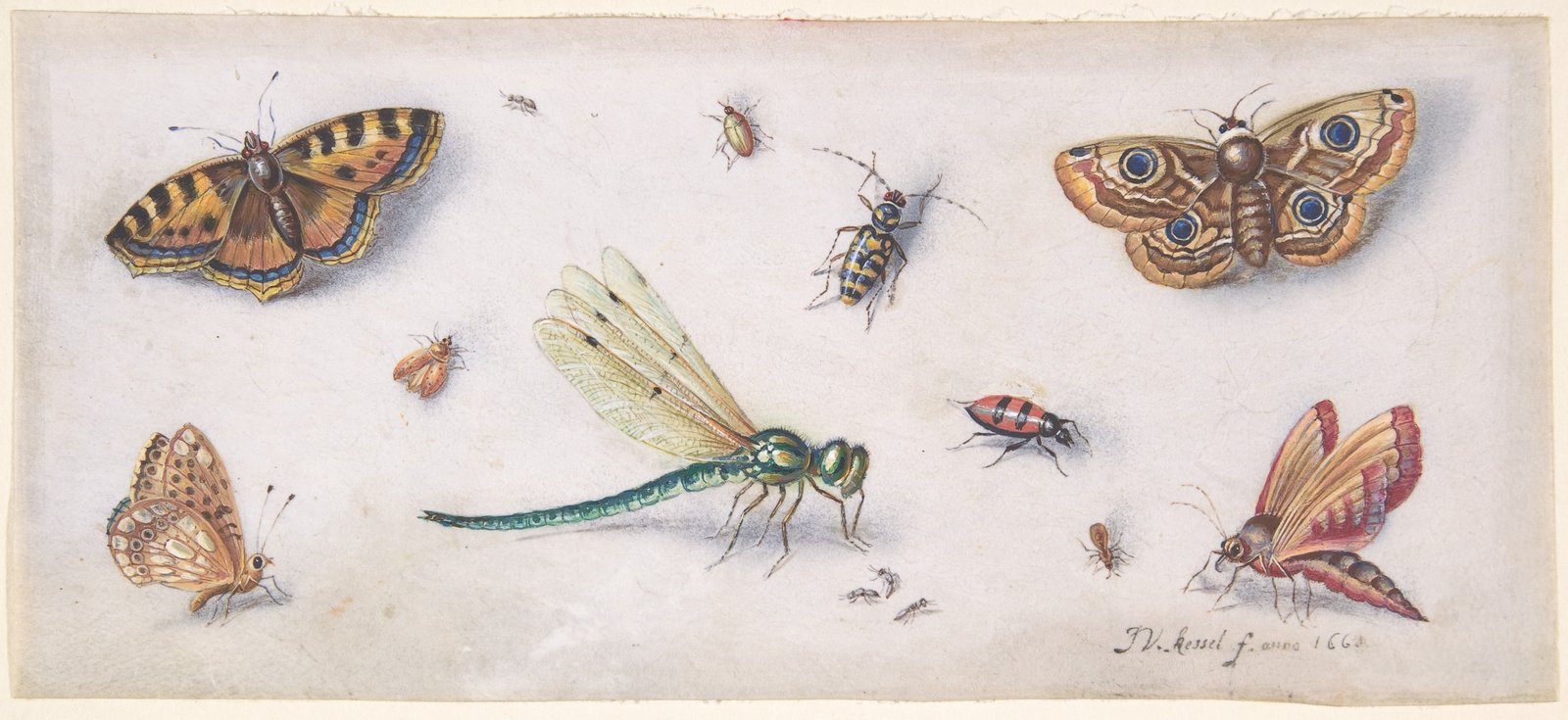
Insect studies on parchment (1660s). The Met holds two small sheets in black chalk, watercolour and gouache on parchment, each about 10.8 by 24.1 centimetres. Insects, Butterflies, and a Dragonfly is dated 1662 and Insects, Butterflies, and a Grasshopper is dated 1664. Both were purchased in 2004 through the Mrs. Howard J. Barnet Gift. Each carries a signature and year in the lower right corner.
Cabinet pictures on copper. Biographies describe numerous small oil paintings on copper by van Kessel, some of which decorated cabinets for collectors. The smooth metal surface suited fine detail. Panels of insects, flowers and animals were arranged into ordered sets.
The Four Continents (1660s). He painted two series representing Europe, Asia, Africa and America, each made of a large central picture surrounded by small copper panels mounted in an ebony cabinet. The surviving series are reported to be in the Alte Pinakothek in Munich and the Museo del Prado in Madrid, with some panels missing from the Madrid set.
Garland paintings. Following his grandfather’s example, van Kessel painted flower garlands around a central cartouche, often in collaboration with a figure painter. The Soap Bubbles, a collaboration with David Teniers the Younger, is in the Louvre, dated about 1660–1670.
What to look at in a Jan van Kessel sheet
- Scatter with order. On the 1664 sheet the large grasshopper sits low and central, the peacock butterfly top left, two butterflies at top right and tiny flies and beetles fill the gaps. The big forms anchor the corners and the small ones fill the space between them.
- Shadows as grounding. A soft grey shadow under each creature makes it look real without drawing a table or a landscape. The shadow does the work of a background.
- Accent colour. The reds and blues on the peacock butterfly’s wings, and the yellow of the large butterfly on the right, are the brightest spots on the sheet. On the 1662 sheet the dragonfly’s body is a cool blue-green against warmer butterflies.
- Ground. The parchment is a pale pinkish grey. Measured from the museum’s scan, the 1664 sheet’s ground sits near #ede1d8 and the 1662 sheet’s near #ebe5e4. These are scan measurements, not original pigments.
- Signature as design element. The cursive signature and year sit in the lower right as a small counterweight to the specimens above. Biographies note that he used two styles of signature, a more decorative one for larger formats.
Technique: miniature detail on parchment and copper
The Met gives black chalk, watercolour and gouache on parchment for the insect sheets. Parchment has a fine, slightly absorbent skin that holds thin washes and takes opaque gouache well, which suits tiny, crisp detail such as antennae, wing veins and the hairs on a caterpillar. Van Kessel’s larger pictures are usually on copper panels or occasionally on wood, and accounts of his practice say that he worked from living specimens and from printed natural history books. He drew on the older tradition of Joris Hoefnagel, whose studies of flowers and insects were engraved and published as the Archetypa in 1592.
His family background matters here. Jan Brueghel the Elder, his grandfather, showed that a painter could describe the world by observing and classifying its parts, and van Kessel stays close to that idea while giving more weight to composition than a naturalist’s plate usually does. For the wider context see our guides to Baroque art and still life painting.
Collecting, cabinets and the Wunderkammer
Van Kessel painted for an audience that collected the natural world: shells, minerals, dried insects, coins and curiosities kept in cabinets. Accounts of his work describe painted sets that were sometimes used on cabinet fronts and drawer fronts, so that the owner opened the doors on living colour before reaching the pinned specimens inside. The idea is a good one for any designer working with unboxing or reveal: the outer layer promises what the inside delivers.
The grid matters too. A cabinet front is divided into compartments, and each compartment holds a self-contained picture. That is close to a modern card layout, in which every cell has its own subject, margin and focal point, while the whole still reads as one object. When you plan a catalogue page or a dashboard, ask what van Kessel asked of his panels: does each cell work alone, and does the set work together?
His sets also show how to keep variety under control. Within a series the format, scale and ground stay fixed, while the subject and the dominant colour change from panel to panel. That is the same discipline used in a good icon family or a seasonal campaign: fix the frame, vary the content.
How designers can borrow Jan van Kessel’s ideas
- Scatter on a pale ground. Use one large element, a few medium ones and many tiny ones. Place the heaviest form low or central and let the small ones float between. This works for hero banners, pattern repeats and packaging.
- Add soft shadows, not backgrounds. A faint contact shadow lets individual icons or products float on a plain ground and still look grounded.
- Reserve saturated colour. Keep the sheet’s ground neutral and spend colour on a few focal spots, such as eyespots, wing tips or a single dragonfly body. Check swatches with the image colour picker.
- Build a cabinet. The Four Continents pattern, a large central picture surrounded by small ones, is a useful template for dashboards, onboarding screens and catalogue spreads where one hero item needs a supporting set.
- Sign the work. A small, well-placed signature or date can finish a composition. Treat it as a typographic accent in a corner, not an afterthought.
- Browse natural-history sources. Our botanical theme in the museum collection has more specimen-style images that suit the same layouts.
Frequently asked questions
Who was Jan van Kessel the Elder?
A Flemish painter from Antwerp, baptised in 1626 and died in 1679, according to standard biographies. He was a grandson of Jan Brueghel the Elder and worked in many genres, including insect studies, flower still lifes and cabinet pictures on copper.
What is Jan van Kessel known for?
For small, precise studies of insects, flowers and animals, for series of copper panels such as the Four Continents cabinet pictures now in Munich and Madrid, and for flower garlands painted around central scenes in collaboration with other artists.
Which Jan van Kessel is which?
Several painters shared the name. The Elder (1626–1679) worked in Antwerp. His son Jan van Kessel the Younger was also a painter, and another Jan van Kessel painted landscapes in Amsterdam. Check the dates in a museum record before attributing a work.
Are Jan van Kessel’s insect sheets public domain?
The Metropolitan Museum of Art flags its two insect sheets, dated 1662 and 1664, as public domain in its open-access data, so they can be reused. Check each museum’s rights statement before reusing any other image of his work.